


Mother vs Father of all deals: How India benefits from EU and US trade pacts
India and the United States have announced their long-pending trade deal. The announcement, made on social media by US President Donald Trump, comes a week after India finalised negotiations with the EU on a trade pact. But how does two compare?

It has finally happened.
India and the United States have announced their long-pending trade deal. The announcement was made by US President Donald Trump on social media, who said that the tariff on India would be cut to 18 per cent.
Washington had previously announced a 25 per cent tariff on India, plus another 25 per cent for buying Russian oil. The development comes after India and the European Union signed the ‘mother of all trade deals’ last week.
But how do the two FTAs compare? What’s in them? How do they benefit India, the US and the EU?
Let’s take a closer look.
What’s in the India-EU deal
The India-EU deal was concluded after two decades of negotiations.
India, under the agreement, will eliminate or reduce tariffs on 96.6 per cent of EU exports. India is bringing down tariffs on cars from the EU from 110 per cent to 10 per cent. New Delhi will also phase out tariffs on car parts over the next decade. Most of the tariffs on machinery, chemicals and pharmaceuticals will also be done away with.
 More from Explainers
India has also cut tariffs on alcoholic beverages like wines by half, from 150 per cent to 75 per cent. This will eventually be cut further to 20 per cent. The EU has said that New Delhi will reduce tariffs on spirits to 40 per cent.
Meanwhile, India will have zero tax imposed on 99.5 per cent of its exports by the bloc. Union Minister Piyush Goyal has said that almost 95 per cent of Indian “labour-intensive” exports will now get duty-free access to the bloc under the agreement.
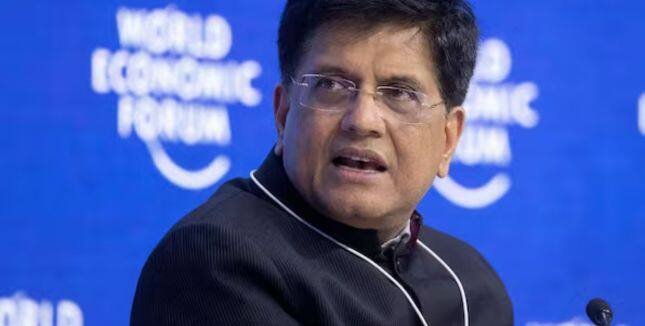
Goyal told NDTV that the deal is a “pathway to many people who are the new middle class”. “The 25 crore people were removed out of poverty and were entering the middle class levels. This is an opportunity for them to increase their incomes, become more aspirational, and with growing incomes, look for the better things of life.”
“Our view is that we are actually providing the pathway for greater prosperity for 140 crore Indians,” he added.
How it benefits India and the EU
Trade between India and the EU stood at $136.5 billion (Rs 12.29 lakh crore) in the fiscal year through March 2025. The Germany-based Kiel Institute for World Economy has said the pact would increase trade between India and the bloc by 41 to 65 per cent. Some have claimed it could increase India’s exports to the EU by $75 billion (Rs 6.75 lakh crore). Trade between India and the bloc could hit $272 billion (Rs 24.50 lakh crore) by 2032.
The deal is important for the EU as it gives the bloc greater access to the world’s fourth-biggest economy. India’s GDP will likely cross $4 trillion (Rs 360.2 lakh crore) this year and overtake Japan. India is also the world’s fastest-growing major economy.
“India exported about $76 billion (Rs 6.84 lakh crore) of goods to the EU while importing $61 billion (Rs 5.49 lakh crore), earning a trade surplus, but the withdrawal of EU GSP benefits in 2023 eroded competitiveness for many Indian products,” Ajay Srivastava of the Delhi-based Global Trade Research Initiative (GTRI) told the BBC.
“An FTA would restore lost market access, lower tariffs on key exports such as garments, pharmaceuticals, steel, petroleum products and machinery, and help Indian firms better absorb shocks from higher US tariffs,” Srivastava added.
India and the EU are also both looking to keep their options open in this new world.
“Ultimately, it could expedite trade decoupling from the US and other unreliable partners. It will mean reducing dependencies on Trump’s America — or China for that matter — reducing vulnerabilities to on-again, off-again tariffs, export controls and the general weaponisation of supply chains,” Alex Capri of the National University of Singapore added.
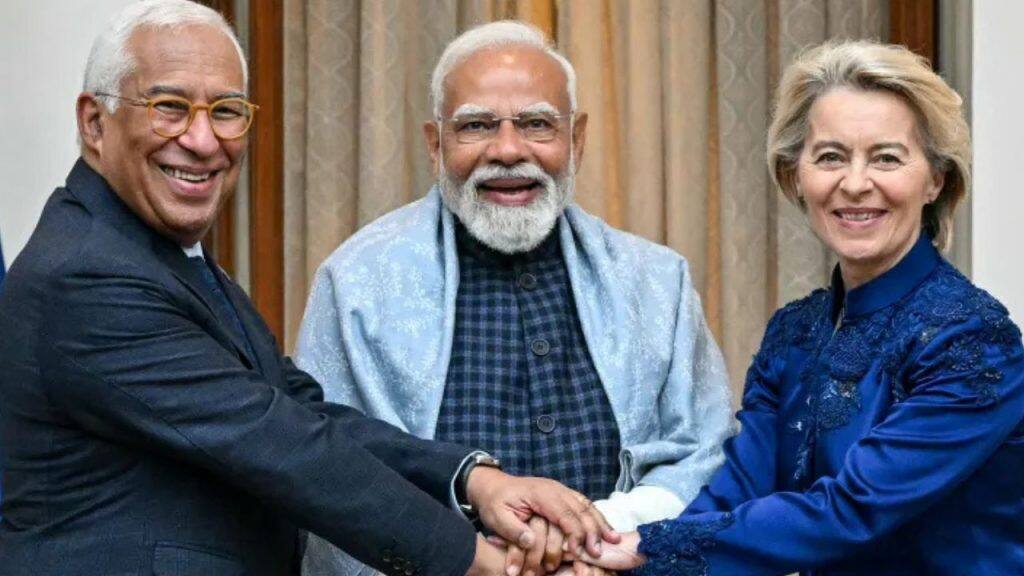
New Delhi previously finalised pacts with Britain, New Zealand and Oman, while the EU signed a pivotal pact with the South American bloc Mercosur, as well as Indonesia, Mexico and Switzerland last year.
The formal signing of the India-EU deal would take place after legal vetting, expected to last five to six months, an Indian government official aware of the matter has said.
“We expect the deal to be implemented within a year,” the official added.
Prime Minister Narendra Modi said the pact “represents about 25 per cent of global GDP, and one-third of global trade”. It came as European Council President Antonio Luís Santos da Costa and European Commission President Ursula von der Leyen were chief guests at India’s Republic Day celebrations.
“The EU and India make history today, deepening the partnership between the world’s biggest democracies. We have created a free trade zone of 2 billion people, with both sides set to gain economically. We have sent a signal to the world that rules-based cooperation still delivers great outcomes. And, best of all, this is only the start — we will build on this success, and grow our relationship to be even stronger,” von der Leyen said.
What’s in the India-US deal
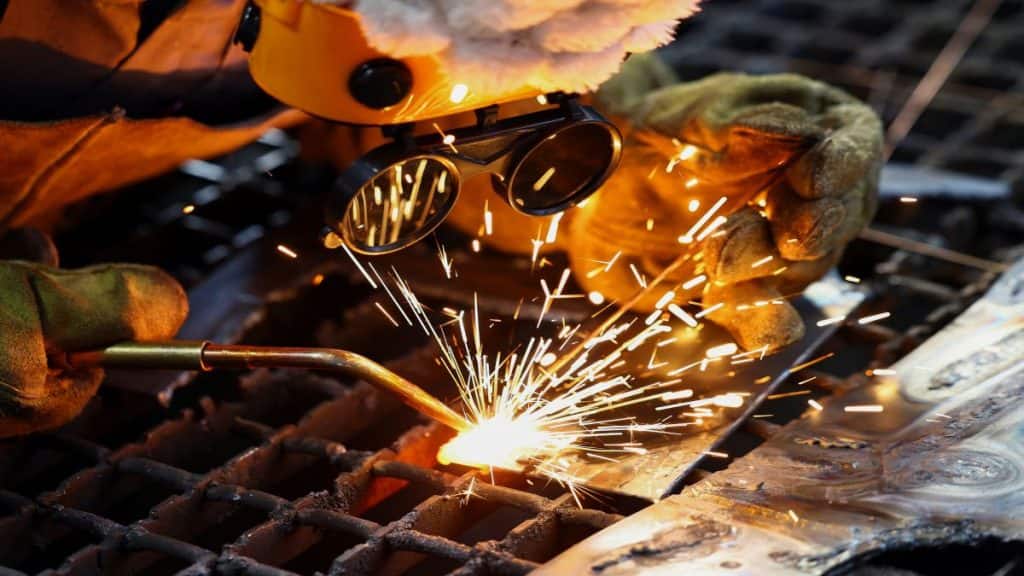
According to NDTV, Trump’s tariffs on India impacted numerous sectors, including steel, textiles and pharmaceuticals. It noted that steel exports to the US declined a whopping 40 per cent in the aftermath of the levy. It said the steel sector could potentially gain back around $2 billion (Rs 0.18 lakh crore).
Generic drug makers, who were dealing with tariffs of up to 26 per cent, could see exports increase as much as $10 billion (Rs 0.90 lakh crore). Seafood, on which 60 per cent tariffs were imposed, could also claw back gains. Seafood exports to the US are currently valued at over $850 million (Rs 0.08 lakh crore).
“Wonderful to speak with my dear friend President Trump today. Delighted that Made in India products will now have a reduced tariff of 18%. Big thanks to President Trump on behalf of the 1.4 billion people of India for this wonderful announcement,” Modi wrote on X.
How it benefits India and the US
Trade between India and the United States stands at $132 billion (Rs 11.88 lakh crore). Experts say it could touch as much as $300 billion (Rs 27.02 lakh crore) in the short term.
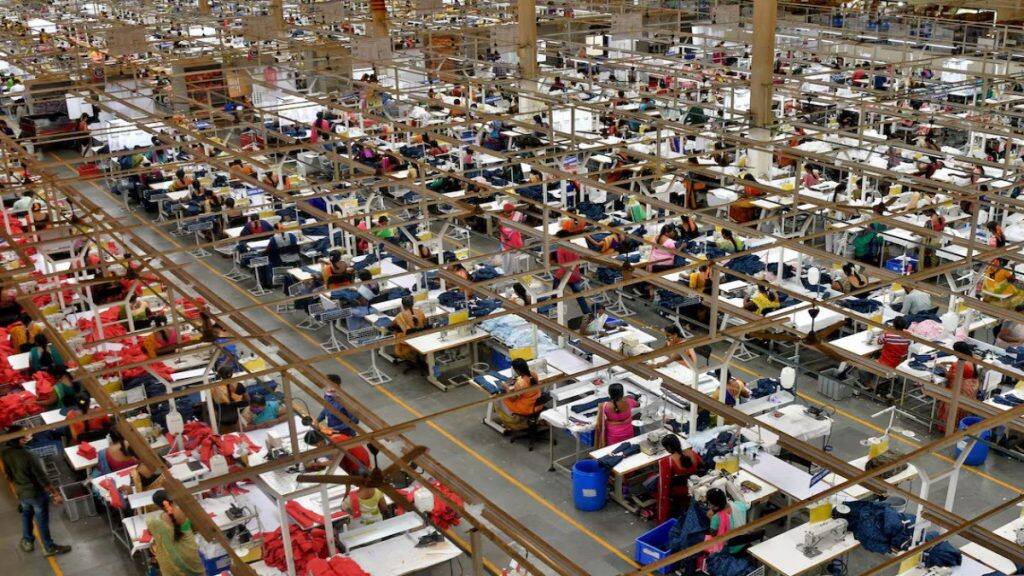
The deal puts India ahead of its competitors Bangladesh and Vietnam, on whomthe US has imposed a 19 per cent tariff. The deal will also help those exporting textiles, gems and jewellery to the US.
US Secretary of Agriculture Brooke Rollins said the deal would help the US “export more American farm products to India’s massive market, lifting prices, and pumping cash into rural America”.
“While the devil is in the details, it removes a hanging sword over the rupee, equity and rates market. Let us hope that it is a win-win deal for both the countries,” fund manager Nilesh Shah told the BBC.
“This greatly boosts India’s appeal as an alternative to China for the reconfiguration of supply chains. Indeed, India still offers many other advantages that other manufacturing hubs can’t, including low labour costs, political stability and a large domestic market for MNCs to sell to as a hedge against future tariffs,” Shilan Shah of Capital Economics added.
But some suggest waiting for the fine print to be clarified.
“Until there is a joint statement, negotiated text, and clarity on enforceability, this should be treated as a political signal — not a concluded trade deal. Caution, not celebration, is warranted,” Srivastava added.
Government sources say that while some are complaining that the tariff imposed by the US is 18 per cent, which is higher than earlier, the deal with the EU — signed after a raft of other pacts — means India now has multiple options.
They said this two-pronged strategy opens up newer markets for India as well as newer products. Multiple FTAs signed by India with other countries provide multiple options, sources added.
With inputs from agencies

Military drones & police check-ups: How Sri Lanka is fighting against worst dengue outbreak in a decade
How Facebook job ad lured 2 Karnataka men into Myanmar cyber scam camp
Why is India seeing 95% cloud cover despite a Super El Niño?
What is CJP’s fourth demand to the government as protests in Delhi intensify?
The new geography of war: Why the Houthis can no longer be ignored