
Advertisement


Sections
Luck is All We Need: What are longevity noodles, a Lunar New Year staple?
Longevity noodles are a popular Lunar New Year dish. The Chinese believe these egg-wheat noodles ensure a long life. The strands are to be eaten whole without breaking into pieces: The longer they remain intact, the longer your lifespan

The Lunar New Year is here. In China, it’s time for festivities, food, and wishful thinking. In a country that is said to have suffered the “worst COVID-19 outbreak in the world”, who wouldn’t wish for some luck? Well, it can be served on a plate and they call it “longevity noodles”.The “long-life noodles”These noodles, it is believed, ensure a long and prosperous life. Hence the name. They are called yi mein or e-fu noodles, depending on the dish they are served in. These long spongy egg wheat strands are a must-have during the Spring Festival – celebrations that occur in the run-up to the new year.Traditions dictate that these noodles can’t be cut by the chef. They need to be eaten whole. No breaking it before eating. It’s believed that the longer the noodles remain intact, the longer your lifespan will be. The whole noodle should be eaten bit by bit without breaking into pieces.Diana Chan, who won MasterChef 2017, told ABC Australia, “They don’t cut these noodles when they make them, so they stay very long. The longer the noodle, the longer, healthier and wealthier life you’ll have.”According to Louise Kwok, who manages a Hong Kong-style restaurant, saying “long life” in China is like saying “congratulations” or even “have a nice day”. Apart from the Spring Festival, it is common to have these noodles on birthdays or weddings. “… Any occasion when you want an omen of a long life,” she said.[caption id="attachment_12024522" align="alignnone" width="640"]![]() Lunar New Year celebrations are filled with traditions. The long-life noodles are served at the end of a big feast. AP[/caption]Making the noodlesThese noodles are deep-fried and made with egg, wheat flour and bicarbonate soda. They are golden yellow; spongey and chewy.In Guangzhou and Hong Kong, where yi mein are from, the weather is hot and humid. Hence fresh noodles cannot be preserved for a long time. People started frying them to remove the water, shaped them into discs and dried them.Now they are packaged and sold in many Asian grocery stores.They come at the end of a mealThe longevity noodles are served with oyster sauce and finely sliced shiitake mushrooms and bok choy; or with bok choy in a simple broth that’s lightly seasoned with soy and ginger, according to Serious Eats.They can also be topped with crab, lobster or prawns. For those who want to keep it simple, even cabbage and mushrooms will do with soy and sesame oil. What you need is some juicy sauce that the noodles can soak in.“The most traditional way is actually to just put aromatics like scallions and garlic, along with freshly-ground red chilli powder on top of the noodles, sear it with vegetable oil and dress it with soy sauce and black rice vinegar. We call these Spicy Hot-Oil Seared Hand-Ripped Noodles,” Jason Wang, CEO of Famous Foods, a New York restaurant tells CNN Travel.They are served at the end of a big feast that includes lots of dishes. Author Magie Zhu writes in her cookbook Omnivore’s Cookbook, “the noodles are like the pumpkin pie dessert… you know you’re too full to eat it, but feel that the occasion would be incomplete without eating some of it.”Also read: What is China’s Chunyun, the world’s largest annual migration?The other long-life noodles Yi mein are the noodles that Cantonese speakers eat. But many provinces across China have their own version of the longevity noodles. In the north of China, where it is difficult to grow rice, the noodles are made of wheat.But even flat rice noodles, hokkien noodles or spaghetti can double up as long-life noodles.“The exact type of noodles varies, but the idea remains ‘long noodles for long life,’ and any long noodles serve that purpose,” Wang told CNN Travel.[caption id="attachment_12024492" align="alignnone" width="640"]
Lunar New Year celebrations are filled with traditions. The long-life noodles are served at the end of a big feast. AP[/caption]Making the noodlesThese noodles are deep-fried and made with egg, wheat flour and bicarbonate soda. They are golden yellow; spongey and chewy.In Guangzhou and Hong Kong, where yi mein are from, the weather is hot and humid. Hence fresh noodles cannot be preserved for a long time. People started frying them to remove the water, shaped them into discs and dried them.Now they are packaged and sold in many Asian grocery stores.They come at the end of a mealThe longevity noodles are served with oyster sauce and finely sliced shiitake mushrooms and bok choy; or with bok choy in a simple broth that’s lightly seasoned with soy and ginger, according to Serious Eats.They can also be topped with crab, lobster or prawns. For those who want to keep it simple, even cabbage and mushrooms will do with soy and sesame oil. What you need is some juicy sauce that the noodles can soak in.“The most traditional way is actually to just put aromatics like scallions and garlic, along with freshly-ground red chilli powder on top of the noodles, sear it with vegetable oil and dress it with soy sauce and black rice vinegar. We call these Spicy Hot-Oil Seared Hand-Ripped Noodles,” Jason Wang, CEO of Famous Foods, a New York restaurant tells CNN Travel.They are served at the end of a big feast that includes lots of dishes. Author Magie Zhu writes in her cookbook Omnivore’s Cookbook, “the noodles are like the pumpkin pie dessert… you know you’re too full to eat it, but feel that the occasion would be incomplete without eating some of it.”Also read: What is China’s Chunyun, the world’s largest annual migration?The other long-life noodles Yi mein are the noodles that Cantonese speakers eat. But many provinces across China have their own version of the longevity noodles. In the north of China, where it is difficult to grow rice, the noodles are made of wheat.But even flat rice noodles, hokkien noodles or spaghetti can double up as long-life noodles.“The exact type of noodles varies, but the idea remains ‘long noodles for long life,’ and any long noodles serve that purpose,” Wang told CNN Travel.[caption id="attachment_12024492" align="alignnone" width="640"]![Longevity noodles]() Longevity noodles symbolise long life and are to be eaten without breaking the strands. Image coutresy: Flickr[/caption]The history of longevity noodles How did eating long-life noodles become a tradition?The tradition dates back to Emperor Wu of the Han Dynasty (141-87 BCE). He once told his ministers that he’d heard that a person with a long face has a long wife. He could not change the length of his face, of course, according to several blogs.That’s when the emperor decided to start eating long noodles as the word noodle and face sound similar in Chinese. It became a ritual that stuck.Zhao Rongguan, a leading scholar in China, told CNN Travel that the noodle culture flourished during the Han Dynasty. “It was the era that laid the foundations and techniques of modern-day noodles. But to say that Emperor Wu was why we have longevity noodles, I’d say it’s ridiculous internet heresy,” he said.Chen Yuanpeng, a professor at Taiwan’s National Dong Hwa University, said that the lore has been shared so many times that many people believe it is true. “…we can’t dismiss the story – even if it probably was just a myth… it has also become a part of the culture and history of longevity noodles, which has been documented for more than 1,000 years,” he told CNN Travel.Longevity noodles are so popular that they have been adopted by other countries that celebrate the Lunar New Year like Vietnam, South Korea, Singapore and Malaysia.What can we say: Long live the myth of longevity noodles.With inputs from agenciesAlso read: The Luxury Life: Are big brands Louis Vuitton, Dior picking Japan, South Korea over China? Read all the Latest News, Trending News, Cricket News, Bollywood News,India News and Entertainment News here. Follow us on Facebook, Twitter and Instagram.
Longevity noodles symbolise long life and are to be eaten without breaking the strands. Image coutresy: Flickr[/caption]The history of longevity noodles How did eating long-life noodles become a tradition?The tradition dates back to Emperor Wu of the Han Dynasty (141-87 BCE). He once told his ministers that he’d heard that a person with a long face has a long wife. He could not change the length of his face, of course, according to several blogs.That’s when the emperor decided to start eating long noodles as the word noodle and face sound similar in Chinese. It became a ritual that stuck.Zhao Rongguan, a leading scholar in China, told CNN Travel that the noodle culture flourished during the Han Dynasty. “It was the era that laid the foundations and techniques of modern-day noodles. But to say that Emperor Wu was why we have longevity noodles, I’d say it’s ridiculous internet heresy,” he said.Chen Yuanpeng, a professor at Taiwan’s National Dong Hwa University, said that the lore has been shared so many times that many people believe it is true. “…we can’t dismiss the story – even if it probably was just a myth… it has also become a part of the culture and history of longevity noodles, which has been documented for more than 1,000 years,” he told CNN Travel.Longevity noodles are so popular that they have been adopted by other countries that celebrate the Lunar New Year like Vietnam, South Korea, Singapore and Malaysia.What can we say: Long live the myth of longevity noodles.With inputs from agenciesAlso read: The Luxury Life: Are big brands Louis Vuitton, Dior picking Japan, South Korea over China? Read all the Latest News, Trending News, Cricket News, Bollywood News,India News and Entertainment News here. Follow us on Facebook, Twitter and Instagram.
 Lunar New Year celebrations are filled with traditions. The long-life noodles are served at the end of a big feast. AP[/caption]Making the noodlesThese noodles are deep-fried and made with egg, wheat flour and bicarbonate soda. They are golden yellow; spongey and chewy.In Guangzhou and Hong Kong, where yi mein are from, the weather is hot and humid. Hence fresh noodles cannot be preserved for a long time. People started frying them to remove the water, shaped them into discs and dried them.Now they are packaged and sold in many Asian grocery stores.They come at the end of a mealThe longevity noodles are served with oyster sauce and finely sliced shiitake mushrooms and bok choy; or with bok choy in a simple broth that’s lightly seasoned with soy and ginger, according to Serious Eats.They can also be topped with crab, lobster or prawns. For those who want to keep it simple, even cabbage and mushrooms will do with soy and sesame oil. What you need is some juicy sauce that the noodles can soak in.“The most traditional way is actually to just put aromatics like scallions and garlic, along with freshly-ground red chilli powder on top of the noodles, sear it with vegetable oil and dress it with soy sauce and black rice vinegar. We call these Spicy Hot-Oil Seared Hand-Ripped Noodles,” Jason Wang, CEO of Famous Foods, a New York restaurant tells CNN Travel.They are served at the end of a big feast that includes lots of dishes. Author Magie Zhu writes in her cookbook Omnivore’s Cookbook, “the noodles are like the pumpkin pie dessert… you know you’re too full to eat it, but feel that the occasion would be incomplete without eating some of it.”Also read: What is China’s Chunyun, the world’s largest annual migration?The other long-life noodles Yi mein are the noodles that Cantonese speakers eat. But many provinces across China have their own version of the longevity noodles. In the north of China, where it is difficult to grow rice, the noodles are made of wheat.But even flat rice noodles, hokkien noodles or spaghetti can double up as long-life noodles.“The exact type of noodles varies, but the idea remains ‘long noodles for long life,’ and any long noodles serve that purpose,” Wang told CNN Travel.[caption id="attachment_12024492" align="alignnone" width="640"]
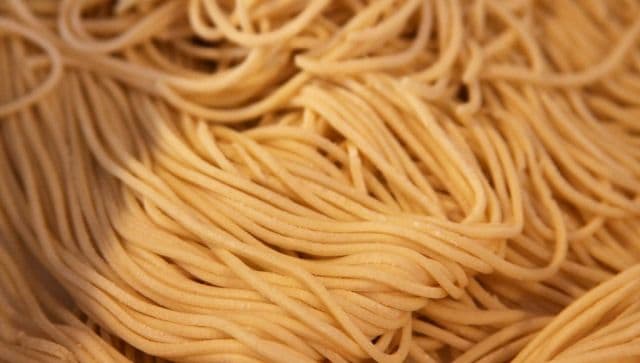 Longevity noodles symbolise long life and are to be eaten without breaking the strands. Image coutresy: Flickr[/caption]The history of longevity noodles How did eating long-life noodles become a tradition?The tradition dates back to Emperor Wu of the Han Dynasty (141-87 BCE). He once told his ministers that he’d heard that a person with a long face has a long wife. He could not change the length of his face, of course, according to several blogs.That’s when the emperor decided to start eating long noodles as the word noodle and face sound similar in Chinese. It became a ritual that stuck.Zhao Rongguan, a leading scholar in China, told CNN Travel that the noodle culture flourished during the Han Dynasty. “It was the era that laid the foundations and techniques of modern-day noodles. But to say that Emperor Wu was why we have longevity noodles, I’d say it’s ridiculous internet heresy,” he said.Chen Yuanpeng, a professor at Taiwan’s National Dong Hwa University, said that the lore has been shared so many times that many people believe it is true. “…we can’t dismiss the story – even if it probably was just a myth… it has also become a part of the culture and history of longevity noodles, which has been documented for more than 1,000 years,” he told CNN Travel.Longevity noodles are so popular that they have been adopted by other countries that celebrate the Lunar New Year like Vietnam, South Korea, Singapore and Malaysia.What can we say: Long live the myth of longevity noodles.With inputs from agenciesAlso read: The Luxury Life: Are big brands Louis Vuitton, Dior picking Japan, South Korea over China? Read all the Latest News, Trending News, Cricket News, Bollywood News,India News and Entertainment News here. Follow us on Facebook, Twitter and Instagram.
First Published:Jan 21, 2023, 11:51:47 IST
Advertisement
Advertisement

Military drones & police check-ups: How Sri Lanka is fighting against worst dengue outbreak in a decade
Sri Lanka is fighting its most severe dengue outbreak in nearly a decade, with infections rising sharply across the nation. Military drones have been deployed to tackle the outbreak, which has claimed 56 lives. Health officials said the outbreak is being driven primarily by the DENV-2 variant of the virus
3 min read
How Facebook job ad lured 2 Karnataka men into Myanmar cyber scam camp
The Karnataka Cyber Command has rescued two youths from a scam compound in Myanmar operated by Chinese fraudsters. The duo from Karnataka were lured on the pretext of data-entry jobs. They were asked to work for 16 hours a day and were expected to sleep for six hours daily
4 min read
Why is India seeing 95% cloud cover despite a Super El Niño?
India is witnessing nearly 95 per cent cloud cover despite a Super El Niño, a climate event usually linked to weaker monsoons. Regional weather systems, cyclonic circulations, the monsoon trough and moisture from two seas are temporarily overpowering one of the world's strongest climate phenomena
5 min read
What is CJP’s fourth demand to the government as protests in Delhi intensify?
The protest by the Cockroach Janta Party at Delhi’s Jantar Mantar refuses to die down. The group have made a fourth demand to the Centre, asking that no FIRs are filed against the agitators and that no legal action be taken. The government has expressed willingness to speak to the protesters, but refused to accede on the resignation of Education Minister Dharmandra Pradhan
5 min read
The new geography of war: Why the Houthis can no longer be ignored
The rise of the Houthis marks the emergence of a new geography of war — one in which influence flows not only from capitals and conventional armies, but also from rugged mountains overlooking vital sea lanes
6 min read
Advertisement
Advertisement