


Beyond Kohinoor: Which Indian artefacts do the British still possess
The Kohinoor diamond is back in the spotlight after New York City Mayor Zohran Mamdani called for its return during King Charles’ US visit this week. There are many other Indian gems and artefacts that remain in British museums. We take a look

New York City Mayor Zohran Mamdani’s request for Britain’s King Charles III to return the Kohinoor diamond has sparked interest in other lost or stolen artefacts that India wants back from the United Kingdom. The Indian-origin politician’s remarks came during the British monarch’s four-day visit to the United States this week.
India has made several efforts to reclaim the Kohinoor, which is believed to have been discovered in the Kollur Mines in the Golconda region. Beyond the fabled diamond, there are many Indian artefacts that were taken away by British colonisers.
We take a look.
Sultanganj Buddha
The Sultanganj Buddha is a 7.5-foot-tall statue that dates back to the Gupta-Pala period between 500-700 AD. It was found in Bihar’s Bhagalpur district during the construction of the East Indian Railway in 1862.
 More from Explainers
Weighing over 500 kg, the statue is made of pure, unrefined copper. It depicts a standing Buddha with one hand raised in the abhaymudra position, as per a Scroll report.
As the news of its excavation spread, 30,000 local visitors came to view the statue. Samuel Thornton, a Birmingham industrialist and MP, purchased it for 200 pounds. The Sultanganj Buddha was shipped off to England in 1861.
"He paid £200 to get the statue shipped to England via Calcutta, and donated it in 1864, making it one of the first pieces to enter Birmingham's collection," Uday Chandra Jha, a college teacher, told The Telegraph.
The statue arrived in Birmingham after narrowly escaping an alleged ambush near London docks by curators of the British Museum, reported BBC.
The Sultanganj Buddha, which is the largest known complete Indian metal sculpture, adorns the Birmingham Museum and Art Gallery.
Amravati stupa, railings
The origin of the Amravati stupa, or the Great Shrine of Amaravati, can be traced back to the 3rd century BC. It was established in the Guntur district of Andhra Pradesh, where it was revered as an important Buddhist site until the 14th century AD, as per an Indian Express report.
The Amravati railings are limestone slab carvings made in phases between the 1st century BC and the 8th century AD. The Archaeological Survey of India (ASI) wants these railings to be repatriated.
In the late 18th century, the stupa was excavated by British army officer Colin Mackenzie. By 1845, Sir Walter Elliot of the Madras Civil Service extracted parts of the sculpture and housed them in the Madras museum. They were sent to London in 1859, citing concerns over their possible damage in India. The artefact is displayed at the British Museum.
“It was loot. The pretext was to ‘save objects’,” Dr Anisha Saxena, historian of ancient and medieval Indian art, told the newspaper.
Maharaja Ranjit Singh’s throne
Maharaja Ranjit Singh was the founder of the Sikh Empire in Punjab. In the 1820s, his goldsmith Hafez Multani built a precious wood and gold throne for the ruler, as per Scroll.
The throne was carved in the form of a two-tiered lotus, giving it an octagonal shape. It has a wood and resin core covered with sheets of engraved gold.
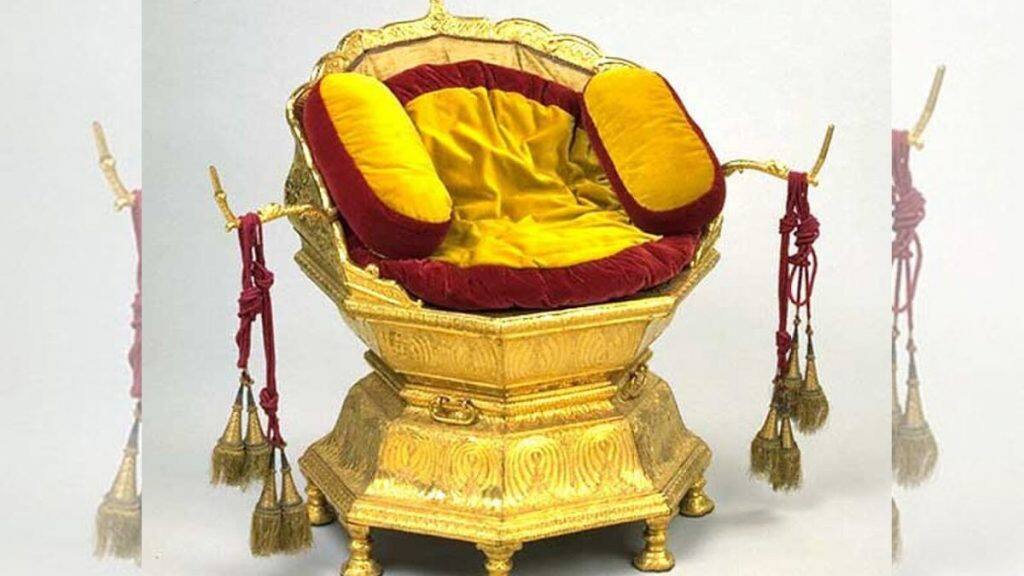
It was during the rule of Ranjit Singh that the Kohinoor diamond achieved its fame. After he died in 1839, four different rulers ascended the Punjabi throne over four years.
As the violent period ended, Duleep Singh, Ranjit Singh’s youngest son, and his mother, Rani Jindan, were the only ones left in line for the throne.
In 1849, the British forced Duleep to sign a legal document amending the Treaty of Lahore, which included surrendering the Kohinoor and any sovereignty claims.
Amid Punjab's annexation, Ranjit Singh’s throne was taken away by the British as “state property”.
In 1851, the Punjabi throne was put on display in the Indian Empire collection of the “Great Exhibition” of global artworks in London. Today, it adds shine to the Victoria and Albert Museum.
In recent years, descendants of Duleep Singh have made attempts to get both the diamond and the throne back.
Tipu’s tiger
Tipu’s Tiger sits in a glass case in the Victoria and Albert Museum in London. The mechanical toy belonged to Tipu Sultan, the 18th-century ruler of the Mysore kingdom.
The piece depicts a British soldier being mauled by a tiger. The man has a shocked smile on his face as the tiger rips into his chest. The toy has a faded brass handle, which, when pressed, releases screaming and groaning sounds.
The tiger was looted by the East India Company officials after the siege of Seringapatam in 1799, wherein the company defeated Tipu Sultan and took over the kingdom of Mysore.
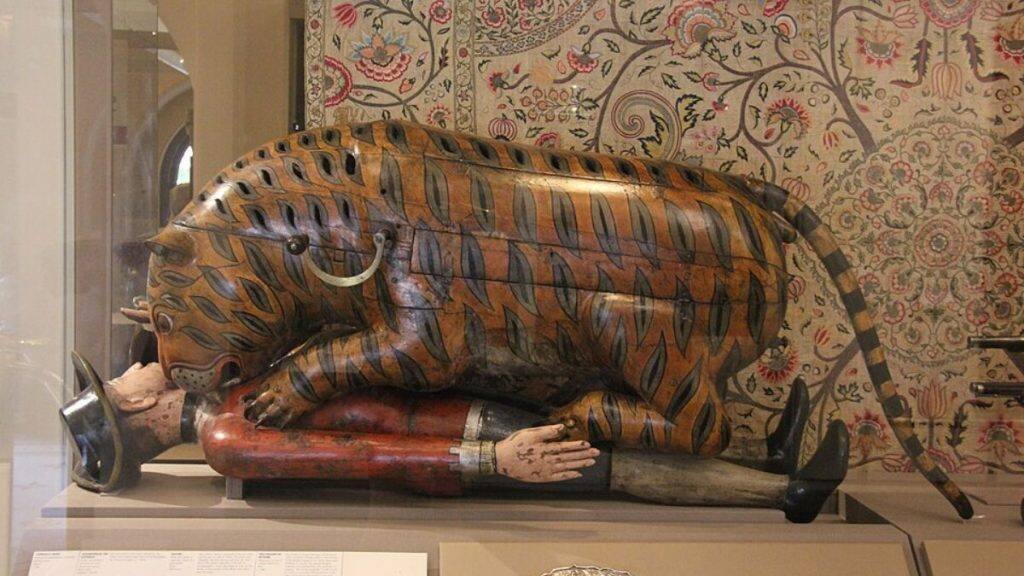
While there has been no official demand for its repatriation, Congress MP Shashi Tharoor called for the tiger's return in an interview with the Australian broadcaster ABC in 2020.
“There’s something wrong about stealing items that belong to another people and then, self righteously claiming you look after them better than those who are entitled to own them would,” he said.
Bakhtiar Ali Shah, a sixth-generation descendant of Tipu Sultan, told ABC that the return of the tiger would be "symbolic and meaningful".
Ambika/Saraswati idol from Bhojshala
The British Museum is adorned with a four-foot-tall white marble statue of a goddess from Dhar, a city in present-day Madhya Pradesh. As per the museum, it is an 11th-century Paramara dynasty sculpture of the Jain figure Ambika.
The statue was transported to the museum in the 1880s.
However, claims have emerged over the past 20 years that the idol is of the goddess Saraswati, originally from the controversial Bhojshala complex of Dhar. There have been calls to bring the statue back to India.
However, the British government has officially clarified that the statue in its museum is of Ambika.
With inputs from agencies

Military drones & police check-ups: How Sri Lanka is fighting against worst dengue outbreak in a decade
How Facebook job ad lured 2 Karnataka men into Myanmar cyber scam camp
Why is India seeing 95% cloud cover despite a Super El Niño?
What is CJP’s fourth demand to the government as protests in Delhi intensify?
The new geography of war: Why the Houthis can no longer be ignored