


There’s a new COVID-19 variant. What's JN.1, will vaccines work against it?
Scientists have detected a new COVID-19 variant, called JN.1, believed to be a descendant of the fast-spreading Pirola strain. Identified in cases across over 15 countries, it is more infectious and easily transmissible

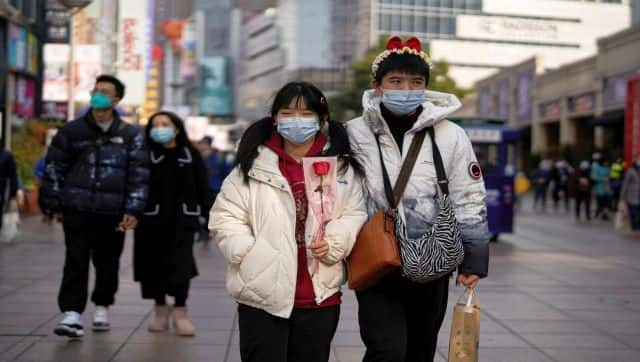
A couple wearing protective masks walks with a rose on a street in Shanghai, China. JN.1 has since been identified in 130 infections, including cases in England, France, the US and 15 other countries. File image/Reuters[/caption]Are there any specific symptoms to look out for?Currently, there’s no data that suggests that the symptoms from the JN.1 variant are any different from the ones from other COVID variants. However, experts note that if one experiences these symptoms, they should isolate and seek a test.The symptoms are: fever or chills, cough, shortness of breath, fatigue, muscle or body aches, headaches, new loss of taste or smell, sore throat, congestion or a runny nose, nausea and diarrhoea.Should we be worried then?While the variant isn’t the dominant one yet, some experts are concerned that it could pose a health risk in the future. Dr Thomas Russo notes that due to the mutation to the spike protein, JN.1 seems to be much more immune invasive, making it quite devious.“There is some data that suggest JN.1’s parent BA.2.86 may be more transmissible than previous variants,” he added.But even though it may be easily transmissible, doctors believe that the current vaccines against COVID would be effective. The CDC has observed that the spike protein is part of the virus that vaccines target and, as a result, the updated COVID-19 vaccine should work against JN.1.“The updated vaccine is closer to JN.1 than our old vaccine,” Dr Russo told Prevention.com. “The hope is that, even if we see more cases with JN.1, the updated vaccine will protect against severe disease.”Another doctor, Dr T Ryan Gregory, an evolutionary and genome biologist at the University of Guelph in Canada, said that he wasn’t particularly perturbed about JN.1, saying: “I am not so concerned about any one variant causing a huge wave anymore.“I don’t think wondering if any particular new variant will take over and cause a huge wave is the right way to think about variants anymore,” he was quoted as telling Salon.Also read: Is it time to start believing in the COVID-19 ‘lab leak’ theory?A COVID winter?The emergence of a new variant before the winter has also caused doctors some amount of concern. Experts note that each winter, they have seen a surge in COVID cases since the pandemic began.Even the World Health Organization has warned of “concerning” COVID-19 trends in advance of winter, calling for increased vaccinations and surveillance. “We continue to see concerning trends for COVID-19 ahead of the winter season,” WHO chief Tedros Adhanom Ghebreyesus told an online news conference in September.“Deaths are increasing in some parts of West Asia and Asia, intensive care unit admissions are increasing in Europe and hospitalisations are increasing in several regions,” he said.Maria Van Kerkhove, the WHO’s technical lead on COVID-19, also expressed worry about the upcoming winter. “When we get to colder months, in some countries, people tend to spend more time indoors together, and viruses that transmit through the air like COVID will take advantage of that,” she said.Moreover, people are already vulnerable to diseases in the winter as influenza and respiratory syncytial virus, or RSV are also circulating.As one doctor has noted, “The JN.1 variant shows us what is out there. It is a reminder that the virus continues to evolve in many different ways. Our best approach is not to rely only on one measure but to take a layered approach that includes vaccination but also mitigation.”With inputs from agencies

Military drones & police check-ups: How Sri Lanka is fighting against worst dengue outbreak in a decade
How Facebook job ad lured 2 Karnataka men into Myanmar cyber scam camp
Why is India seeing 95% cloud cover despite a Super El Niño?
What is CJP’s fourth demand to the government as protests in Delhi intensify?
The new geography of war: Why the Houthis can no longer be ignored