


Former FBI chief James Comey charged over ‘8647’ seashell post. What does it mean?
Former FBI director James Comey faces fresh criminal charges over a viral '8647' seashell post allegedly interpreted as a threat to US President Donald Trump. The case raises key questions around free speech, political messaging, and how US law defines a 'true threat' in the digital age

Former FBI director James Comey has been indicted once again over a seemingly innocuous social media post that has spiralled into a political controversy in the United States.
The case, centred on a photograph of seashells forming the numbers “8647,” has brought back into the spotlight tensions between Comey and US President Donald Trump.
Filed by the US Department of Justice in a federal court in North Carolina, the indictment accuses Comey of making a threat against a sitting president and transmitting that threat across state lines.
The development marks the second time in months that prosecutors have pursued criminal action against the former FBI chief.
 More from Explainers
How did a beach photo lead to criminal charges? What is 8647?
The controversy traces back to May 2025, when Comey posted an image on Instagram while on vacation in North Carolina. The photograph showed seashells arranged in a way that displayed the numbers “86 47.”
At the time, the post appeared casual and unremarkable, accompanied by a simple caption. “Cool shell formation on my beach walk,” Comey said.
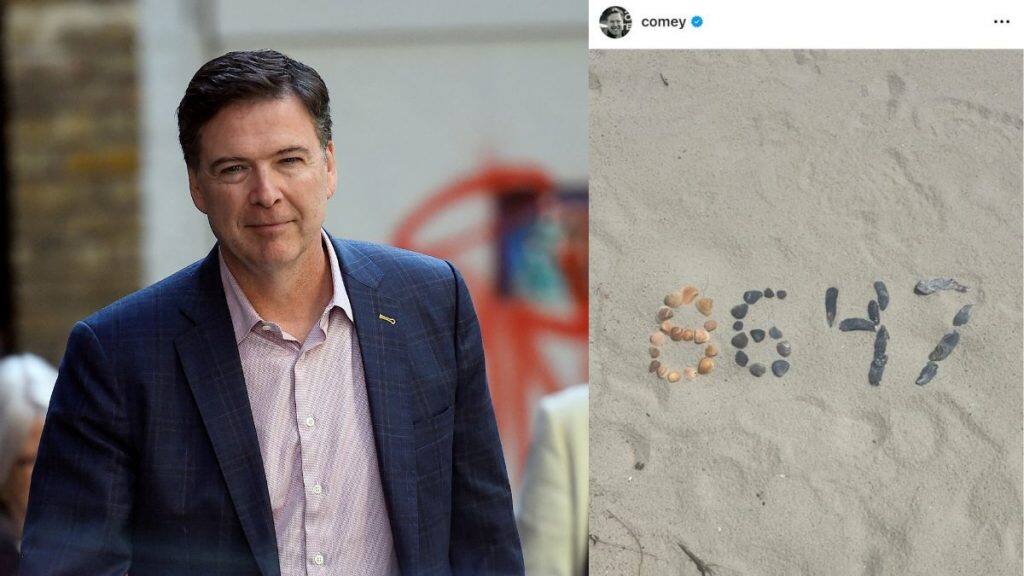
However, the image quickly gained traction online, with many interpreting the numbers as carrying a political message. The number “47” was widely seen as a reference to Trump’s position as the 47th president of the United States.
Meanwhile, “86” drew attention for its colloquial meanings in American English.
According to Merriam-Webster, “86” has long been used to mean “to throw out,” “to get rid of,” or “to refuse service to.” The term is believed to date back to the 1930s, where it was used in soda-counter slang to indicate that an item was no longer available.
Over time, it became common in the hospitality industry, particularly in bars and restaurants, where staff would “86” unruly patrons or items that were out of stock.
The origins of the phrase remain debated. One account links it to Chumley’s, a historic bar in New York located at 86 Bedford Street, where bartenders allegedly used the term when ejecting troublesome customers.
Another version suggests that during Prohibition, authorities would call ahead to warn staff, who would then “86” patrons through a specific exit to avoid arrests. A separate explanation traces the term to the word “nix,” used in service settings to indicate refusal.
While these meanings are largely non-violent, some interpretations of “86” have taken on darker connotations. Merriam-Webster acknowledges that in rare and more recent usage, the term has been associated with killing, though it notes that this meaning is not widely established.
It is this ambiguity that fuelled controversy around Comey’s post. Critics, including Trump’s allies, argued that the combination “8647” could be read as a call to remove — or even harm — the US president.
Among the most vocal was Donald Trump Jr, who claimed the post amounted to a dangerous message directed at his father.
At the same time, the phrase “8647” had already circulated in political spaces as a form of protest against Trump, often appearing on merchandise such as T-shirts and stickers. These items, sold on platforms like Amazon and Etsy, frequently presented the slogan as a subtle or symbolic expression of opposition rather than a literal threat.
Comey later addressed the controversy, explaining that he had not intended any violent implication. “I didn't realise some folks associate those numbers with violence. It never occurred to me but I oppose violence of any kind so I took the post down,” he said.
In another remark, he noted that he had photographed the shells assuming they conveyed a political message, without anticipating the backlash that would follow.
What are the charges against Comey?
Prosecutors have charged Comey with threatening the life of a public official and transmitting that threat across state lines — offences that carry serious penalties under US law.
According to the indictment filed in the Eastern District of North Carolina, Comey faces one count for each of these charges.
US Acting Attorney General Todd Blanche stated that each count carries a maximum prison sentence of 10 years, although he acknowledged that actual sentences are often significantly lower.
An arrest warrant has been issued as part of the proceedings, and the case has been assigned to US District Judge Louise Flanagan, who has served on the federal bench since being appointed in 2003 by former US President George W Bush.
Blanche sought to frame the prosecution as a standard application of the law, rather than a politically motivated move.
“While this case is unique and this indictment stands out because of the name of the defendant, his alleged conduct is the same kind of conduct that we will never tolerate, and that we will always investigate and regularly prosecute,” he said.
He added that threats against the president are treated with utmost seriousness by federal authorities, regardless of the individual involved. “Threatening the life of the President of the United States will never be tolerated by the Department of Justice,” Blanche said.
The case comes with a five-year statute of limitations, which Blanche highlighted during his remarks, indicating that prosecutors are operating within the legally permissible timeframe for bringing such charges.
How has Comey responded to the indictment?
Comey has denied the allegations, maintaining that his actions did not constitute a threat. In a video posted online following the indictment, he expressed defiance and confidence in the judicial process.
“I'm still innocent. I'm still not afraid,” Comey said.
He also criticised the handling of the case, suggesting that it deviates from established norms within the Justice Department. “This is not how the Department of Justice is supposed to be,” he added.
In a separate video response titled “Seashells,” Comey elaborated on his position. “I’m still innocent, I’m still not afraid, and I still believe in the independent federal judiciary, so let’s go,” he said.
“But it’s really important that all of us remember that this is not who we are as a country,” Comey said. “This is not how the Department of Justice is supposed to be. And the good news is we get closer every day to restoring those values. Keep the faith.”
His legal team has also pushed back forcefully. Defence lawyer Patrick Fitzgerald issued a statement rejecting the charges and signalling a robust legal challenge. “Mr. Comey vigorously denies the charges contained in the Indictment filed in the Eastern District of North Carolina.”
“We will contest these charges in the courtroom and look forward to vindicating Mr. Comey and the First Amendment,” Fitzgerald said.
Comey’s lawyers are expected to argue that the prosecution is unjustified and that the post falls within the bounds of constitutionally protected speech.
What happened in Comey’s earlier legal case?
The latest indictment follows a previous case brought against Comey in September, in which he was accused of making false statements to Congress and obstructing proceedings related to disclosures about FBI investigations.
That case encountered significant legal hurdles. A federal judge ultimately dismissed the charges after determining that the prosecutor responsible for the indictment had not been lawfully appointed. The Justice Department has since appealed that decision.
Additional complications arose during the proceedings. One judge raised concerns about potential errors made before the grand jury, while another ruled that key evidence could not be used because it had been obtained in violation of constitutional protections against unlawful searches and seizures.
Comey’s defence team has previously characterised the earlier case as a “vindictive prosecution,” a line of argument that could resurface in the new legal battle.
Where does free speech law stand in this case?
At the heart of the case lies a fundamental constitutional question: whether Comey’s post constitutes protected speech or a prosecutable threat.
The First Amendment provides broad safeguards for expression, particularly in the political realm. Even speech that is provocative or unsettling can fall within its protections.
However, the law draws a distinction between protected expression and what is known as a “true threat.” Statements that directly threaten harm to an individual are not shielded by the Constitution and can be subject to criminal penalties.
The challenge lies in determining where that line is drawn. The US Supreme Court has not provided a definitive standard for identifying a “true threat,” leaving lower courts and law enforcement agencies to interpret the concept on a case-by-case basis.
In practice, investigators often look for clear indicators of intent, such as explicit language or contextual evidence suggesting a genuine plan to cause harm. Ambiguous or symbolic statements, like the “8647” post, can be more difficult to assess.
The First Amendment has, at times, limited the Justice Department’s ability to pursue cases involving inflammatory rhetoric directed at public officials.
Legal scholars note that this area of law remains unsettled, particularly in the context of social media, where messages can spread rapidly and be interpreted in multiple ways.
Is this part of a broader political battle?
The indictment cannot be viewed in isolation from the long-running feud between Comey and Trump.
The former FBI director has been a frequent target of criticism from Trump, particularly over his role in overseeing the FBI’s investigation into alleged links between Trump’s 2016 presidential campaign and Russian officials.
Trump has repeatedly called for legal action against Comey and other perceived adversaries. In the past, he used social media to urge the Justice Department to pursue criminal charges, contributing to concerns about the independence of federal law enforcement.
The current case has reignited accusations that the Justice Department is being used to settle political scores. US Senator Dick Durbin described the indictment as politically motivated.
“Just like the last baseless indictment against Mr. Comey, this is another case of a weaponized Justice Department lashing out on behalf of a vengeful President,” he said.
At the same time, the Justice Department has undertaken a series of actions under Blanche’s leadership that have drawn attention.
Since assuming office in April, he has moved swiftly on several fronts, including bringing charges against the Southern Poverty Law Center, releasing a report alleging misconduct in previous prosecutions of anti-abortion activists, and indicting a former National Institutes of Health official over alleged concealment of records related to Covid-19 research.
In July last year, the US Justice Department had dismissed Comey's daughter, Maurene Comey, who served as a federal prosecutor in high-profile cases involving Jeffrey Epstein associate Ghislaine Maxwell and music mogul Sean “Diddy” Combs.
With inputs from agencies

Military drones & police check-ups: How Sri Lanka is fighting against worst dengue outbreak in a decade
How Facebook job ad lured 2 Karnataka men into Myanmar cyber scam camp
Why is India seeing 95% cloud cover despite a Super El Niño?
What is CJP’s fourth demand to the government as protests in Delhi intensify?
The new geography of war: Why the Houthis can no longer be ignored