


Jaishankar calls World Press Index ‘mind games’: Why the ranking is questionable
India’s ranking of 161 out of 180 on the World Press Freedom Index has raised eyebrows with External Affairs Minister S Jaishankar calling it ‘mind games’. This isn’t the first time the ranking has caused controversy in the country. Critics question the methodology and the bias of people involved

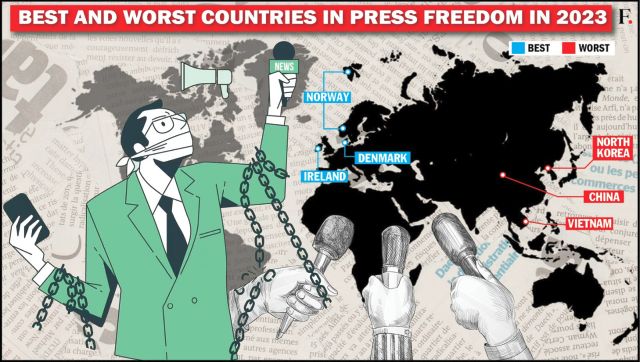
Graphic: Pranay Bhardwaj[/caption]What do the rankings reveal this year?The World Press Freedom Index released this year on 5 May painted a not-so-pretty picture for India. It pushed India’s ranking from 150 to 161 this year, a drop of 11 places. Interestingly, when this ranking began back in 2002, India was initially placed at the 80th spot.The RSF said that “the situation has gone from ‘problematic’ to ‘very bad’ in three other countries: Tajikistan (down one at 153rd), India (down 11 at 161st) and Turkey (down 16 at 165th)”.In its report, the RSF further noted, “The purchase of media outlets by oligarchs with strong ties to political figures is another phenomena that dangerously hinders the free flow of information.”Also read: China biggest global jailer of journalists, exporter of propaganda content: Press groupShockingly for India, Afghanistan had a better ranking and was placed at the 152nd spot. Meanwhile, Norway came out on top, followed by Ireland and Denmark. When it came to the worst countries, it was North Korea at the bottom, followed by China and Vietnam.Why is the ranking criticised?External Affairs Minister S Jaishankar is not the only one to criticise the ranking. Earlier in March, Union Information and Broadcasting Minister Anurag Thakur had said that the government did not subscribe to the rankings.“The World Press Freedom Index is published by a foreign non-government organisation, called Reporters Without Borders, and the government does not subscribe to its views and country rankings and does not agree to the conclusions drawn by this organisation,” he had then written in a response in Rajya Sabha.He said this was owing to various factors, including a “very low sample size, little or no weightage to fundamentals of democracy, adoption of a methodology which is questionable and non-transparent”.A previously-published NITI Aayog report also highlighted issues with the questionnaire used to gather data. It states that question-wise or category-wise scores used are not made public, nor is the list of respondents provided. It also adds that the questions are biased in nature.Another criticism of the index is that it usually ranks developing countries, which have government media ownership lower than other countries. However, countries like Denmark and Norway, which usually rank high, provide direct subsidies to the press. Hence, this raises a huge question on the credibility of the ranking.There’s also the question of funding to RSF. The Street reports that through their funding, billionaires, including George Soros via his Open Society and Pierre Omidyar, have indirectly shaped RSF activities. In return for French and US funds, the RSF has been largely silent about media abuses in France and the West.And it’s not just India that has raised questions on the credibility of the ranking. Fifteen years ago, Singapore’s then-PM Goh Chok Tong had denounced the index as “a subjective measure computed through the prism of Western liberals.” Today, Singapore continues to rank low on the index – it is ranked at 129.With inputs from agenciesRead all the Latest News, Trending News, Cricket News, Bollywood News,India News and Entertainment News here. Follow us on Facebook, Twitter and Instagram.

Military drones & police check-ups: How Sri Lanka is fighting against worst dengue outbreak in a decade
How Facebook job ad lured 2 Karnataka men into Myanmar cyber scam camp
Why is India seeing 95% cloud cover despite a Super El Niño?
What is CJP’s fourth demand to the government as protests in Delhi intensify?
The new geography of war: Why the Houthis can no longer be ignored