


'It's frosty outside': How the polar vortex brought bitter cold to Asia this January
Scientists say Asia’s extreme cold is largely the result of the so-called polar vortex, an expanse of cold air that generally circles the Arctic but occasionally shifts south from the North Pole. It was the same weather phenomenon that brought exceptionally cold weather to the US last month

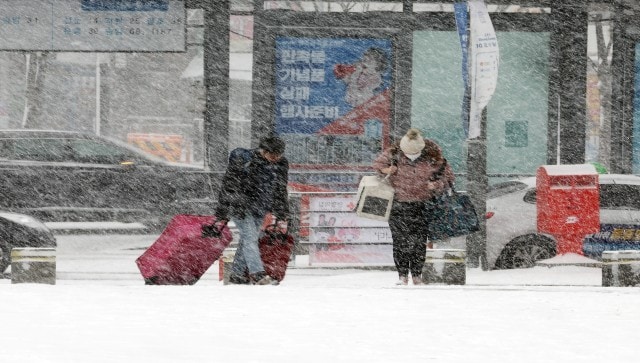
People head to a bus station amid heavy snowfall in Gwangju, South Korea. AP[/caption]It’s likely that recent droughts in Asia made the region even more susceptible to temperature extremes, said Mark Howden, the director of the Institute for Climate, Energy and Disaster Solutions at the Australian National University. He added that he expected the vortex to move east toward North America over the next few weeks.There has been a general decrease in the frequency and intensity of cold extremes across much of the world since the 1950s, the Intergovernmental Panel on Climate Change noted in a report last year. But Howden, the vice chair of an IPCC working group, said the trend is an average that doesn’t account for local variations.“What’s actually happening in parts of the world is that we’re actually getting more cold weather and more extreme weather,” he said. “So hotter hot days and colder cold days.”Cold from Kabul to TokyoAfghanistan has felt the cold snap more acutely than any other country in Asia this month. The country’s minister of disaster management told Reuters this week that about half of the 162 deaths since 10 January had occurred in the previous week.Afghanistan’s coldest winter in about a decade has come at a time when many nonprofits have suspended operations in the country because of a recent law that barred women from aid work, hampering a United Nations-led relief program.“Six million people are close to famine” in Afghanistan, Martin Griffiths, the U.N.’s top humanitarian chief, told CNN from Kabul this week. “So if this program doesn’t function as it’s supposed to, we’re in very serious trouble.”At least three deaths in Japan this week were also linked to cold weather, a Cabinet secretary told reporters Wednesday. Heavy snow has suspended flights and high-speed trains.“The snowfall was not so bad, but it got so cold, which was worse,” said Toshiharu Yamano, 58, the manager of a spa in Fukui, a prefecture along Japan’s western coast. “A lot of people couldn’t get hot water because their water pipes suddenly froze.”On the Korean Peninsula, North Korea’s state meteorological agency warned residents in the last week of “the most bitter cold wave in 23 years.” And in South Korea, hundreds of flights were grounded, and beaches were covered in ice. The local news media quoted ice fishermen who said they had cut an excursion short after their lines froze.‘It’s Too Chilly’China’s national weather agency issued daily warnings of extremely cold temperatures earlier this week for almost the entire country, although the weather started to warm a little as the week wore on.Some tourists, eager to travel again following the lifting of the country’s stringent “zero-COVID” measures last month, were not deterred by the worst of the cold. Earlier this week, crowds gathered for an ice festival in Harbin, a city that was partly founded by Russian railroad engineers and is known for its magnificent Russian architecture. Gawkers mobbed ice sculptures the size of houses, and there was an hourslong line for a Ferris wheel.But in a country where the combination of cold temperatures and natural gas shortages has been making this winter unbearable for people in some northern provinces, the extreme cold was largely a downside to an otherwise festive Lunar New Year holiday week.In downtown Beijing, the wind chill was minus 13 degrees Fahrenheit (-25 degrees Celsius) by Monday night. Powerful winds howled around the city’s tall buildings through the night, before calm skies returned by midday Tuesday. Few people ventured outside.Zhang, the pancake shop owner in Mohe, also stayed home.“People dare not go out,” she said. “It’s too chilly.”Mike Ives and John Yoon, c.2023 The New York Times CompanyRead all the Latest News, Trending News, Cricket News, Bollywood News,India News and Entertainment News here. Follow us on Facebook, Twitter and Instagram.

Military drones & police check-ups: How Sri Lanka is fighting against worst dengue outbreak in a decade
How Facebook job ad lured 2 Karnataka men into Myanmar cyber scam camp
Why is India seeing 95% cloud cover despite a Super El Niño?
What is CJP’s fourth demand to the government as protests in Delhi intensify?
The new geography of war: Why the Houthis can no longer be ignored