


ISRO ready for Aditya-L1 launch: What are solar storms that the mission will study?
India will launch its first space-based solar mission, Aditya-L1, on 2 September. The observatory will examine solar storms – triggered by coronal mass ejections – which can impact Earth, including by disrupting GPS and electrical systems

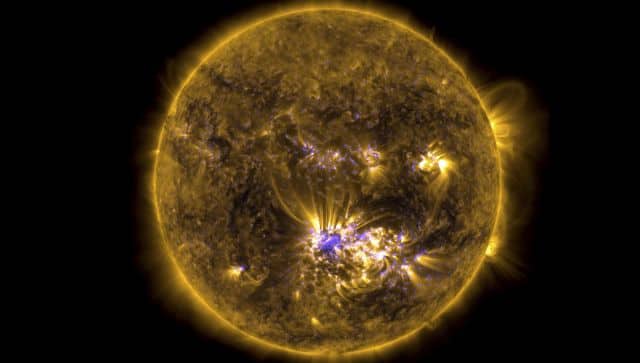
A NASA handout of the Sun before it released a major solar flare in 2012. Reuters File Photo[/caption]The Earth experienced its greatest solar storm in 1859. Known as the ‘Carrington Event’, a major CME triggered a geomagnetic storm, which sent telegraph and electrical systems haywire for days.Last February, a geomagnetic storm was blamed for Elon Musk’s Starlink losing dozens of satellites following their launch.ALSO READ: ISRO gearing up for Aditya-L1 mission launch: Why studying the Sun mattersWhy studying solar storms is importantIt is hard to forecast when CMEs will occur, so it can help scientists tremendously if there are more findings about these ejections.Speaking to News18, Professor Ramesh R of Bengaluru’s Indian Institute of Astrophysics (IIA) said, “We do not know when and where they can happen. Usually, there can be two to three CMEs per day, but they can even go up to 11 to 12 per day when there are more sunspots. Therefore, it is essential to understand the solar atmosphere and the changes in its magnetic field, so we can devise ways to predict these flares”.The Sun’s corona continues to pose a great mystery for scientists. “It is the most important star for us and we need to understand its effect on us. With Aditya-L1, we hope that we will be able to study even the lowest boundary of corona,” Ramesh added.As solar storms impact global positioning systems (GPS), radio, and satellite communications, more knowledge about these events is important.IIA director Annapurni Subramaniam told Moneycontrol, "Depending on the intensity of solar mass that is ejected during a CME, space weather gets affected. The question is how much does the sun affect things in space because we are more and more dependent on space technology such as GPS, mobile connectivity and so on."What will Aditya-L1 do?As per ISRO, the space observatory will study the dynamics of the chromosphere and corona; in-situ particle and plasma environment; the heating mechanism of the corona; magnetic field topology and magnetic field measurements in corona; temperature, velocity and density of coronal and coronal loops plasma; and development, dynamics and origin of CMEs.It will also study chromospheric and coronal heating, space weather, the physics of the partially ionized plasma, what leads to solar eruptive events, and how CMEs and solar flares start.With inputs from agencies

Military drones & police check-ups: How Sri Lanka is fighting against worst dengue outbreak in a decade
How Facebook job ad lured 2 Karnataka men into Myanmar cyber scam camp
Why is India seeing 95% cloud cover despite a Super El Niño?
What is CJP’s fourth demand to the government as protests in Delhi intensify?
The new geography of war: Why the Houthis can no longer be ignored