
Advertisement


Sections
Israel-Palestine conflict: How the recent outbreak of violence deepens humanitarian crisis in Gaza
The intense conflict in the region has extracted a very heavy civilian toll. The latest attacks have claimed at least 44 lives, including 15 Palestinian children, and injured another 350 civilians

Israel launched multiple air strikes on Gaza on 5 August, in another eruption of open warfare between Israel and Palestinian militants. The latest attacks come just over a year after hundreds were killed in an intense period of conflict in the territory.Israel announced its missile strikes were targeting military leaders of the al-Quds Brigades, the military wing of the Islamic Jihad militant organisation in Gaza. Israel alleged Islamic Jihad forces were making “threatening movements” near the Israeli border.Israel’s strikes killed two key leaders of Islamic Jihad in Gaza and severely damaged its military capabilities.Palestinian Islamic Jihad responded by launching hundreds of rockets into Israel. The Israel Defence Forces reported its Iron Dome missile defence system was operating at a 97 per cent success rate in intercepting rockets launched from Gaza. No Israelis had been killed or seriously injured.But the past three days of intense conflict have extracted a very heavy civilian toll in Gaza. The Palestinian Health Ministry reports at least 44 dead and over 350 civilians wounded. Reportedly among the dead were 15 Palestinian children, including five boys killed by a missile strike as they visited their grandfather’s grave.An Egyptian-brokered ceasefire between Israel and Islamic Jihad has now begun. It is too early to say whether the ceasefire will hold, or for how long.The Palestinian governing authority in Gaza is Hamas, which was elected in 2006. Hamas does not recognise the legitimacy of the Israeli state and aims to liberate Palestine through armed resistance. Yet Hamas has not engaged in the most recent outbreak of warfare.[caption id="attachment_11029701" align="alignnone" width="640"]![Mourners carry the bodies of Khaled Mansour a senior commander in the Palestinian militant group Islamic Jihad and other Palestinians, who were killed in Israeli airstrikes. AP]() Mourners carry the bodies of Khaled Mansour a senior commander in the Palestinian militant group Islamic Jihad and other Palestinians, who were killed in Israeli airstrikes. AP[/caption]The Gaza Strip is a 365-square-kilometre territory that has been under Israeli control since 1967, along with the other Palestinian territories of the West Bank and East Jerusalem. Over two million Palestinians live in the densely populated territory. Nearly 80 per cent depend on aid to survive.Gaza has been under blockade for 15 years. Israel controls its airspace and territorial waters, along with two of three border crossings (Egypt controls the third). Gaza is often referred to as “the world’s largest open-air prison”.[caption id="attachment_11030231" align="alignnone" width="640"]
Mourners carry the bodies of Khaled Mansour a senior commander in the Palestinian militant group Islamic Jihad and other Palestinians, who were killed in Israeli airstrikes. AP[/caption]The Gaza Strip is a 365-square-kilometre territory that has been under Israeli control since 1967, along with the other Palestinian territories of the West Bank and East Jerusalem. Over two million Palestinians live in the densely populated territory. Nearly 80 per cent depend on aid to survive.Gaza has been under blockade for 15 years. Israel controls its airspace and territorial waters, along with two of three border crossings (Egypt controls the third). Gaza is often referred to as “the world’s largest open-air prison”.[caption id="attachment_11030231" align="alignnone" width="640"]![Humanitarian organisations reported the situation as extreme crisis and blamed the Israeli blockade in Gaza for the same. AP]() Humanitarian organisations reported the situation as extreme and blamed the Israeli blockade in Gaza for the same. AP[/caption]Humanitarian organisations blame the blockade for the extreme humanitarian crisis in Gaza. Statistics tell a dire story of life in Gaza today:
Humanitarian organisations reported the situation as extreme and blamed the Israeli blockade in Gaza for the same. AP[/caption]Humanitarian organisations blame the blockade for the extreme humanitarian crisis in Gaza. Statistics tell a dire story of life in Gaza today:![The Conversation]() Amy Maguire, Associate Professor in Human Rights and International Law, University of NewcastleThis article is republished from The Conversation under a Creative Commons license. Read the original article.Read all the Latest News, Trending News, Cricket News, Bollywood News,India News and Entertainment News here. Follow us on Facebook, Twitter and Instagram.
Amy Maguire, Associate Professor in Human Rights and International Law, University of NewcastleThis article is republished from The Conversation under a Creative Commons license. Read the original article.Read all the Latest News, Trending News, Cricket News, Bollywood News,India News and Entertainment News here. Follow us on Facebook, Twitter and Instagram.
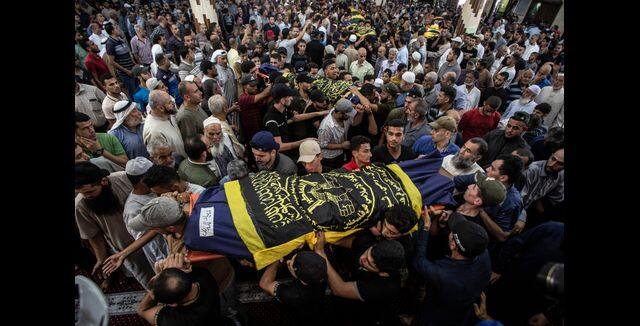 Mourners carry the bodies of Khaled Mansour a senior commander in the Palestinian militant group Islamic Jihad and other Palestinians, who were killed in Israeli airstrikes. AP[/caption]The Gaza Strip is a 365-square-kilometre territory that has been under Israeli control since 1967, along with the other Palestinian territories of the West Bank and East Jerusalem. Over two million Palestinians live in the densely populated territory. Nearly 80 per cent depend on aid to survive.Gaza has been under blockade for 15 years. Israel controls its airspace and territorial waters, along with two of three border crossings (Egypt controls the third). Gaza is often referred to as “the world’s largest open-air prison”.[caption id="attachment_11030231" align="alignnone" width="640"]
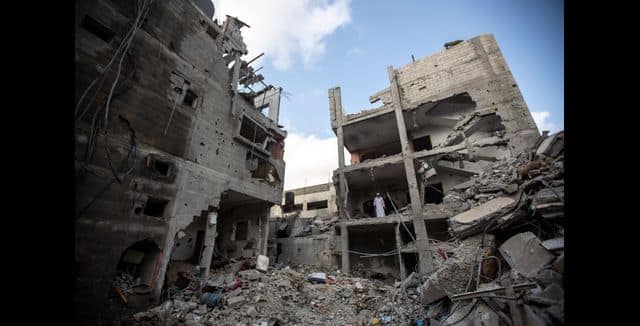 Humanitarian organisations reported the situation as extreme and blamed the Israeli blockade in Gaza for the same. AP[/caption]Humanitarian organisations blame the blockade for the extreme humanitarian crisis in Gaza. Statistics tell a dire story of life in Gaza today:
- around two-thirds of the Palestinian population of Gaza are refugees, with over 500,000 living in eight refugee camps across the Gaza Strip, in some of the highest population densities in the world
- 97 per cent of Gaza’s water is undrinkable, and contaminated water is poisoning people
- people in Gaza receive a daily average of 12 hours of electricity supply and are subject to rolling power cuts
- healthcare services in Gaza are in perpetual crisis, starved of power, vital equipment, staff and essential medicines
- 39 per cent of patients needing specialist care in the West Bank or Israel were denied or delayed permission to leave Gaza by Israel this year
- the unemployment rate is 46.6 per cent, and over 62 per cent for young people
- four in five children in Gaza report living with fear, grief and depression, often manifesting in self-harm
- tens of thousands are displaced within Gaza due to the bombardment and ruin of their homes.
For more than 40 years, the UN Security Council and General Assembly have stated in hundreds of resolutions that Israel’s annexation of occupied territory is unlawful, its construction of hundreds of Jewish settlements are illegal, and its denial of Palestinian self-determination breaches international law. The Council and the Assembly have repeatedly criticised Israel for defying their resolutions. They have threatened consequences. But no accountability has ever followed. If the international community had truly acted on its resolutions 40 or 30 years ago, we would not be talking about apartheid today.Israel’s most powerful ally, the United States, rejects such characterisations. In relation to the most recent warfare, the US ambassador to Israel, Tom Nides, tweeted:British Foreign Secretary Liz Truss echoed this position:There is no sign that the most recent outbreak of warfare has or will alter the status quo. No peace process is operating to find durable solutions to the conflict.Recent years show no trend away from perpetual conflict and entrenchment of positions anathema to a two-state solution for Palestine and Israel.For the people of Gaza, the stalemate becomes increasingly untenable every day.
 Amy Maguire, Associate Professor in Human Rights and International Law, University of NewcastleThis article is republished from The Conversation under a Creative Commons license. Read the original article.Read all the Latest News, Trending News, Cricket News, Bollywood News,India News and Entertainment News here. Follow us on Facebook, Twitter and Instagram.
First Published:Aug 08, 2022, 17:20:27 IST
Advertisement
Advertisement

Military drones & police check-ups: How Sri Lanka is fighting against worst dengue outbreak in a decade
Sri Lanka is fighting its most severe dengue outbreak in nearly a decade, with infections rising sharply across the nation. Military drones have been deployed to tackle the outbreak, which has claimed 56 lives. Health officials said the outbreak is being driven primarily by the DENV-2 variant of the virus
3 min read
How Facebook job ad lured 2 Karnataka men into Myanmar cyber scam camp
The Karnataka Cyber Command has rescued two youths from a scam compound in Myanmar operated by Chinese fraudsters. The duo from Karnataka were lured on the pretext of data-entry jobs. They were asked to work for 16 hours a day and were expected to sleep for six hours daily
4 min read
Why is India seeing 95% cloud cover despite a Super El Niño?
India is witnessing nearly 95 per cent cloud cover despite a Super El Niño, a climate event usually linked to weaker monsoons. Regional weather systems, cyclonic circulations, the monsoon trough and moisture from two seas are temporarily overpowering one of the world's strongest climate phenomena
5 min read
What is CJP’s fourth demand to the government as protests in Delhi intensify?
The protest by the Cockroach Janta Party at Delhi’s Jantar Mantar refuses to die down. The group have made a fourth demand to the Centre, asking that no FIRs are filed against the agitators and that no legal action be taken. The government has expressed willingness to speak to the protesters, but refused to accede on the resignation of Education Minister Dharmandra Pradhan
5 min read
The new geography of war: Why the Houthis can no longer be ignored
The rise of the Houthis marks the emergence of a new geography of war — one in which influence flows not only from capitals and conventional armies, but also from rugged mountains overlooking vital sea lanes
6 min read
Advertisement
Advertisement