
Advertisement


Sections
What will happen if Israel invades Gaza?
Israel is amassing its forces and tanks near the Gaza border for a feared ground invasion. A former Israeli PM has predicted that a ground assault would be ‘everything you can imagine and worse’ for both sides. Here's what awaits the forces once they enter the densely packed enclave

Hamas has called on Palestinians to stay put after the Israeli military ordered 1.1 million civilians living in northern Gaza to evacuate within 24 hours and move south “for their own safety and protection”. The Hamas authority for refugee affairs on Friday (13 October) asked people to “remain steadfast in your homes and to stand firm in the face of this disgusting psychological war waged by the occupation”, reported Associated Press (AP).The United Nations warned the Israeli military’s order for the movement of millions of people to the south in Gaza could lead to “devastating humanitarian consequences". Israel's ambassador to the UN has rejected the global organisation’s concerns.The development comes amid Israel’s much-anticipated ground invasion of the densely packed enclave. Israeli prime minister Benjamin Netanyahu has vowed to “crush and eliminate” Hamas, the militant group ruling Gaza, fuelling speculations of an imminent ground offensive.But, what challenges would Israeli troops face if they do invade Gaza? We explain.Israel amasses troopsIsrael has mobilised 300,000 reservists, the highest in its history, to join the active military force of over 150,000 in its war against Hamas.However, Israel will not be deploying all of its troops to storm Gaza, a narrow strip with a little over 2 million population.As per an Al Jazeera report, these military personnel will be divided into three main roles – an offensive force, a defensive force and an internal security force.[caption id="attachment_13245572" align="alignnone" width="640"]![israel gaza war]() A convoy of Armoured Personnel Carriers (APCs) take up position near Israel's border with the Gaza Strip, in southern Israel, on 13 October.[/caption]Israel is erecting a military base near the Gaza Strip for its millions of soldiers as columns of Israeli tanks are diverted towards the region, according to Bloomberg. Reuters and AP have captured images of Israeli soldiers in military vehicles taking position near the border with the Gaza Strip.Israeli troops last invaded the Gaza Strip in 2014 during Operation Protective Edge, spending 19 days on the ground. The Israel Defence Forces (IDF) had then avoided urban warfare by targeting the outskirts of main towns in Gaza and capturing territory neighbouring the border, reported The Economist.However, experts believe Israel will face the “devastating” challenges of urban warfare this time.“The scope of this is going to be bigger than before and more severe. It’s not going to be clean…We are going to go very, very aggressively against Hamas,” Israel’s military spokesman, Richard Hecht, told reporters on Tuesday morning.As per AFP, Hecht said Thursday (12 October) that the army is ready for combat but were “waiting to see what our political leadership decides about a potential ground incursion”.Challenges for Israeli troopsIt’s going to be a bloody war for both sides.Speaking to Financial Times (FT), former Israeli prime minister Ehud Olmert said that Israeli soldiers will face "everything you can imagine and worse" if the military invades Gaza.He said a ground assault "is not going to be simple and it won’t be pleasant — for us or them", adding that Israeli forces could encounter “new shooters or new types of rockets that are stronger [and] bigger or new anti-tank rockets that we’re not familiar with”.Citing Israeli intelligence estimates, a 2021 New York Times (NYT) report said that Hamas, Islamic Jihad and other Palestinian militant groups have around 30,000 rockets and mortar projectiles stocked in Gaza.Israeli troops are likely to engage in street-to-street fighting in densely populated Gaza, a United States official said."The problem is that it's basically house-to-house fighting once you get into Gaza. And so it could be a heavy price," former US defence secretary and CIA director Leon Panetta told Bloomberg Television.Hamas will try to make the most of urban defence – setting up booby traps, deploying snipers, suicide bombers, and anti-tank weapons and using “low-tech tactics” to counter Israel’s offensive, as per the FT report.Israel, which has the most powerful army in West Asia, has developed some of the most sophisticated urban warfare training in the world, the report added.Another task is to dismantle tunnels in Gaza. The Palestinian militant group has built several hundred kilometres of underground tunnels in the enclave. Dubbed “Gaza Metro”, Hamas uses these tunnels for the secret movement of food, fighters and weapons.“The tunnel network had also deterred Israel from extensive ground operations inside Gaza”, Shimon Arad, a retired IDF colonel, said, as per FT.[caption id="attachment_13245582" align="alignnone" width="640"]
A convoy of Armoured Personnel Carriers (APCs) take up position near Israel's border with the Gaza Strip, in southern Israel, on 13 October.[/caption]Israel is erecting a military base near the Gaza Strip for its millions of soldiers as columns of Israeli tanks are diverted towards the region, according to Bloomberg. Reuters and AP have captured images of Israeli soldiers in military vehicles taking position near the border with the Gaza Strip.Israeli troops last invaded the Gaza Strip in 2014 during Operation Protective Edge, spending 19 days on the ground. The Israel Defence Forces (IDF) had then avoided urban warfare by targeting the outskirts of main towns in Gaza and capturing territory neighbouring the border, reported The Economist.However, experts believe Israel will face the “devastating” challenges of urban warfare this time.“The scope of this is going to be bigger than before and more severe. It’s not going to be clean…We are going to go very, very aggressively against Hamas,” Israel’s military spokesman, Richard Hecht, told reporters on Tuesday morning.As per AFP, Hecht said Thursday (12 October) that the army is ready for combat but were “waiting to see what our political leadership decides about a potential ground incursion”.Challenges for Israeli troopsIt’s going to be a bloody war for both sides.Speaking to Financial Times (FT), former Israeli prime minister Ehud Olmert said that Israeli soldiers will face "everything you can imagine and worse" if the military invades Gaza.He said a ground assault "is not going to be simple and it won’t be pleasant — for us or them", adding that Israeli forces could encounter “new shooters or new types of rockets that are stronger [and] bigger or new anti-tank rockets that we’re not familiar with”.Citing Israeli intelligence estimates, a 2021 New York Times (NYT) report said that Hamas, Islamic Jihad and other Palestinian militant groups have around 30,000 rockets and mortar projectiles stocked in Gaza.Israeli troops are likely to engage in street-to-street fighting in densely populated Gaza, a United States official said."The problem is that it's basically house-to-house fighting once you get into Gaza. And so it could be a heavy price," former US defence secretary and CIA director Leon Panetta told Bloomberg Television.Hamas will try to make the most of urban defence – setting up booby traps, deploying snipers, suicide bombers, and anti-tank weapons and using “low-tech tactics” to counter Israel’s offensive, as per the FT report.Israel, which has the most powerful army in West Asia, has developed some of the most sophisticated urban warfare training in the world, the report added.Another task is to dismantle tunnels in Gaza. The Palestinian militant group has built several hundred kilometres of underground tunnels in the enclave. Dubbed “Gaza Metro”, Hamas uses these tunnels for the secret movement of food, fighters and weapons.“The tunnel network had also deterred Israel from extensive ground operations inside Gaza”, Shimon Arad, a retired IDF colonel, said, as per FT.[caption id="attachment_13245582" align="alignnone" width="640"]![israel hamas war]() Israeli soldiers take position as they are stationed near Israel's border with Gaza in southern Israel, 12 October. Reuters[/caption]A recent review by Nadav Morag, a former Israeli security adviser, found that Israeli forces will have to face mines, ambush sites and mortar targets before they can even reach Hamas’s urban strongholds.If Israel goes ahead with a large-scale operation, “one or two armoured brigades with tanks would probably push 6km west to the coast either north or south of Deir al-Balah, a central city, to cut Gaza in two,” according to The Economist report.Two or three units, consisting of some thousand soldiers each, are likely to target the north, including around Gaza City, the report added.Experts also believe Israel could deploy Sayeret Matkal, an elite special forces unit, for hostage rescue mission, as the Israeli military distracts Hamas with a ground invasion. At least 130 people, including non-Israelis, taken by Hamas militants during their 7 October rampage are reportedly being held captive across Gaza.Israeli troops could also sustain heavy losses during a ground invasion. “I think it’ll (IDF) be willing to inflict a lot of casualties, both to restore deterrence, but also to protect its forces,” Daniel Byman of Georgetown University, told The Economist. Limiting civilian casualties while attacking Hamas targets in Gaza is a critical challenge for Israel. What happens after the potential invasion is also a big question. Israel reoccupying the enclave does not seem to be an option as of now, experts say.The ripple effects of the war are also expected to be felt in West Asia, with fears of it leading to a broader regional conflict.Towns in northern Israel have reportedly been evacuated amid fears of Hezbollah, a Lebanese militant group, participating in the war in case of a ground offensive.Iran’s Supreme Leader Ali Khamenei warned on Tuesday that “the massacre and mass killing of the people of Gaza will bring a greater calamity" on Israel. The US has cautioned Tehran to stay away and also deployed a carrier strike group to the region to deter the West Asian from joining the fray, reported Bloomberg.With inputs from agencies
Israeli soldiers take position as they are stationed near Israel's border with Gaza in southern Israel, 12 October. Reuters[/caption]A recent review by Nadav Morag, a former Israeli security adviser, found that Israeli forces will have to face mines, ambush sites and mortar targets before they can even reach Hamas’s urban strongholds.If Israel goes ahead with a large-scale operation, “one or two armoured brigades with tanks would probably push 6km west to the coast either north or south of Deir al-Balah, a central city, to cut Gaza in two,” according to The Economist report.Two or three units, consisting of some thousand soldiers each, are likely to target the north, including around Gaza City, the report added.Experts also believe Israel could deploy Sayeret Matkal, an elite special forces unit, for hostage rescue mission, as the Israeli military distracts Hamas with a ground invasion. At least 130 people, including non-Israelis, taken by Hamas militants during their 7 October rampage are reportedly being held captive across Gaza.Israeli troops could also sustain heavy losses during a ground invasion. “I think it’ll (IDF) be willing to inflict a lot of casualties, both to restore deterrence, but also to protect its forces,” Daniel Byman of Georgetown University, told The Economist. Limiting civilian casualties while attacking Hamas targets in Gaza is a critical challenge for Israel. What happens after the potential invasion is also a big question. Israel reoccupying the enclave does not seem to be an option as of now, experts say.The ripple effects of the war are also expected to be felt in West Asia, with fears of it leading to a broader regional conflict.Towns in northern Israel have reportedly been evacuated amid fears of Hezbollah, a Lebanese militant group, participating in the war in case of a ground offensive.Iran’s Supreme Leader Ali Khamenei warned on Tuesday that “the massacre and mass killing of the people of Gaza will bring a greater calamity" on Israel. The US has cautioned Tehran to stay away and also deployed a carrier strike group to the region to deter the West Asian from joining the fray, reported Bloomberg.With inputs from agencies
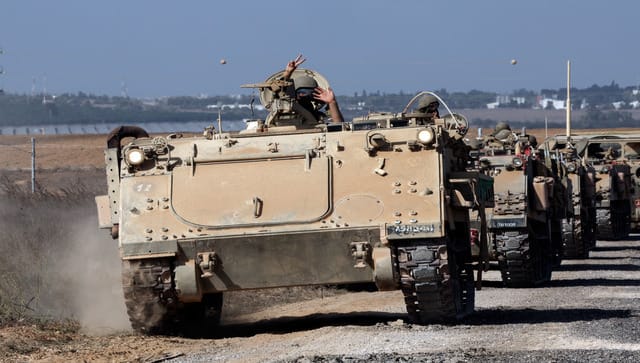 A convoy of Armoured Personnel Carriers (APCs) take up position near Israel's border with the Gaza Strip, in southern Israel, on 13 October.[/caption]Israel is erecting a military base near the Gaza Strip for its millions of soldiers as columns of Israeli tanks are diverted towards the region, according to Bloomberg. Reuters and AP have captured images of Israeli soldiers in military vehicles taking position near the border with the Gaza Strip.Israeli troops last invaded the Gaza Strip in 2014 during Operation Protective Edge, spending 19 days on the ground. The Israel Defence Forces (IDF) had then avoided urban warfare by targeting the outskirts of main towns in Gaza and capturing territory neighbouring the border, reported The Economist.However, experts believe Israel will face the “devastating” challenges of urban warfare this time.“The scope of this is going to be bigger than before and more severe. It’s not going to be clean…We are going to go very, very aggressively against Hamas,” Israel’s military spokesman, Richard Hecht, told reporters on Tuesday morning.As per AFP, Hecht said Thursday (12 October) that the army is ready for combat but were “waiting to see what our political leadership decides about a potential ground incursion”.Challenges for Israeli troopsIt’s going to be a bloody war for both sides.Speaking to Financial Times (FT), former Israeli prime minister Ehud Olmert said that Israeli soldiers will face "everything you can imagine and worse" if the military invades Gaza.He said a ground assault "is not going to be simple and it won’t be pleasant — for us or them", adding that Israeli forces could encounter “new shooters or new types of rockets that are stronger [and] bigger or new anti-tank rockets that we’re not familiar with”.Citing Israeli intelligence estimates, a 2021 New York Times (NYT) report said that Hamas, Islamic Jihad and other Palestinian militant groups have around 30,000 rockets and mortar projectiles stocked in Gaza.Israeli troops are likely to engage in street-to-street fighting in densely populated Gaza, a United States official said."The problem is that it's basically house-to-house fighting once you get into Gaza. And so it could be a heavy price," former US defence secretary and CIA director Leon Panetta told Bloomberg Television.Hamas will try to make the most of urban defence – setting up booby traps, deploying snipers, suicide bombers, and anti-tank weapons and using “low-tech tactics” to counter Israel’s offensive, as per the FT report.Israel, which has the most powerful army in West Asia, has developed some of the most sophisticated urban warfare training in the world, the report added.Another task is to dismantle tunnels in Gaza. The Palestinian militant group has built several hundred kilometres of underground tunnels in the enclave. Dubbed “Gaza Metro”, Hamas uses these tunnels for the secret movement of food, fighters and weapons.“The tunnel network had also deterred Israel from extensive ground operations inside Gaza”, Shimon Arad, a retired IDF colonel, said, as per FT.[caption id="attachment_13245582" align="alignnone" width="640"]
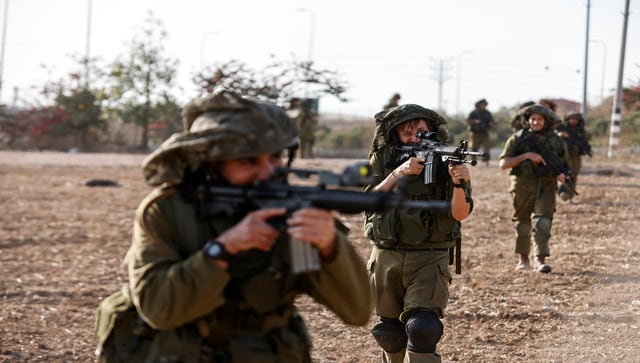 Israeli soldiers take position as they are stationed near Israel's border with Gaza in southern Israel, 12 October. Reuters[/caption]A recent review by Nadav Morag, a former Israeli security adviser, found that Israeli forces will have to face mines, ambush sites and mortar targets before they can even reach Hamas’s urban strongholds.If Israel goes ahead with a large-scale operation, “one or two armoured brigades with tanks would probably push 6km west to the coast either north or south of Deir al-Balah, a central city, to cut Gaza in two,” according to The Economist report.Two or three units, consisting of some thousand soldiers each, are likely to target the north, including around Gaza City, the report added.Experts also believe Israel could deploy Sayeret Matkal, an elite special forces unit, for hostage rescue mission, as the Israeli military distracts Hamas with a ground invasion. At least 130 people, including non-Israelis, taken by Hamas militants during their 7 October rampage are reportedly being held captive across Gaza.Israeli troops could also sustain heavy losses during a ground invasion. “I think it’ll (IDF) be willing to inflict a lot of casualties, both to restore deterrence, but also to protect its forces,” Daniel Byman of Georgetown University, told The Economist. Limiting civilian casualties while attacking Hamas targets in Gaza is a critical challenge for Israel. What happens after the potential invasion is also a big question. Israel reoccupying the enclave does not seem to be an option as of now, experts say.The ripple effects of the war are also expected to be felt in West Asia, with fears of it leading to a broader regional conflict.Towns in northern Israel have reportedly been evacuated amid fears of Hezbollah, a Lebanese militant group, participating in the war in case of a ground offensive.Iran’s Supreme Leader Ali Khamenei warned on Tuesday that “the massacre and mass killing of the people of Gaza will bring a greater calamity" on Israel. The US has cautioned Tehran to stay away and also deployed a carrier strike group to the region to deter the West Asian from joining the fray, reported Bloomberg.With inputs from agencies
First Published:Oct 13, 2023, 17:45:01 IST
Advertisement
Advertisement

Military drones & police check-ups: How Sri Lanka is fighting against worst dengue outbreak in a decade
Sri Lanka is fighting its most severe dengue outbreak in nearly a decade, with infections rising sharply across the nation. Military drones have been deployed to tackle the outbreak, which has claimed 56 lives. Health officials said the outbreak is being driven primarily by the DENV-2 variant of the virus
3 min read
How Facebook job ad lured 2 Karnataka men into Myanmar cyber scam camp
The Karnataka Cyber Command has rescued two youths from a scam compound in Myanmar operated by Chinese fraudsters. The duo from Karnataka were lured on the pretext of data-entry jobs. They were asked to work for 16 hours a day and were expected to sleep for six hours daily
4 min read
Why is India seeing 95% cloud cover despite a Super El Niño?
India is witnessing nearly 95 per cent cloud cover despite a Super El Niño, a climate event usually linked to weaker monsoons. Regional weather systems, cyclonic circulations, the monsoon trough and moisture from two seas are temporarily overpowering one of the world's strongest climate phenomena
5 min read
What is CJP’s fourth demand to the government as protests in Delhi intensify?
The protest by the Cockroach Janta Party at Delhi’s Jantar Mantar refuses to die down. The group have made a fourth demand to the Centre, asking that no FIRs are filed against the agitators and that no legal action be taken. The government has expressed willingness to speak to the protesters, but refused to accede on the resignation of Education Minister Dharmandra Pradhan
5 min read
The new geography of war: Why the Houthis can no longer be ignored
The rise of the Houthis marks the emergence of a new geography of war — one in which influence flows not only from capitals and conventional armies, but also from rugged mountains overlooking vital sea lanes
6 min read
Advertisement
Advertisement