


5 months and counting… How many US soldiers have died in the Iran war?
The US death toll in the Iran war continues to climb. Over the weekend, three more American soldiers died after Tehran struck Jordan and Iraq, taking the total number to 17. Earlier, six troops were killed in Kuwait when the Islamic Republic struck a civilian port, and another six died after a KC-135 refuelling aircraft crashed amid operations

“It’s a very sad thing. We hate to see it happen. They were in the service of our country. And they, every one of them, will never allow, they’ll fight to the death. But never allowing Iran to have a nuclear weapon,” said Donald Trump, reacting to the death of US soldiers amid the Iran war.
The Trump administration has now ramped up its attacks against the Islamic Republic, with the US president noting that the latest strikes on Sunday were carried out in honour of US service members killed in recent days.
“We hit them very hard again tonight, and we did that in honour of the, probably three, it’s probably three great patriots,” Trump told reporters after returning to Washington from the FIFA World Cup final.
 More from Explainers
With the most recent deaths reported on the weekend, the toll of US soldiers has gone up to 17, highlighting that the US troops don’t need to be on the ground to face risks in a conflict that involves drones, missiles, and airplanes.
Read the latest updates from the US-Iran war here
It has also ramped up pressure on Trump, with many asking — how many more US lives will need to be sacrificed for the war with Tehran to end?
US soldiers killed in Iraq and Jordan
The latest US casualties came over the weekend, with deaths reported in northern Iraq and Jordan.
The US Central Command (Centcom) stated that a soldier died during “a controlled detonation of unexploded ordnance” from a downed Iranian drone in Iraq. In a statement posted on X, the US military said, “A US service member in northern Iraq was killed in action on July 18 during a controlled detonation of unexploded ordnance from a downed Iranian one-way attack drone.”
A second US service member was also wounded in the incident and is continuing to receive medical treatment for what officials described as a minor injury.
The death in Iraq follows the killing of two American service members in Jordan, who died while defending against a barrage of Iranian ballistic missiles and drones.
Centcom stated that two US troops were killed in Jordan on July 17 after Iranian ballistic missile and drone attacks struck US and partner forces in Jordan. It added that a third soldier was missing after the attack.
On Sunday, the US said military personnel found remains at the site of Friday’s attack in Jordan. Officials said an examination is underway to determine whether they belong to the missing service member.
Four additional American service members were medically evacuated to hospitals in Jordan but have since been discharged, while other personnel treated for minor injuries have returned to duty.
Until now, the identity of the victims hasn’t been revealed. US leaders mourned the loss of the soldiers. “Godspeed, heroes. Their sacrifice only stiffens our resolve,” said US Defence Secretary Pete Hegseth. Meanwhile, US Secretary of State Marco Rubio said, “Our hearts go out to these families. These are heroes who pay the ultimate price.”
US death toll keeps mounting
The death of the US troops over the weekend takes the toll of the total number of American military personnel killed to 17 since the war began on February 28.
The first US — six of them — came shortly after the war began when an Iranian drone hit a civilian port, Shuaiba, in Kuwait. The soldiers were part of a supply and logistics unit based in Iowa, working in a shipping-container-style building with no defences.
The six were later identified as Sergeant Declan Coady, 20; Sgt 1st Class Nicole Amor, 39; Captain Cody Khork, 35; Sgt 1st Class Noah Tietjens, 42; Chief Warrant Officer 3 Robert Marzan, 54, and Major Jeffrey O’Brien, 45.
Days later, another US soldier died from the injuries he incurred during a March 1 strike on Prince Sultan Air Base, Saudi Arabia.
As the war escalated in March, another six US service members were killed when a KC-135 refuelling aircraft supporting military operations against Iran crashed in Iraq. The Pentagon said those on board the KC-135 plane were: John Klinner, 33, from Alabama, 31-year-old Ariana Savino from Washington, Ashley Pruitt, 34, from Kentucky, 38-year-old Seth Koval from Indiana, and Ohio natives Curtis Angst, 30, and Tyler Simmons, 28.

According to the US military, neither hostile nor friendly fire was involved in the loss of the plane. The aircraft had been on a combat mission when it went down over western Iraq and was one of two planes involved in the incident. The second landed safely.
However, the Islamic Resistance of Iraq, an umbrella group of factions loyal to Iran, claimed responsibility for downing the aircraft, adding that it targeted a second KC-135, forcing it to make an emergency landing. The group did not provide evidence for its claims.
Another soldier, a US Navy helicopter pilot, also died in a helicopter crash in the Arabian Sea. The Navy initially described the July 1 crash as an emergency landing and said there was “no indication the emergency was caused by hostile action.”
US-Iran fighting is spinning out of control
In recent days, the conflict between the US and Iran has escalated with Washington targeting sites within Iran while Tehran strikes back at US allies and military assets in the West Asia region.
The US military said it struck a range of targets in its latest round of bombing overnight Sunday into Monday. Explosions were reported across Iran early Monday, including in coastal port cities on the Gulf of Oman and the Persian Gulf. Explosions were also reported in the northwestern city of Tabriz for the first time in the past nine days, according to state media.
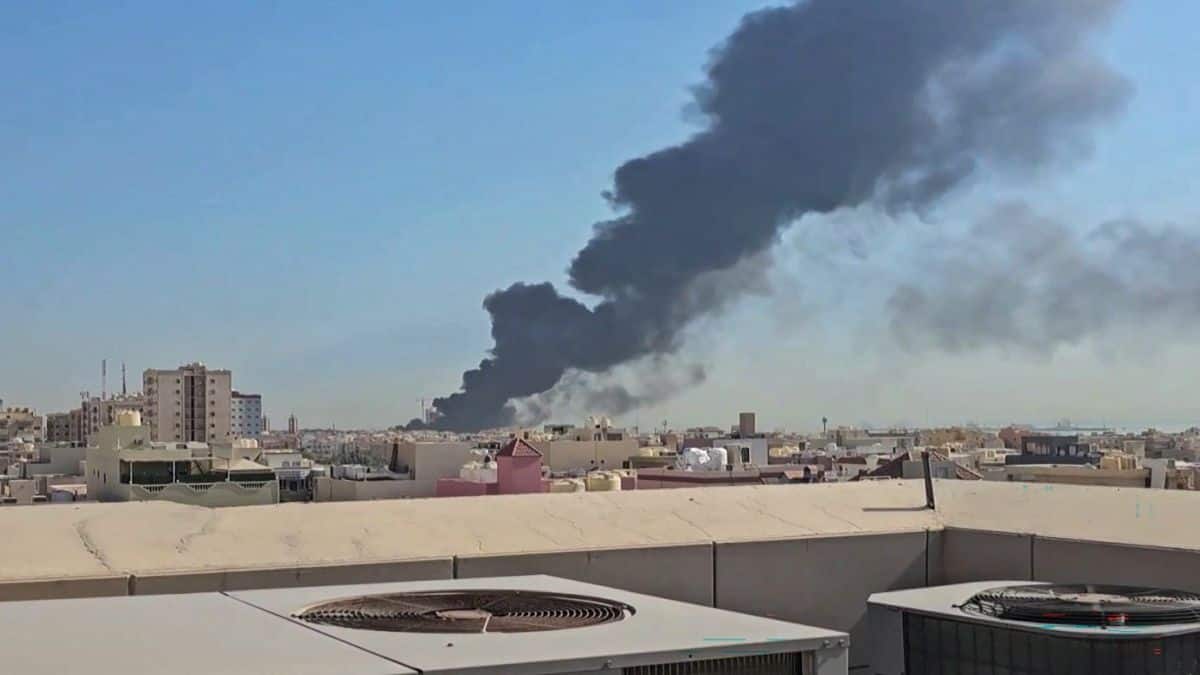
In turn, Iran has launched a barrage of missiles at “enemy targets” on Monday. The US Embassy in Bahrain has issued an advisory, asking Americans to be alert. It comes after Tehran attacked a power and desalination plant in Kuwait on Sunday, and Jordan and Bahrain reported intercepting Iranian strikes.
Additionally, Iran’s Revolutionary Guards said that two oil tankers trying to transit the strait “exploded and were brought to a halt”, according to a statement reported by the Tasnim news agency.
The UK Maritime Trade Operations agency said that a vessel was on fire in the strait, citing information from military authorities. The fire’s cause has not been verified.
US Secretary of State Marco Rubio said America remained open to diplomacy with Iran, but that “even within their own system, there’s a growing split.”
“They continue to send signals that they want to talk, that they want to negotiate,” he said. “But their behaviour is what we’re responding to, and their behaviour is they’re launching missiles and drones against ships, including tonight.”
“Their behaviour has to change in order for ours to change,” Rubio added.
With inputs from agencies

Military drones & police check-ups: How Sri Lanka is fighting against worst dengue outbreak in a decade
How Facebook job ad lured 2 Karnataka men into Myanmar cyber scam camp
Why is India seeing 95% cloud cover despite a Super El Niño?
What is CJP’s fourth demand to the government as protests in Delhi intensify?
The new geography of war: Why the Houthis can no longer be ignored