


INS Mahendragiri joins Indian Navy: What makes the indigenous stealth frigate special?
The Indian Navy has commissioned INS Mahendragiri, the sixth and final Project 17A stealth frigate, strengthening India’s maritime capabilities in the Indo-Pacific. Built with over 75 per cent indigenous content, the warship enhances air, surface and submarine warfare readiness while reinforcing the Aatmanirbhar Bharat and Make in India defence initiatives

The Indian Navy officially inducted its sixth Project 17A stealth frigate, INS Mahendragiri (F38), into the Eastern Fleet on Saturday (July 11, 2026).
The commissioning ceremony, held at the Naval Dockyard in Visakhapatnam, was presided over by Defence Minister Rajnath Singh, marking the culmination of years of intensive indigenous design and manufacturing efforts.
With the arrival of Mahendragiri, the Indian Navy has significantly bolstered its operational footprint in the Indian Ocean Region (IOR), signalling a robust, technology-driven evolution in the country’s naval doctrine.
The induction of Mahendragiri, the final vessel of the current Project 17A series, is being hailed as a watershed moment for the Aatmanirbhar Bharat (Self-Reliant India) initiative rather than just a military acquisition.
 More from Explainers
A strategic asset for the Indo-Pacific
The commissioning of INS Mahendragiri comes at a time of shifting geopolitical gravity in the Indo-Pacific. As the Indian Navy seeks to cement its status as the "Preferred Security Partner" in the region, the need for multi-role, blue-water capable platforms has never been greater.
INS Mahendragiri is engineered for the high-end spectrum of maritime warfare. Its primary directive is to serve as a versatile asset capable of dominating the sea, air, and underwater domains.
Whether tasked with anti-piracy patrols in the Gulf of Aden, maritime surveillance in the South China Sea, or acting as the centerpiece of a carrier strike group, the frigate’s architecture is defined by one core attribute which is versatility.
During the commissioning address, Singh highlighted the strategic necessity of this platform:
“India is a net security provider and a trusted partner dedicated to ensuring security and development across the region,” said Singh, while praising the Indian Navy for consistently demonstrating this commitment through its role in HADR [Humanitarian Assistance and Disaster Relief] operations, anti-piracy missions and the evacuation of Indian and foreign nationals from crisis-hit areas.
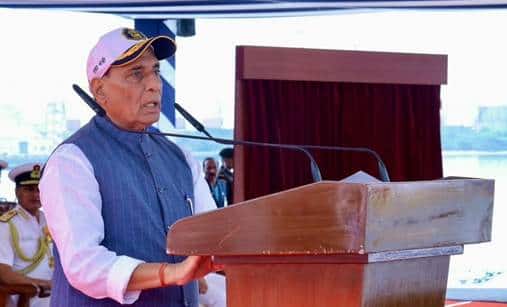
The Indian Navy has earned the recognition as both a First Responder and a Preferred Security Partner in the Indo-Pacific through its timely and effective operational response, he added.
Engineering the "Nilgiri-class" advantage
INS Mahendragiri is the latest iteration of the Nilgiri-class frigates. Designed by the Indian Navy’s Warship Design Bureau (WDB) and constructed by Mazagon Dock Shipbuilders Limited (MDL) in Mumbai, the ship represents a leap in modular ship construction techniques.
By utilising integrated modular construction, where structural blocks were built, outfitted, and tested independently before being welded together in the dry dock, the shipyard significantly reduced the time from keel-laying to commissioning — a vital metric for future naval expansion.
Technical specifications at a glance:
| Metric | Specification |
| Class | Nilgiri-class (Project 17A) |
| Displacement | ~6,670 tonnes |
| Length | 149 metres |
| Beam (width) | 17.8 metres |
| Propulsion | CODOG (2x GE LM2500+ Turbines, 2x MAN Diesel Engines) |
| Max Speed | 28-32 knots |
| Crew | 226 (35 Officers, 191 Sailors) |
| Indigenous Content | > 75% |
The propulsion system is a hybrid marvel. It uses a Combined Diesel or Gas (CODOG) configuration. For long-endurance, economical "blue-water" cruising, the ship relies on two powerful MAN Diesel engines.
When the situation demands high-speed intercept or combat manoeuvres, the vessel switches to two General Electric LM2500+ gas turbines, providing the surge capacity required to outmanoeuvre threats or quickly transit between theatres of operation.
A lethal sensor and weaponry suite
The true capability of INS Mahendragiri lies in its "Combat Management System" (CMS-17A), which acts as the digital nervous system of the ship.
It integrates a labyrinth of data streams from radar, sonar, and electronic support measures into a single tactical picture, allowing the command team to make split-second decisions.
The ship is built to control the air-sea interface. The primary air-defence shield consists of 32 Barak-8 Long-Range Surface-to-Air Missiles (LR-SAM), housed in four 8-cell Vertical Launch Systems (VLS).
These missiles, with a range of approximately 100 km, create a protective bubble around the ship and any assets it is escorting, capable of neutralising supersonic anti-ship missiles, fighter jets, and drones.
For surface warfare, Mahendragiri carries 8 BrahMos supersonic cruise missiles. Widely considered one of the fastest and most reliable anti-ship missiles in the world, the BrahMos gives Mahendragiri "stand-off" capability — the ability to engage targets well beyond the reach of traditional naval guns.
Stealth on a surface combatant is not about making the ship invisible, it is about making it hard to classify. Mahendragiri employs "clean lines" and radar-absorbent materials (RAM) to minimize its Radar Cross Section (RCS).
Its mast design specifically integrates electronic sensors to reduce "blooming" on enemy radar screens.
The ship also utilises fluid injection and Venturi-effect cooling in its exhaust systems, drastically reducing its infrared signature to counter modern heat-seeking missile guidance systems.
The industrial triumph of Aatmanirbhar Bharat
The commissioning of INS Mahendragiri is more than a naval event — it is an economic milestone. The "75% indigenous content" figure is not merely a number, it represents a massive, sprawling network of Indian industries, including over 200 Micro, Small, and Medium Enterprises (MSMEs).
From the high-tensile steel supplied by the Steel Authority of India (SAIL) to the complex combat management software developed by the Defence Research and Development Organisation (DRDO), the supply chain for this ship is almost entirely domestic.
For the Indian government, this project validates the "Make in India" defence strategy. By creating a consistent pipeline of orders for frigates, the Navy has provided the stability required for shipyards like MDL and GRSE to invest in advanced infrastructure, robotics, and skilled labour.
This "industrial ecosystem" is now the backbone of India’s capability to produce ships at a pace that keeps up with the rapid modernisation of peer competitors in the region.
What challenges lay ahead
Despite celebratory commissioning, analysts and the Comptroller and Auditor General (CAG) have previously noted the challenges inherent in such a rapid industrial scale-up.
Previous Project 17A vessels faced delays in the integration of high-end sensors and specialised propulsion components — many of which, despite the "indigenous" tag, still rely on a complex global supply chain for raw materials and sub-components.
The Indian Navy’s next step is Project 17B, which is currently moving through the planning and request-for-proposal stages. This successor class is expected to be even more advanced, incorporating directed-energy weapons (lasers) and AI-driven data processing.
The success of Mahendragiri serves as a blueprint for Project 17B. It proves that India can successfully integrate disparate indigenous systems into a cohesive, lethal platform.
As Admiral Krishna Swaminathan, Chief of the Naval Staff added that alongside achieving the indigenous content, MDL and the Navy have set several new benchmarks in this project, including reduction of the timeframe from launch to delivery by approximately 50 per cent, dropping from 63 months to 31 months.
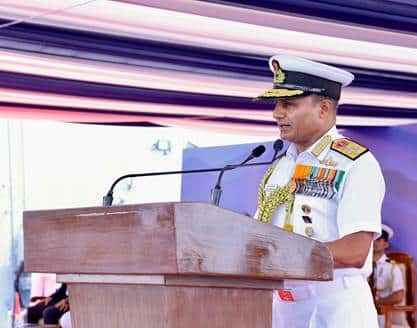
He also stated that the total construction time has decreased by approximately 20 per cent, falling from 95 months to 75 months, and all technical analyses have been completed in just a single sea trial instead of the usual five to seven sea trials.
These achievements, he said, reflect the collaborative efforts of MDL, Indian manufacturers, MSMEs, the Warship Overseeing Team, trial agencies, and the crew.
Life aboard Mahendragiri
While technology and steel grab the headlines, the soul of INS Mahendragiri is its crew of 226 sailors and officers. Being the first ship to bear this name means the crew does not have a "battle honour" legacy to inherit, they must create it.
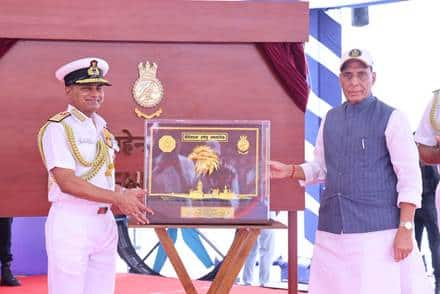
The commissioning ceremony involved the traditional "unveiling of the plaque," a moment where the ship’s name — derived from the majestic Mahendragiri mountain range in the Eastern Ghats of Odisha — was etched into the naval register forever.
For the commissioning crew, this is a distinct privilege. They are the architects of the ship’s culture, setting the standards for damage control, watch-keeping, and operational discipline that will define the ship for the next thirty years.
In the words of the ship's motto, “Sthitpragyah, Raneshu, Aprajitah” (Steadfast, Wisdom, and Invincible in Battle), the crew now begins their work. As they sail out from Visakhapatnam into the Bay of Bengal, they carry the weight of a nation’s maritime ambitions.
Key capabilities summary:
- Anti-air: 32 Barak-8 VLS cells (100 km range).
- Anti-surface: 8 BrahMos Supersonic Cruise Missiles.
- Anti-submarine: HUMSA-NG Active Sonar, Torpedoes, RBU-6000 Rocket Launchers.
- Electronic warfare: DRDO "Shakti" Suite (ESM/ECM/RFPS).
- Aviation: Hangar capacity for HAL Dhruv or Sea King Mk.42B helicopters.
With INS Mahendragiri fully integrated, the Eastern Fleet enters a new chapter of operational readiness. The ship is prepared to serve as a floating embassy, a guardian of trade routes, and, when called upon, an invincible instrument of national defence.
With inputs from agencies
Inhaling global affairs daily, Anmol covers foreign policy & defence with the occasional piece in lifestyle and the thrilling sport of polo, to keep things light when they get too tense. He has far too many disparate interests with a constant itch for travel. You can follow him on X (AnmolSingla001); and please feel free to reach out to him at anmol.singla@nw18.com for interviews, tips, feedback or travel recommendations.

Military drones & police check-ups: How Sri Lanka is fighting against worst dengue outbreak in a decade
How Facebook job ad lured 2 Karnataka men into Myanmar cyber scam camp
Why is India seeing 95% cloud cover despite a Super El Niño?
What is CJP’s fourth demand to the government as protests in Delhi intensify?
The new geography of war: Why the Houthis can no longer be ignored