


India's Aditya-L1 and other nations racing to Sun
As Indian Space Research Organisation is set to launch its solar mission Aditya-L1 on 2 September, following are some important missions launched by space agencies of different countries exploring the Sun

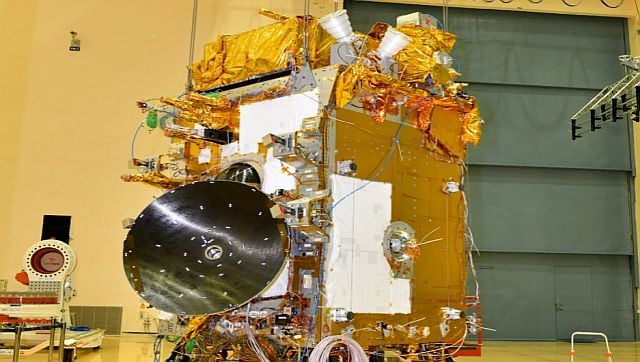
Aditya-L1 spacecraft is designed to provide remote observations of the solar corona and in-situ observations of the solar wind at L1 (Sun-Earth Lagrange point), which is about 1.5 million kilometres from the Earth. Image Courtesy: ISRO/Twitter[/caption]Other active solar missions by NASA are Advanced Composition Explorer launched in August, 1997; Solar Terrestrial Relations Observatory in October, 2006; Solar Dynamics Observatory in February, 2010; and Interface Region Imaging Spectrograph launched in June, 2013.Also, in December, 1995, NASA, ESA and JAXA (Japan Aerospace Exploration Agency) jointly launched the Solar and Heliospheric Observatory (SOHO).Japan: JAXA, the Japan's space agency, launched its first solar observation satellite, Hinotori (ASTRO-A), in 1981. The objective was to study solar flares using hard X-rays, according to JAXA's official website.JAXA's other solar exploratory missions are Yohkoh (SOLAR-A) launched in 1991; SOHO (along with NASA and ESA) in 1995; and Transient Region and Coronal Explorer (TRACE), along with NASA, in 1998.In 2006, Hinode (SOLAR-B) was launched, which was the successor to Yohkoh (SOLAR-A), the orbiting solar observatory. Japan launched it in collaboration with the US and the UK. The objective of Hinode, an observatory satellite, is to study the impact of the Sun on the Earth.Europe: In October, 1990, the ESA launched Ulysses to study the environment of space above and below the poles of the Sun. Other than solar missions launched in collaboration with the NASA and the JAXA, the ESA launched Proba-2 in October, 2001. Proba-2 is the second of the Proba series, building on nearly eight years of successful Proba-1 experience, even as Proba-1 was not a solar exploratory mission.On-Board Proba-2 were four experiments, two of them were solar observation experiments.Proba stands for Project for On-Board Autonomy. Upcoming solar missions of the ESA include Proba-3, scheduled for 2024 and Smile, scheduled for 2025.China: The Advanced Space-based Solar Observatory (ASO-S) was successfully launched by National Space Science Centre, Chinese Academy of Sciences (CAS), on 8 October, 2022.With inputs from PTI

Military drones & police check-ups: How Sri Lanka is fighting against worst dengue outbreak in a decade
How Facebook job ad lured 2 Karnataka men into Myanmar cyber scam camp
Why is India seeing 95% cloud cover despite a Super El Niño?
What is CJP’s fourth demand to the government as protests in Delhi intensify?
The new geography of war: Why the Houthis can no longer be ignored