


Alaknanda: How Indian astronomers found a Milky Way-like galaxy
Indian astronomers have identified a surprisingly mature, Milky Way-like galaxy from the universe’s early era. Named Alaknanda, the spiral system — visible thanks to the James Webb Space Telescope and gravitational lensing — formed just 1.5 billion years after the Big Bang. Its structure challenges long-standing theories about when well-organised galaxies first emerged

Astronomers in India have identified a remarkably mature galaxy from the universe’s early history, one that mirrors the Milky Way so closely that it is now considered one of the most significant detections yet made with the James Webb Space Telescope (JWST).
The galaxy, which they named Alaknanda, displays a spiral structure so clear and symmetrical that it challenges long-held assumptions about how quickly ordered galaxies could have formed after the Big Bang.
The finding, made by Rashi Jain and Professor Yogesh Wadadekar at the National Centre for Radio Astrophysics of the Tata Institute of Fundamental Research (NCRA-TIFR) in Pune, has been published in Astronomy & Astrophysics, a leading European academic journal.
Alaknanda dates back to a period when the universe was barely a tenth of its current age.
 More from Explainers
This era — roughly 1.5 billion years after the Big Bang — is ordinarily associated with chaotic, irregular, or clumpy galaxies still undergoing early assembly.
Instead, this galaxy exhibits a shape, symmetry and disk-like organisation typically attributed to systems that have evolved quietly for billions of years.
Why discovery of Alaknanda is special
The most striking feature of the discovery is Alaknanda’s architecture. It stretches across about 30,000 light-years, forming a recognisable pattern of two grand, sweeping spiral arms encircling a prominent central bulge.
Such structure is a textbook example of a grand-design spiral galaxy, the same class to which the Milky Way belongs.
In the standard view of cosmic evolution, such well-defined spirals are not expected so soon after the universe’s birth.
Early systems typically endure intense gravitational interactions, rapid star formation, and turbulent gas flows, which make it difficult for them to settle into stable, rotating disks.
Addressing the announcement, Wadadekar said, "This galaxy looks like a regular, well-structured system."
Jain, the lead researcher on the study, echoed this observation, saying, "The galaxy looks remarkably similar to our own Milky Way despite being present when the universe was only 10 per cent of its current age."
These characteristics run counter to older theoretical models that projected that spiral disks only emerge after galaxies have undergone extensive evolution over several billion years.
In those models, it should have taken substantial time for gas to cool, smoothen, and settle enough to generate the classic spirals seen in the nearby universe.
Yet Alaknanda, observed at a staggering 12 billion light-years from Earth, had already developed a coherent disk and arms.
Why the name 'Alaknanda'
Jain explained that the team chose the name because of its association with the Milky Way’s Hindi name.
As she put it, "Just as the Alaknanda is the sister river of the Mandakini river, which is also the Hindi name for our own Milky Way galaxy, we thought it fitting to name this distant spiral galaxy after the Alaknanda river."
This analogy extends beyond the name, since the newly found galaxy mirrors the Milky Way not only in general appearance but also in the clarity of its spiral formation — an uncommon attribute for such a distant, ancient system.
How JWST’s deep-field imaging was key to discovering Alaknanda
The discovery was made possible through the unique capabilities of the James Webb Space Telescope, which detects faint, distant light from the early universe more effectively than any instrument before it.
For this particular observation, JWST’s imaging was boosted by a natural cosmic effect: gravitational lensing.
Alaknanda lies behind Abell 2744 — popularly referred to as Pandora’s Cluster — whose gravitational field acts as a magnifier.
Massive galaxy clusters like Abell 2744 bend the light of objects in the background, enlarging them and enhancing their brightness. This phenomenon allowed Alaknanda’s spiral structure to be visible in greater detail than it would have been under normal circumstances.
Jain and Wadadekar interpreted images taken through as many as 21 different filters, which isolated different wavelengths of light and made it possible to derive precise information about the galaxy’s properties.
These observations were part of JWST’s major UNCOVER and MegaScience surveys — deep data-collection programmes focused on studying faint galactic populations.
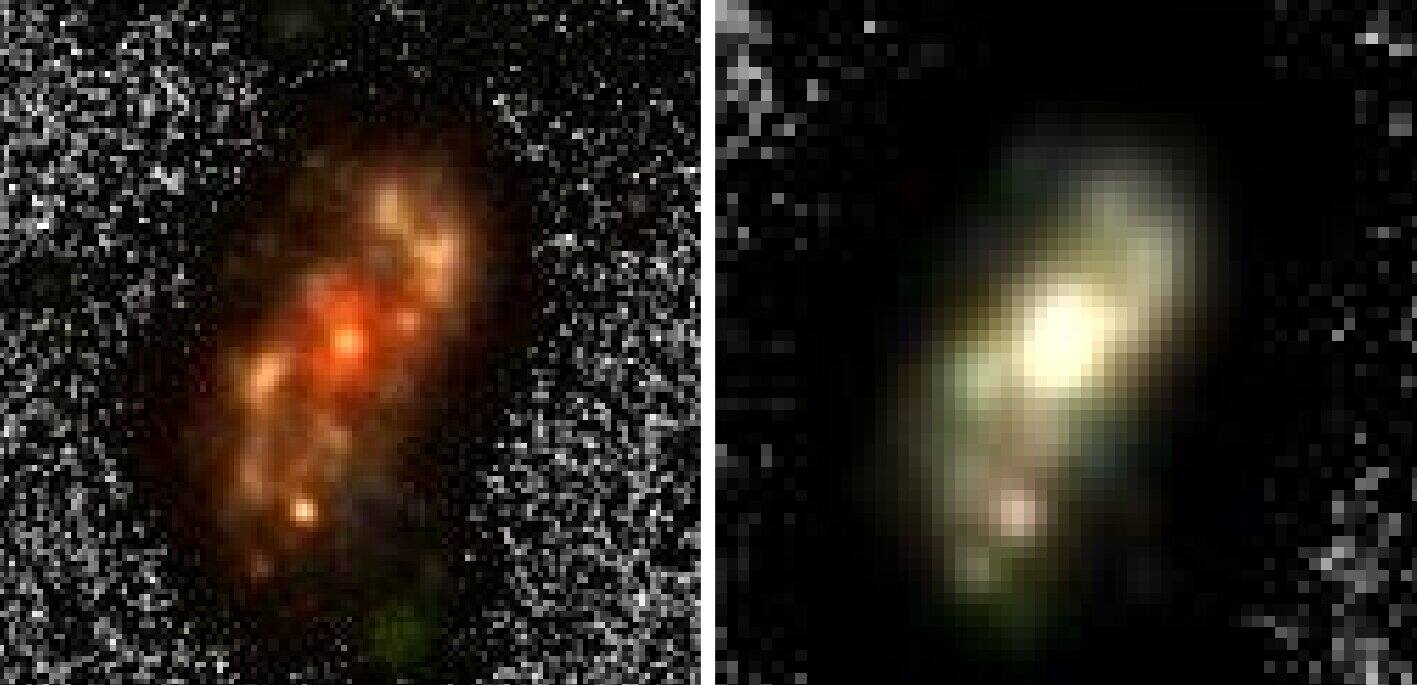
Figure 1: Left panel: Image of Alaknanda in rest-frame near-ultraviolet filters. The star-forming
regions in the spiral arms form a beads-on-a-string pattern, characteristic of UV emission from
massive stars in star-forming regions. Right panel: Alaknanda as seen in rest-frame optical
filters. The spiral arms are less prominent and the underlying disk is clearly seen.
Through the filtered observations, the researchers determined the galaxy’s stellar mass, dust content, distance, and star-formation rate with unusually high accuracy.
The findings revealed that Alaknanda’s stars collectively add up to about ten billion times the mass of the Sun — an exceptionally large value for a galaxy so early in the universe.
The team also found that the galaxy is producing new stars at a rate equivalent to nearly 60 solar masses per year.
This figure is about 20 times the star-formation rate of the Milky Way today. Half of its stars appear to have formed in about 200 million years, an extraordinarily brief span by cosmic standards.
Jain highlighted the implications, stating, "Finding such a well-formed spiral galaxy at this early epoch is quite unexpected. It tells us that sophisticated structures were being built in our universe much earlier than we thought possible."
Why this discovery challenges conventional timelines
Astronomers generally believed that spiral galaxies require at least three billion years to attain stable, long-term structures. This timeline was based on models that proposed that the gas within young galaxies is too hot and turbulent to settle into disks quickly.
Spirals, especially the symmetric kind seen in the Milky Way, supposedly demanded long periods of gradual growth.
Yet Alaknanda defies these expectations.
It shows that some galaxies could assemble rapidly, forming large, organized spiral disks in a few hundred million years instead of several billion.
Wadadekar explained the significance of this accelerated timeline, stating, "Alaknanda reveals that the early Universe was capable of far more rapid galaxy assembly than we anticipated."
He added that “somehow, this galaxy managed to pull together ten billion solar masses of stars and organise them into a beautiful spiral disk in just a few hundred million years.”
The research team did not attribute the spiral arms to any single mechanism in their published analysis. However, established explanations in astrophysics include two possibilities for how such spirals might appear:
- gradual accretion of cold gas from surrounding space, which can create density variations that lead to arm formation, and
- gravitational interactions with smaller companion galaxies, which can temporarily trigger spiral patterns.
The researchers did not speculate on these hypotheses in their press statements.
What next
Although the primary focus of the study was to document the galaxy’s basic characteristics, the discovery naturally leads to questions about how such early spirals evolved.
Determining whether Alaknanda’s disk rotates in an orderly manner or whether it is more turbulent will require additional spectroscopic studies.
Future observations with JWST’s spectroscopic instruments or with the Atacama Large Millimeter Array (ALMA) in Chile may reveal details about the galaxy’s internal motions.
Those data could confirm whether Alaknanda possesses a dynamically “cold” disk — one with smooth, coherent rotation — or a “hot” disk featuring significant internal turbulence.
Such follow-up investigations are essential for refining the understanding of how early spirals reached advanced evolutionary stages.
Also Watch:
With inputs from agencies

Military drones & police check-ups: How Sri Lanka is fighting against worst dengue outbreak in a decade
How Facebook job ad lured 2 Karnataka men into Myanmar cyber scam camp
Why is India seeing 95% cloud cover despite a Super El Niño?
What is CJP’s fourth demand to the government as protests in Delhi intensify?
The new geography of war: Why the Houthis can no longer be ignored