


PM Modi flags off India’s first hydrogen train: What makes it so special?
PM Narendra Modi flagged off India’s first hydrogen train, travelling from Haryana’s Jind to Sonipat. With this, the country joins an elite club of nations who possess this technology. The Indian train, with 10 cars, boasts of being one of the longest and also most powerful in the world

Today (July 17) is a big, big day for India. Today, the country joins an elite club of nations as Prime Minister Narendra Modi flags off the nation’s first-ever hydrogen train from Haryana’s Jind station. The only other countries that are exploring hydrogen power for rail transportation are Germany, Japan, China, and the United States.
With the new hydrogen-powered train, the Indian Railways is taking a bold move to replace traditional diesel engines with cutting-edge technology that emits nothing but water vapour.
As India celebrates this momentous occasion, let’s understand what a hydrogen train is and why India is betting on it.
 More from Explainers
What are hydrogen-powered trains?
In the most basic terms, a hydrogen train is one that uses hydrogen as a fuel, either within a hydrogen internal combustion engine or through a reaction with oxygen within a hydrogen fuel cell.
Conventional trains draw power from overhead lines. However, a hydrogen train generates electricity onboard through a chemical reaction between hydrogen and oxygen, with water vapour as its only by-product.
Hydrogen stored in the train’s cylinders combines with oxygen from the surrounding air inside the fuel cell, producing electricity that powers the traction motors and turns the wheels. The only direct by-products of this electrochemical reaction are water vapour and heat. There is no combustion, no smoke, and no tailpipe carbon emissions.
According to experts, hydrogen trains are useful on routes where electrification is either expensive or difficult to implement. Instead of building extensive overhead electric infrastructure, railways can use hydrogen-powered systems to run cleaner trains on existing tracks.
What sets India’s hydrogen train apart from the rest?
There are many reasons why India’s hydrogen train is special.
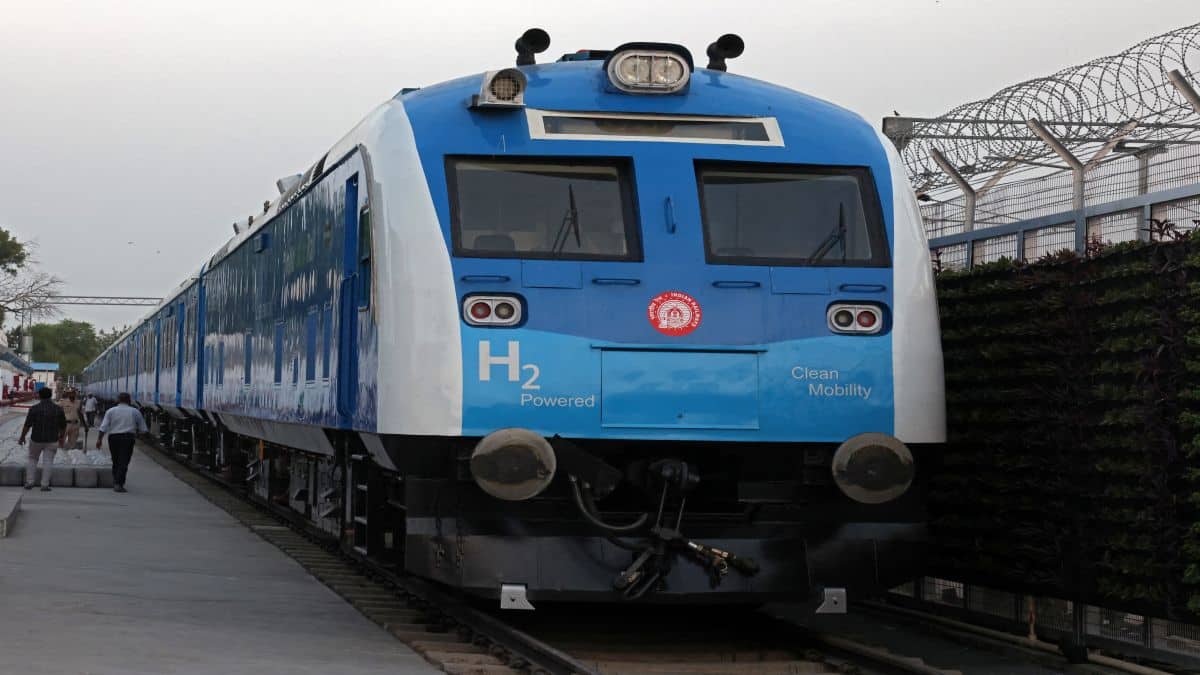
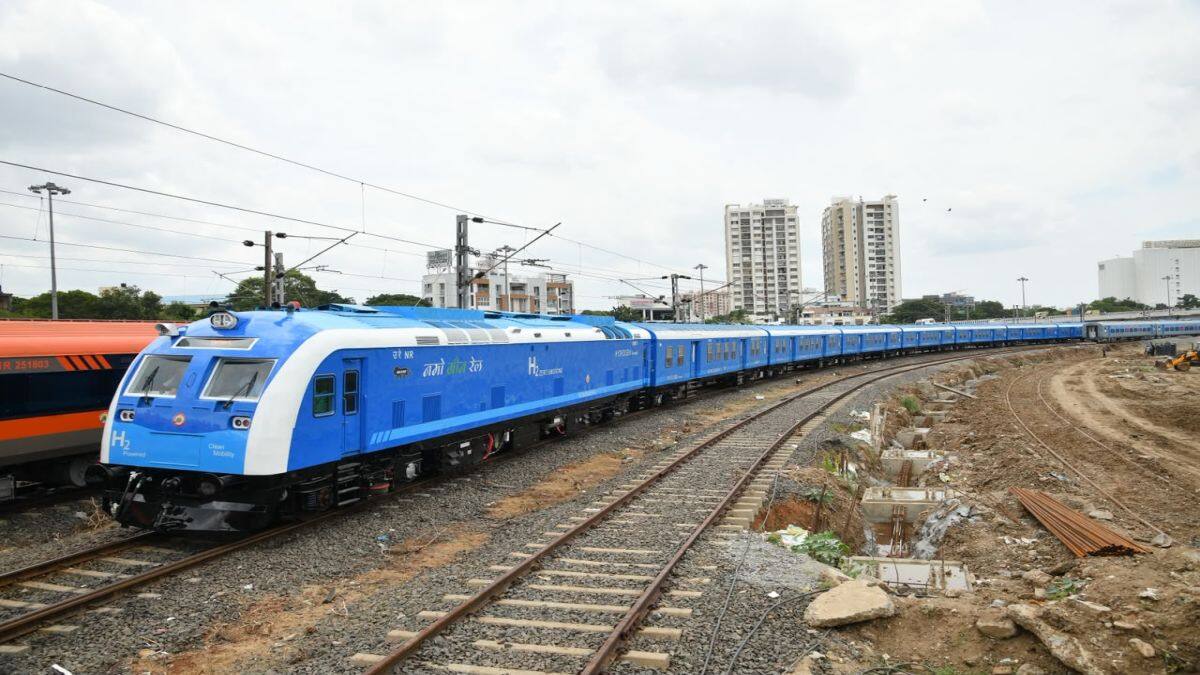
Firstly, the Indian Railways has noted that this is one of the world’s longest — it consists of eight passenger cars and two driving power cars — and most powerful (2400 kilowatt) hydrogen trainsets.
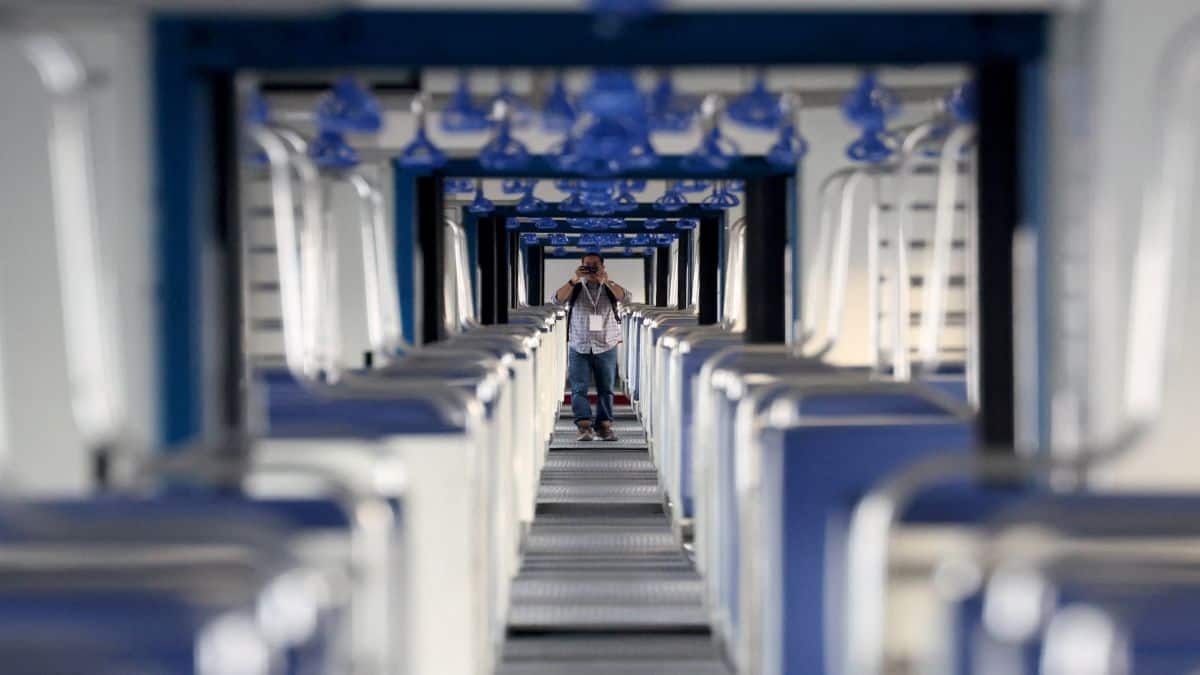
It has the capacity to accommodate 682 passengers and will travel across 89 kilometres between Jind and Sonipat in Haryana. The hydrogen-powered train will also have an operational speed of 75 km/h, which can go up to as high as 120 km/h. The Railways have said that it will make two round trips a day, covering 356 km and consuming an estimated 300 kg of hydrogen.
In comparison, most hydrogen trains have only two to four coaches and primarily serve short regional routes. In fact, the first time the technology was presented in 2016, the train set had only two cars.
More notably, this train has been built and designed fully in India, demonstrating the vision of Atmanirbhar Bharat. It has been developed in accordance with design approval and technical specifications prepared by the Research, Design & Standards Organisation (RDSO), with Union Minister for Railways Ashwini Vaishnaw saying, “This is a major milestone for the Railways today, as the entire technology was developed in India and the IP rights are with India.”
How will the hydrogen train work in India?
In the Indian train, each of the two driving power cars will have four sets of integrated power packs, comprising hydrogen fuel cells and a lithium ferro phosphate battery. The fuel cell on board the train will draw in the hydrogen and the oxygen from the atmosphere to combine them, which will then release electrical energy.
According to an Indian Express report, since the train has two power cars, the total power generated doubles to 2400 kW (3200 hp). This is comparable to the power generated by normal ‘electrical multiple unit’ or ‘diesel electric multiple unit’ trains, which cover similar short-haul distances.
The Indian Railways has also noted that for this project, they have set up a dedicated hydrogen storage, compression, and dispensing facility at Jind that will support refuelling operations.
Which other countries have this technology?
India joins a select group of countries that run hydrogen-powered trains. The first ever country to have this technology was Germany, and in 2022, the Alstom Coradia iLint completed a record 1,175 km journey without refuelling.
Japan, according to Kyodo News, is expected to launch operations by the end of 2027. The train will run on the Tsurumi and Nambu lines in Kanagawa Prefecture near Tokyo and will be known as the “Hybari” train.
In the US, California introduced the country’s first hydrogen-powered passenger train, known as Zemu, in San Bernardino in 2024.
Is it safe to travel on hydrogen-powered trains?
For many, there’s a concern about the safety of such trains. That’s because while hydrogen is a green fuel, it is highly inflammable. As it can’t be seen or smelled, safety is of paramount importance.
For this purpose, the entire system has undergone an independent third-party safety assessment by TÜV SÜD, Germany, one of the world’s leading technical inspection and certification agencies.
Additionally, safety sensors, including hydrogen leak detectors and flame detectors, have been installed at the hydrogen production, storage, and dispensing facility. These will be regularly inspected and cleaned to prevent dust accumulation and ensure safe operation.
The railway minister also assured that the train has undergone rigorous international testing. “A very comprehensive safety assessment was conducted over a long period. An independent safety assessment was done by TUV SUD. In every way, the train is secure.”
Why is India betting on hydrogen-powered trains?
For India, the flagging off of the hydrogen-powered train is significant. It signals a broader push towards sustainable and pollution-free public transport for the future.
Public transportation insiders are of the opinion that the success of this project could open the doors for newer, cleaner regional and semi-urban transport systems.
Moreover, India’s railway network is among the largest in the world and remains heavily dependent on fossil fuels in several sections. With a hydrogen-powered train, India could have an option that reduces emissions, which, in turn, supports India’s bigger net-zero ambitions.
Hydrogen power could also aid India in reducing its dependence on imported fuel over a period of time.
It also gives India a chance of looking at exporting this technology abroad as it has the full IP rights over it.
Based on this project, India will move forward on this technology, highlighting the importance of today’s event.
With inputs from agencies
Tags

Military drones & police check-ups: How Sri Lanka is fighting against worst dengue outbreak in a decade
How Facebook job ad lured 2 Karnataka men into Myanmar cyber scam camp
Why is India seeing 95% cloud cover despite a Super El Niño?
What is CJP’s fourth demand to the government as protests in Delhi intensify?
The new geography of war: Why the Houthis can no longer be ignored