
Advertisement


Sections
IAF bids adieu to the MiG-21: Why India is discontinuing its longest-serving fighter jet
The IAF bid farewell to the MiG-21 Bison aircraft in a historic ceremony in Rajasthan, marking the end of its service. The fighter jet, which was first inducted in 1963, has served the country well. But its legacy is marred with crashes and has earned it the moniker ‘widow maker’

They soared over Indian skies for the last time. On 31 October, the Indian Air Force’s MiG-21 Bison fighter jets flew for the last time over the Barmer town of Rajasthan. The MiG-21 shared the space with the Su-30 MKI, signifying the transformation within the Air Force.The phase out is part of the Indian Air Force’s transformation and the IAF has said that the MiG-21 will be fully retired from service by 2025 and will be replaced by Mk-IA aircraft. Presently, there are only two MiG-21 squadrons still in operation and they are currently based at Bikaner and Suratgarh in Rajasthan.As we mark this pivotal moment in Indian Air Force history, let’s take a closer look at this fighter jet’s storied history and how it has played a central role in bolstering India’s aerial combat capabilities.Taking to the skiesThe MiG-21 has a long history in India; it is the country’s longest-serving fighter plane. The single engine, single-seater multi-role fighter/ground attack aircraft was designed by the Mikoyan-Gurevich Design Bureau (OKB) of the erstwhile Soviet Union.In 1963, India inducted the jet into our forces, and over the next few decades they were upgraded to perform a variety of roles performed by a fighter aircraft, including ground attack.Since its induction, India has procured over 700 MiG-21 aircraft of different variations. The latest of these was the MiG-21 Bison, which is an upgraded aircraft with advanced missiles and radars and better avionics. Over a 100 MiG-21s with the IAF have been upgraded to Bison since 2006.The plane received tremendous coverage in 2019 when Wing Commander Abhinandan Varthaman, piloting the aircraft, had shot down a F-16 fighter of Pakistan a day after India had carried out the Balakot air strikes.[caption id="attachment_13328182" align="alignnone" width="640"]![]() A MIG-21 aircraft soars high in the skies in Bengaluru. In 1963, India inducted the jet into our forces, and over the next few decades they were upgraded to perform a variety of roles performed by a fighter aircraft, including ground attack. File image/PTI[/caption]MiG-21 proves its mettleOver the years, the MiG-21 has been an invaluable part of the Indian Air Force. It has made substantial contributions during India’s wars.In the 1965 war with Pakistan, it served as the mainstay of the IAF. In fact, the MiG-21s had a very memorable encounter with the Pakistan Air Force during that time.Later during the Bangladesh Liberation War of 1971, the MiG-21 once again played a major role in swaying the result in India’s favour. On 4 December 1971, the MiG-21 first saw action when Flying Officer Jayendra Sukrut Raj of the No. 4 Oorials shot down a Pakistani Canadair F-86E Sabre over Tezgaon in East Pakistan.Also read: How the MiG-21 tilted the 1971 war in India’s favour with its 13/1 success ratioOn 6 December, Wing Commander Bishnoi led a formation of four MiG-21s from the 28th squadron towards Tezgaon, the only operational Pakistan Air Force Airbase in East Pakistan. Each MiG-21 dropped a pair of 500 kg iron bombs directly onto the runway and grounded the Pakistan Air Force (PAF). Not a single PAF Sabre was able to take off from the cratered runway thereafter and the IAF had established air supremacy over East Pakistan within 48 hours.The MiG-21 also served India well during the 1999 Kargil War.[caption id="attachment_13328242" align="alignnone" width="640"]
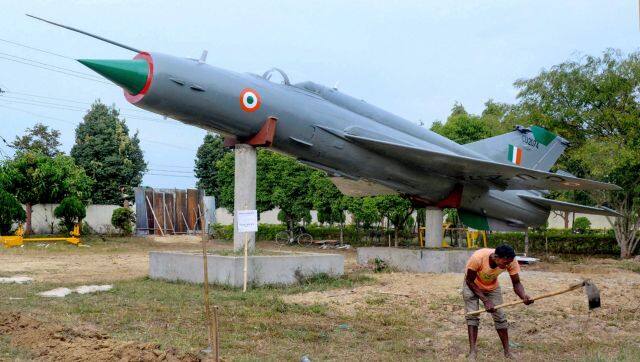
A MIG-21 aircraft soars high in the skies in Bengaluru. In 1963, India inducted the jet into our forces, and over the next few decades they were upgraded to perform a variety of roles performed by a fighter aircraft, including ground attack. File image/PTI[/caption]MiG-21 proves its mettleOver the years, the MiG-21 has been an invaluable part of the Indian Air Force. It has made substantial contributions during India’s wars.In the 1965 war with Pakistan, it served as the mainstay of the IAF. In fact, the MiG-21s had a very memorable encounter with the Pakistan Air Force during that time.Later during the Bangladesh Liberation War of 1971, the MiG-21 once again played a major role in swaying the result in India’s favour. On 4 December 1971, the MiG-21 first saw action when Flying Officer Jayendra Sukrut Raj of the No. 4 Oorials shot down a Pakistani Canadair F-86E Sabre over Tezgaon in East Pakistan.Also read: How the MiG-21 tilted the 1971 war in India’s favour with its 13/1 success ratioOn 6 December, Wing Commander Bishnoi led a formation of four MiG-21s from the 28th squadron towards Tezgaon, the only operational Pakistan Air Force Airbase in East Pakistan. Each MiG-21 dropped a pair of 500 kg iron bombs directly onto the runway and grounded the Pakistan Air Force (PAF). Not a single PAF Sabre was able to take off from the cratered runway thereafter and the IAF had established air supremacy over East Pakistan within 48 hours.The MiG-21 also served India well during the 1999 Kargil War.[caption id="attachment_13328242" align="alignnone" width="640"]![]() An Indian Air Force MiG-21 fighter aircraft has been an invaluable part of the Indian Air Force. It has made substantial contributions during India’s wars. File image/PTI[/caption]‘Flying coffin, widow maker’However, despite the MiG-21’s invaluable contributions, it has also had a chequered past. It has been dubbed grim names such as the “widow-maker” or the “flying coffin” owing to the numerous crashes during its years in service.According to government data, close to 500 MiG-21s have crashed in the last 60 years, killing over 170 pilots. More than 20 aircraft have crashed since 2010. In fact, in the very first year of its induction in 1963, two of the Soviet-era aircraft had crashed.In 2012, then Defence Minister AK Antony had said in Parliament that more than half of the 872 MiG aircraft purchased from Russia had crashed.[caption id="attachment_13328262" align="alignnone" width="640"]
An Indian Air Force MiG-21 fighter aircraft has been an invaluable part of the Indian Air Force. It has made substantial contributions during India’s wars. File image/PTI[/caption]‘Flying coffin, widow maker’However, despite the MiG-21’s invaluable contributions, it has also had a chequered past. It has been dubbed grim names such as the “widow-maker” or the “flying coffin” owing to the numerous crashes during its years in service.According to government data, close to 500 MiG-21s have crashed in the last 60 years, killing over 170 pilots. More than 20 aircraft have crashed since 2010. In fact, in the very first year of its induction in 1963, two of the Soviet-era aircraft had crashed.In 2012, then Defence Minister AK Antony had said in Parliament that more than half of the 872 MiG aircraft purchased from Russia had crashed.[caption id="attachment_13328262" align="alignnone" width="640"]![]() Locals gather after a MiG-21 fighter aircraft of the Indian Air Force (IAF) crashed in Hanumangarh district in May. At least three civilians were killed in the incident. File image/PTI[/caption]This year, a MiG-21 crashed near Rajasthan’s Suratgarh during a routine training sortie in May, killing three civilians. The IAF had then issued a statement: “A MiG-21 fighter aircraft of the Indian Air Force (IAF) crashed. The aircraft had got airborne for a routine operational training sortie from the Air Force Station at Suratgarh. Soon thereafter, the pilot experienced an onboard emergency, following which he attempted to recover the aircraft as per existing procedures.”“Having failed to do so, he initiated an ejection, sustaining minor injuries in the process. The pilot was recovered from about 25 kilometres North East of Suratgarh base. The aircraft wreckage fell on a house in Bahlol Nagar in Hanumangarh district, unfortunately leading to the loss of three lives,” it added.In 2022, one MiG-21 had crashed while another five had crashed in 2021. These incidents led to the deaths of five pilots.The reasons for the crashes have been several — ranging from technical defects, human error, bird hits or spatial disorientation of pilots in certain circumstances.But despite the many crashes, the MiG-21 continues to be used with several retired personnel vouching for its safety. Air Marshal Anil Chopra (retired), the Director General of Centre for Air Power Studies (CAPS), told ThePrint, “The MiG-21 Bison is an upgraded aircraft. While the aircraft has got the tag of flying coffins, the safety record of the aircraft is actually good if one compares the years in service and the flying hours.”Making way for advanced aircraftThe phase out of the MiG-21 comes in order to revolutionise the Indian Air Force. Experts believe that the absence of more fighter jets in the Indian Air Force for a long time was one of the reasons for the accident. For a long time, with the inclusion of no new fighter jets in the Air Force, the entire weight was on the MiG-21.However, the IAF will now induct different variants of Tejas LCA in the coming years to replace the ageing aircraft. The defence ministry in 2021 awarded a Rs 48,000-crore contract to Hindustan Aeronautics Limited for 83 LCA Mk-1A jets for IAF. The first Mk-1A aircraft will be delivered to the Air Force in three years, with the rest being supplied by 2030. The deal involves the supply of 73 Mk-1A fighter jets and 10 LCA Mk-1 trainer aircraft.Former Air Vice Marshal Sunil Nanodkar (retired) said that currently 36 Rafale have been included in the Air Force, but their number is still less compared to the requirement.As of now, the Indian Air Force has 32 squadrons against the 42 mandated by the government to tackle a collusive threat from China and Pakistan. The number could go down to 28 squadrons by 2024-25 when all the MiG-21s are phased out.With inputs from agencies
Locals gather after a MiG-21 fighter aircraft of the Indian Air Force (IAF) crashed in Hanumangarh district in May. At least three civilians were killed in the incident. File image/PTI[/caption]This year, a MiG-21 crashed near Rajasthan’s Suratgarh during a routine training sortie in May, killing three civilians. The IAF had then issued a statement: “A MiG-21 fighter aircraft of the Indian Air Force (IAF) crashed. The aircraft had got airborne for a routine operational training sortie from the Air Force Station at Suratgarh. Soon thereafter, the pilot experienced an onboard emergency, following which he attempted to recover the aircraft as per existing procedures.”“Having failed to do so, he initiated an ejection, sustaining minor injuries in the process. The pilot was recovered from about 25 kilometres North East of Suratgarh base. The aircraft wreckage fell on a house in Bahlol Nagar in Hanumangarh district, unfortunately leading to the loss of three lives,” it added.In 2022, one MiG-21 had crashed while another five had crashed in 2021. These incidents led to the deaths of five pilots.The reasons for the crashes have been several — ranging from technical defects, human error, bird hits or spatial disorientation of pilots in certain circumstances.But despite the many crashes, the MiG-21 continues to be used with several retired personnel vouching for its safety. Air Marshal Anil Chopra (retired), the Director General of Centre for Air Power Studies (CAPS), told ThePrint, “The MiG-21 Bison is an upgraded aircraft. While the aircraft has got the tag of flying coffins, the safety record of the aircraft is actually good if one compares the years in service and the flying hours.”Making way for advanced aircraftThe phase out of the MiG-21 comes in order to revolutionise the Indian Air Force. Experts believe that the absence of more fighter jets in the Indian Air Force for a long time was one of the reasons for the accident. For a long time, with the inclusion of no new fighter jets in the Air Force, the entire weight was on the MiG-21.However, the IAF will now induct different variants of Tejas LCA in the coming years to replace the ageing aircraft. The defence ministry in 2021 awarded a Rs 48,000-crore contract to Hindustan Aeronautics Limited for 83 LCA Mk-1A jets for IAF. The first Mk-1A aircraft will be delivered to the Air Force in three years, with the rest being supplied by 2030. The deal involves the supply of 73 Mk-1A fighter jets and 10 LCA Mk-1 trainer aircraft.Former Air Vice Marshal Sunil Nanodkar (retired) said that currently 36 Rafale have been included in the Air Force, but their number is still less compared to the requirement.As of now, the Indian Air Force has 32 squadrons against the 42 mandated by the government to tackle a collusive threat from China and Pakistan. The number could go down to 28 squadrons by 2024-25 when all the MiG-21s are phased out.With inputs from agencies
 A MIG-21 aircraft soars high in the skies in Bengaluru. In 1963, India inducted the jet into our forces, and over the next few decades they were upgraded to perform a variety of roles performed by a fighter aircraft, including ground attack. File image/PTI[/caption]MiG-21 proves its mettleOver the years, the MiG-21 has been an invaluable part of the Indian Air Force. It has made substantial contributions during India’s wars.In the 1965 war with Pakistan, it served as the mainstay of the IAF. In fact, the MiG-21s had a very memorable encounter with the Pakistan Air Force during that time.Later during the Bangladesh Liberation War of 1971, the MiG-21 once again played a major role in swaying the result in India’s favour. On 4 December 1971, the MiG-21 first saw action when Flying Officer Jayendra Sukrut Raj of the No. 4 Oorials shot down a Pakistani Canadair F-86E Sabre over Tezgaon in East Pakistan.Also read: How the MiG-21 tilted the 1971 war in India’s favour with its 13/1 success ratioOn 6 December, Wing Commander Bishnoi led a formation of four MiG-21s from the 28th squadron towards Tezgaon, the only operational Pakistan Air Force Airbase in East Pakistan. Each MiG-21 dropped a pair of 500 kg iron bombs directly onto the runway and grounded the Pakistan Air Force (PAF). Not a single PAF Sabre was able to take off from the cratered runway thereafter and the IAF had established air supremacy over East Pakistan within 48 hours.The MiG-21 also served India well during the 1999 Kargil War.[caption id="attachment_13328242" align="alignnone" width="640"]
 An Indian Air Force MiG-21 fighter aircraft has been an invaluable part of the Indian Air Force. It has made substantial contributions during India’s wars. File image/PTI[/caption]‘Flying coffin, widow maker’However, despite the MiG-21’s invaluable contributions, it has also had a chequered past. It has been dubbed grim names such as the “widow-maker” or the “flying coffin” owing to the numerous crashes during its years in service.According to government data, close to 500 MiG-21s have crashed in the last 60 years, killing over 170 pilots. More than 20 aircraft have crashed since 2010. In fact, in the very first year of its induction in 1963, two of the Soviet-era aircraft had crashed.In 2012, then Defence Minister AK Antony had said in Parliament that more than half of the 872 MiG aircraft purchased from Russia had crashed.[caption id="attachment_13328262" align="alignnone" width="640"]
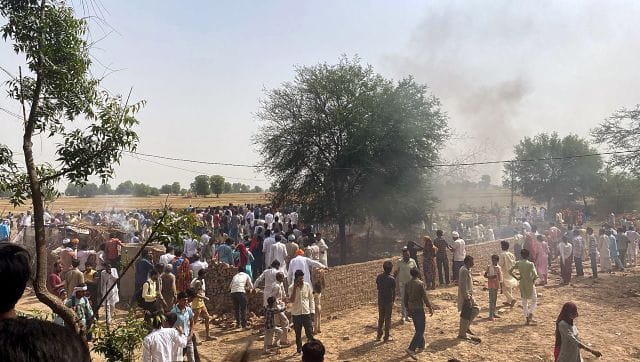 Locals gather after a MiG-21 fighter aircraft of the Indian Air Force (IAF) crashed in Hanumangarh district in May. At least three civilians were killed in the incident. File image/PTI[/caption]This year, a MiG-21 crashed near Rajasthan’s Suratgarh during a routine training sortie in May, killing three civilians. The IAF had then issued a statement: “A MiG-21 fighter aircraft of the Indian Air Force (IAF) crashed. The aircraft had got airborne for a routine operational training sortie from the Air Force Station at Suratgarh. Soon thereafter, the pilot experienced an onboard emergency, following which he attempted to recover the aircraft as per existing procedures.”“Having failed to do so, he initiated an ejection, sustaining minor injuries in the process. The pilot was recovered from about 25 kilometres North East of Suratgarh base. The aircraft wreckage fell on a house in Bahlol Nagar in Hanumangarh district, unfortunately leading to the loss of three lives,” it added.In 2022, one MiG-21 had crashed while another five had crashed in 2021. These incidents led to the deaths of five pilots.The reasons for the crashes have been several — ranging from technical defects, human error, bird hits or spatial disorientation of pilots in certain circumstances.But despite the many crashes, the MiG-21 continues to be used with several retired personnel vouching for its safety. Air Marshal Anil Chopra (retired), the Director General of Centre for Air Power Studies (CAPS), told ThePrint, “The MiG-21 Bison is an upgraded aircraft. While the aircraft has got the tag of flying coffins, the safety record of the aircraft is actually good if one compares the years in service and the flying hours.”Making way for advanced aircraftThe phase out of the MiG-21 comes in order to revolutionise the Indian Air Force. Experts believe that the absence of more fighter jets in the Indian Air Force for a long time was one of the reasons for the accident. For a long time, with the inclusion of no new fighter jets in the Air Force, the entire weight was on the MiG-21.However, the IAF will now induct different variants of Tejas LCA in the coming years to replace the ageing aircraft. The defence ministry in 2021 awarded a Rs 48,000-crore contract to Hindustan Aeronautics Limited for 83 LCA Mk-1A jets for IAF. The first Mk-1A aircraft will be delivered to the Air Force in three years, with the rest being supplied by 2030. The deal involves the supply of 73 Mk-1A fighter jets and 10 LCA Mk-1 trainer aircraft.Former Air Vice Marshal Sunil Nanodkar (retired) said that currently 36 Rafale have been included in the Air Force, but their number is still less compared to the requirement.As of now, the Indian Air Force has 32 squadrons against the 42 mandated by the government to tackle a collusive threat from China and Pakistan. The number could go down to 28 squadrons by 2024-25 when all the MiG-21s are phased out.With inputs from agencies
First Published:Nov 01, 2023, 13:17:00 IST
Advertisement
Advertisement

Military drones & police check-ups: How Sri Lanka is fighting against worst dengue outbreak in a decade
Sri Lanka is fighting its most severe dengue outbreak in nearly a decade, with infections rising sharply across the nation. Military drones have been deployed to tackle the outbreak, which has claimed 56 lives. Health officials said the outbreak is being driven primarily by the DENV-2 variant of the virus
3 min read
How Facebook job ad lured 2 Karnataka men into Myanmar cyber scam camp
The Karnataka Cyber Command has rescued two youths from a scam compound in Myanmar operated by Chinese fraudsters. The duo from Karnataka were lured on the pretext of data-entry jobs. They were asked to work for 16 hours a day and were expected to sleep for six hours daily
4 min read
Why is India seeing 95% cloud cover despite a Super El Niño?
India is witnessing nearly 95 per cent cloud cover despite a Super El Niño, a climate event usually linked to weaker monsoons. Regional weather systems, cyclonic circulations, the monsoon trough and moisture from two seas are temporarily overpowering one of the world's strongest climate phenomena
5 min read
What is CJP’s fourth demand to the government as protests in Delhi intensify?
The protest by the Cockroach Janta Party at Delhi’s Jantar Mantar refuses to die down. The group have made a fourth demand to the Centre, asking that no FIRs are filed against the agitators and that no legal action be taken. The government has expressed willingness to speak to the protesters, but refused to accede on the resignation of Education Minister Dharmandra Pradhan
5 min read
The new geography of war: Why the Houthis can no longer be ignored
The rise of the Houthis marks the emergence of a new geography of war — one in which influence flows not only from capitals and conventional armies, but also from rugged mountains overlooking vital sea lanes
6 min read
Advertisement
Advertisement