


Why the Morocco earthquake was so devastating
A rare and powerful quake that hit Morocco Friday night had a preliminary magnitude of 6.8 with shaking that lasted several seconds. The country's deadliest tremor in more than six decades claimed more than 2000 lives so far and toppled many houses in the High Atlas mountains

A rare and powerful earthquake struck Morocco late Friday night.
The country's deadliest tremor in more than six decades left many buildings damaged, claimed thousands of lives, and left many others injured in the village near Atlas Mountains in the historic city of Marrakech.
Here's all we know about the quake.
Also read: PM Modi condoles loss of lives in Morocco quake, offers all possible help
The epicentre
According to the US Geological Survey, the quake had a preliminary magnitude of 6.8 when it hit central Morocco at 11:11 p.m. (3:41 IST), with shaking that lasted several seconds. There was also a magnitude 4.9 aftershock that hit 19 minutes later.
 More from Explainers
It is classified as "strong" on the magnitude scale with a magnitude of 6.8.
The epicentre of Friday’s tremor was near the town of Ighil in Al Haouz Province, roughly 70 kilometres (43.5 miles) south of Marrakech. The popular tourist destination is known for scenic villages and valleys tucked in the High Atlas, and villages built into mountainsides.
The USGS said the epicentre was 18 kilometres (11 miles) below the Earth’s surface, while Morocco’s seismic agency put it at 11 kilometres (7 miles) down. Such shallow quakes are more dangerous.
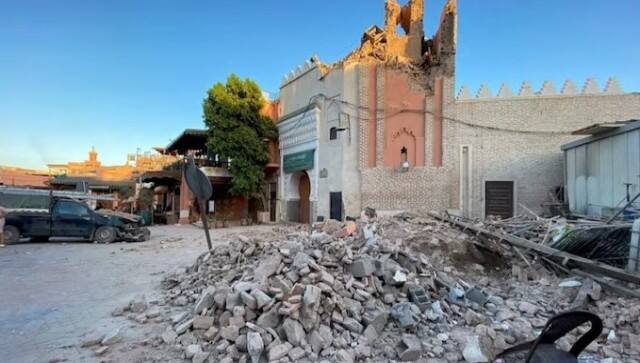
Many buildings and walls in ancient cities made from stone and masonry were damaged as they were not designed to withstand quakes.
The full toll was not known as rescuers struggled to get through boulder-strewn roads to the remote mountain villages hit hardest.
Thousands of lives lost, many buildings damaged
More than 2000 people died, mostly in Marrakech and other provinces of Al-Haouz, Ouarzazate, Azilal, Chichaoua and Taroudant, near the quake’s epicentre, and another 2000 people were injured, Morocco's Interior Ministry said. Of the injured, more than 1,400 are in a critical condition.
According to AP, state television showed people clustered in the streets of Marrakech, afraid to go back inside buildings that might still be unstable. In Marrakech, the famous Koutoubia Mosque, built in the 12th century, was damaged, but the extent was not immediately clear. Its 69-metre (226-foot) minaret is known as the “roof of Marrakech.”
Moroccans also posted videos showing damage to parts of the famous red walls that surround the old city, a UNESCO World Heritage site.
Most of the tiny village of Moulay Brahim, carved into a mountainside south of Marrakech, was uninhabitable after walls crumbled, windows shattered and more than a dozen homes were reduced to piles of concrete and bent metal poles. At least five residents were trapped.
The head of a town near the earthquake's epicentre told Moroccan news site 2M that several homes in nearby towns had partly or totally collapsed, and electricity and roads were cut off in some places.
Friday's quake was felt as far away as Portugal and Algeria, according to the Portuguese Institute for Sea and Atmosphere and Algeria's Civil Defense agency, which oversees emergency response.
Rescue efforts
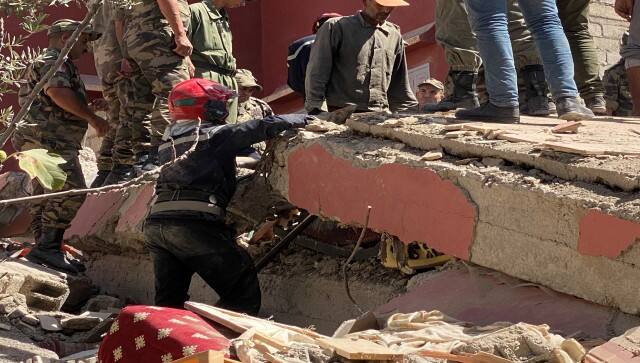
Rescuers worked through the night, searching for survivors in darkness, dust and rubble. They were using hammers and axes to free a man trapped under a two-storey building. People capable of squeezing into the tiny space were giving him water.
It is likely the death toll will rise as rescue efforts continue.
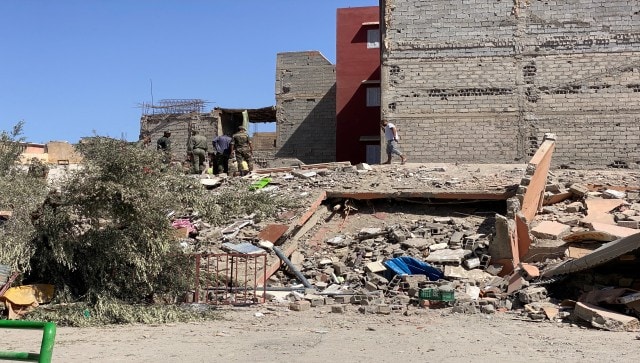
Abderrahim Ait Daoud, head of the town of Talat N’Yaaqoub, said authorities are working to clear roads in Al Haouz Province to allow passage for ambulances and aid to populations affected, but said large distances between mountain villages mean it will take time to learn the extent of the damage. According to BBC, they have also called on residents to donate blood to assist the injured.
On the steep and winding switchbacks from Marrakech to Al Haouz, ambulances with sirens blaring and honking cars veered around piles of Mars-like red rock that had tumbled from the mountainside and blocked the road. Red Cross workers tried to clear a boulder blocking the two-lane highway.
In a sign of the huge scale of the disaster, Morocco’s King Mohammed VI ordered the armed forces to mobilise air and land assets like aircraft, helicopters and drones, specialised search and rescue teams and a surgical field hospital, according to a statement from the military. Trucks loaded with blankets, camp cots and lighting equipment were trying to region that hard-hit area, the official news agency MAP reported.
Also read: Death toll rises to 820 after 6.8 magnitude earthquake jolts Morocco
Survivors’ ordeal
People woken by the quake ran into the streets in terror and disbelief.
A man visiting a nearby apartment said dishes and wall hangings began raining down, and people were knocked off their feet and chairs. A woman described fleeing her house after an “intense vibration.’’ A man holding a child said he was jarred awake in bed by the shaking.
Ayoub Toudite said he had been working out with friends at the gym when “we felt a huge shake like it was doomsday.” In 10 seconds, he said, everything was gone.
“We found casualties and people running and kids crying,” he told AP. “We never saw anything like this, 20 deaths in the area, 30 injuries. We are all terrified that this happens again.”
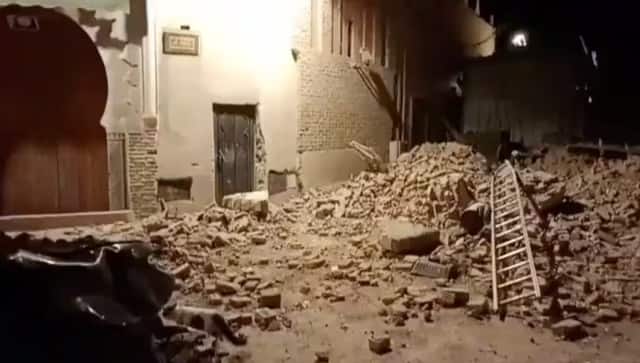
Michael Bizet, who was in Marrakech’s old town, told news agency AFP that he thought his bed was going to “fly away.” He said, “It was total chaos, a real catastrophe, madness.” Another resident identified as Fayssal Badour was driving when the quake hit. “I stepped and realised what a disaster it was. The screaming and crying was unbearable," he said.
A resident by the name of Mina Metioui told BBC that the noise sounded like “a fighter jet,” that was getting louder and louder. She said, "It took a second that felt like minutes. Then I heard people screaming, getting out of the property… It was really a horrible experience.”
International response
World leaders offered to send in aid or rescue crews as condolences poured in from countries around Europe, the Middle East and a Group of 20 summit in India.
Turkey’s president, whose country lost tens of thousands of people in a massive earthquake earlier this year, was among those proposing assistance.
France and Germany, with large populations of people with Moroccan origins, also offered to help, and the leaders of both Ukraine and Russia expressed support for Moroccans.
Prime Minister Narendra Modi, while speaking at the G20 Summit in New Delhi, said the international community would come to Morocco’s aid. Taking to X, formerly known as Twitter, he said, “Extremely pained by the loss of lives due to an earthquake in Morocco. In this tragic hour, my thoughts are with the people of Morocco. Condolences to those who have lost their loved ones. May the injured recover at the earliest.”
US president Joe Biden, who is also attending the Summit hosted by India, said he is “deeply saddened by the loss of life and devastation.” UK foreign secretary James Cleverly said, “We stand ready to help our Moroccan friends in whatever way we can,” and added that his country was supporting British nationals stuck in the region.
French president Emmanuel Macron said he was “devastated” and his country stands “ready to help with first aid," while Spanish PM Pedro Sanchez said, “All my solidarity and support to the people of Morocco in the wake of this terrible earthquake.”
Russian president Vladimir Putin also shared “the pain and the mourning of the friendly Moroccan people,” while Ukrainian president Volodymyr Zelenskyy expressed his solidarity and sent his “deepest condolences” to Morocco.
Despite an outpouring of offers of help from around the world, the Moroccan government had not formally asked for assistance, a step required before outside rescue crews could deploy.
Quake is so rare in the region
According to CNN which cited USGS, earthquakes of this scale are rare in the area but not unprecedented. It stated that nine earthquakes with a magnitude of 5 or higher have occurred since 1900, however, none of them have reached a magnitude of six. On the scale, 32 times more strength is produced for every whole number increment.
Although the earthquake was 30 times weaker than the 7.8 magnitude one that struck Turkey earlier this year, it still released "a tremendous amount of energy" and was likely to cause significant damage, Jonathan Stewart, a professor of civil and environmental engineering at the University of California, Los Angeles told the Georgia-based media company.
According to AP, the deadliest was in Agadir on the southern Atlantic coast, in 1960. The magnitude 6.7 quake killed about 12,000 people. The quake prompted changes in construction rules in Morocco, but many buildings, especially rural homes, are not built to withstand such tremors.
In 2004, a 6.4 magnitude earthquake near the Mediterranean coastal city of Al Hoceima left more than 600 dead.
“The problem is that where destructive earthquakes are rare, buildings are simply not constructed robustly enough to cope with strong ground shaking, so many collapses resulting in high casualties," said Bill McGuire, professor emeritus of geophysical and climate hazards at University College London, adding, "I would expect the final death toll to climb into the thousands once more is known. As with any big quake, aftershocks are likely, which will lead to further casualties and hinder search and rescue.”
With inputs from agencies

Military drones & police check-ups: How Sri Lanka is fighting against worst dengue outbreak in a decade
How Facebook job ad lured 2 Karnataka men into Myanmar cyber scam camp
Why is India seeing 95% cloud cover despite a Super El Niño?
What is CJP’s fourth demand to the government as protests in Delhi intensify?
The new geography of war: Why the Houthis can no longer be ignored