
Advertisement


Sections
How useful is your degree? Why Indian graduates remain unemployed
Across India, thousands of graduates simply don’t have the expertise employers are looking for. Experts say the education system is to blame and that youths require skills that are ‘future-ready’

Half of India’s graduates are unemployable in the future – that’s the conclusion a new study by the talent assessment firm Wheebox has reached, according to Bloomberg.And what’s to blame for this problem? Issues with the country’s education system.Let’s take a closer look:Education in IndiaEducation is big business in India.Bloomberg quoted the India Brand Equity Foundation as pegging the industry’s value at $117 billion in 2020.That figure is expected to nearly double – to $225 billion by 2025.Nearly half of the population is below the age of 25, as per India Today.![]() Graphic: Pranay Bhardwaj[/caption]Tiwari, who remains unemployed four years after finishing his course, added, "I just secured certificates on paper, but those are of no use."YouthKiAwaaz quoted the World Economic Forum as saying in 2022 that just 1 in 10 graduates are employable.The website quoted another report as saying that nearly two million graduates and another half a million postgraduates remain unemployed.
Graphic: Pranay Bhardwaj[/caption]Tiwari, who remains unemployed four years after finishing his course, added, "I just secured certificates on paper, but those are of no use."YouthKiAwaaz quoted the World Economic Forum as saying in 2022 that just 1 in 10 graduates are employable.The website quoted another report as saying that nearly two million graduates and another half a million postgraduates remain unemployed.![]() India's emphasis on white collar work is an issue, experts say.[/caption]Thus, those with vocational skills or on-the-job training are sidelined.“Indian youth end up looking for ‘honourable’ jobs. They either drop out of their vocational courses or leave vocational skill-based jobs after just 2-3 years,” the piece noted.As Jayati Ghosh, an economics professor at Jawaharlal Nehru University in New Delhi, told Al Jazeera, “As you get higher up the education scale, people are more willing to be ‘openly unemployed’. If there are no jobs available and you’ve done your BA degree, you’re not going to then become a rickshaw driver. It doesn’t make sense for them.”
India's emphasis on white collar work is an issue, experts say.[/caption]Thus, those with vocational skills or on-the-job training are sidelined.“Indian youth end up looking for ‘honourable’ jobs. They either drop out of their vocational courses or leave vocational skill-based jobs after just 2-3 years,” the piece noted.As Jayati Ghosh, an economics professor at Jawaharlal Nehru University in New Delhi, told Al Jazeera, “As you get higher up the education scale, people are more willing to be ‘openly unemployed’. If there are no jobs available and you’ve done your BA degree, you’re not going to then become a rickshaw driver. It doesn’t make sense for them.”
And yet thousands are graduating without the skills employers are looking for.Pankaj Tiwari, who spent Rs 1 lakh for a master’s degree in digital communication told Bloomberg, "If I had received some training and skills in college, my situation would have been different. Now, I feel like I wasted my time."[caption id="attachment_12472642" align="alignnone" width="640"]
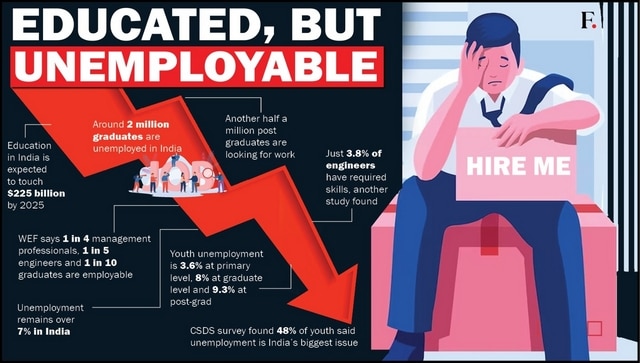 Graphic: Pranay Bhardwaj[/caption]Tiwari, who remains unemployed four years after finishing his course, added, "I just secured certificates on paper, but those are of no use."YouthKiAwaaz quoted the World Economic Forum as saying in 2022 that just 1 in 10 graduates are employable.The website quoted another report as saying that nearly two million graduates and another half a million postgraduates remain unemployed.
Around 47% graduates are not a fit for any type of role within the industry.Only 1 in four management professionals and 1 in five engineers have the requisite skills.While unemployment remains over seven per cent, youth employment is around 3.6 per cent at the primary level, eight per cent at the graduate level and 9.3 per cent at post-grad.Al Jazeera quoted a survey by research firm Aspiring Minds as saying that companies found 80 per cent of Indian engineering graduates did not measure up to their requirements.The Azim Premji University’s Centre for Sustainable Employment found that individuals with graduate degrees are over twice as likely to be unemployed compared to the national average.The survey of 160,000 Indian households also found that women are more likely to be unemployed than men, as per Al Jazeera.What’s more, the youth know it’s a problem.The Center for the Study of Developing Societies (CSDS) in a survey cited nearly half of respondents saying that unemployment is the biggest issue facing India.The 'right' jobBut youths are also apt to hold out for the ‘right job’.This is because, our society puts a higher worth on ‘white-collar’ jobs, according to India Today.[caption id="attachment_12472602" align="alignnone" width="640"]
 India's emphasis on white collar work is an issue, experts say.[/caption]Thus, those with vocational skills or on-the-job training are sidelined.“Indian youth end up looking for ‘honourable’ jobs. They either drop out of their vocational courses or leave vocational skill-based jobs after just 2-3 years,” the piece noted.As Jayati Ghosh, an economics professor at Jawaharlal Nehru University in New Delhi, told Al Jazeera, “As you get higher up the education scale, people are more willing to be ‘openly unemployed’. If there are no jobs available and you’ve done your BA degree, you’re not going to then become a rickshaw driver. It doesn’t make sense for them.”
Businesses also say they are facing a tough time."We do face a challenge in hiring as specific skill sets required for the industry are not currently easily available in the market," Yeshwinder Patial, director for human resources at MG Motor India, told Bloomberg.Speaking to Al Jazeera, Varun Aggarwal, cofounder of Aspiring Minds, blamed ill-equipped teachers, an education system that emphasises rote learning and below par institutions.“Few graduates have done internships or heard an industry talk and few professors discuss industry applications for the skills they teach,” Aggarwal said. “We found over 90 percent of engineering graduates are not even able to write ten lines of code.”What do experts say?According to India Today, students require ‘future-ready’ skills.“They are preparing for jobs that do not exist when they are in school, thanks to the rapidly changing technology-driven job market,” a piece noted.Irwin Anand, MD India and APAC, Udemy, said, “The penetration of technology, especially after the pandemic, has opened new doors for individuals as well as enterprises.”“Digitisation and upskilling are key tools in not just empowering the country’s workforce but also in keeping up with new booming sectors in the economy,” he added.Robin Bhowmik, Chief Business Officer, Manipal Global Education Services (Skills Academy), told India Today the issue is one of opportunity.“While academia provides graduates with general knowledge and comprehension of subjects, industry-academia partnership is vital to empower young professionals with first-day, first-hour productivity training,” Bhowmik said.With inputs from agenciesRead all the Latest News, Trending News, Cricket News, Bollywood News, India News and Entertainment News here. Follow us on Facebook, Twitter and Instagram.
First Published:Apr 18, 2023, 16:39:21 IST
Advertisement
Advertisement

Military drones & police check-ups: How Sri Lanka is fighting against worst dengue outbreak in a decade
Sri Lanka is fighting its most severe dengue outbreak in nearly a decade, with infections rising sharply across the nation. Military drones have been deployed to tackle the outbreak, which has claimed 56 lives. Health officials said the outbreak is being driven primarily by the DENV-2 variant of the virus
3 min read
How Facebook job ad lured 2 Karnataka men into Myanmar cyber scam camp
The Karnataka Cyber Command has rescued two youths from a scam compound in Myanmar operated by Chinese fraudsters. The duo from Karnataka were lured on the pretext of data-entry jobs. They were asked to work for 16 hours a day and were expected to sleep for six hours daily
4 min read
Why is India seeing 95% cloud cover despite a Super El Niño?
India is witnessing nearly 95 per cent cloud cover despite a Super El Niño, a climate event usually linked to weaker monsoons. Regional weather systems, cyclonic circulations, the monsoon trough and moisture from two seas are temporarily overpowering one of the world's strongest climate phenomena
5 min read
What is CJP’s fourth demand to the government as protests in Delhi intensify?
The protest by the Cockroach Janta Party at Delhi’s Jantar Mantar refuses to die down. The group have made a fourth demand to the Centre, asking that no FIRs are filed against the agitators and that no legal action be taken. The government has expressed willingness to speak to the protesters, but refused to accede on the resignation of Education Minister Dharmandra Pradhan
5 min read
The new geography of war: Why the Houthis can no longer be ignored
The rise of the Houthis marks the emergence of a new geography of war — one in which influence flows not only from capitals and conventional armies, but also from rugged mountains overlooking vital sea lanes
6 min read
Advertisement
Advertisement