


How Nasa's Artemis III will take humans closer to the surface of the Moon
Nasa’s original plan for Artemis III was to land humans on the Moon. However, that is no longer the case. The mission will now see astronauts venturing into low-Earth orbit (LEO) and performing a series of tests

Nasa has announced the names of the astronauts for its Artemis III mission.
The announcement came two months after Artemis II’s record-breaking trip around the Moon that surpassed the distance record of Apollo 13.
Nasa’s original plan for the mission was to land humans on the lunar surface. However, that is no longer the case. Instead, Artemis III will serve as a stepping stone for a future Moon landing.
So, what exactly is Artemis III? And who are the astronauts selected for it?
Let’s take a closer look.
What is Artemis III?
When Nasa first unveiled its Artemis Moon Mission, Artemis III was supposed to mark the return of humans to the lunar surface. This would be the first such landing since the landmark Apollo 17 in 1972. But now the mission will see astronauts venturing into low-Earth orbit (LEO) and performing a series of tests.
 More from Explainers
As per Scientific American, this came after delays in the development of key technologies, particularly lunar landers being built by private companies. Instead of waiting for those systems to be fully ready, Nasa has adopted a staged approach: test everything in orbit first, then attempt a landing later. Artemis III, therefore, is about future human missions to the Moon.
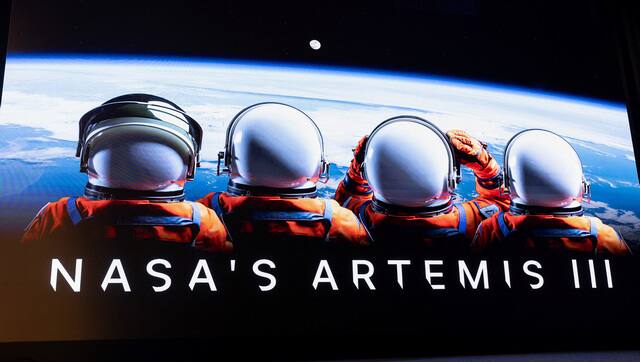
Artemis III astronauts will remain in low-Earth orbit for around two weeks. The mission is essentially a “spacecraft docking demonstration”, involving multiple launches and coordinated manoeuvres between different spacecraft. The crew will fly aboard Nasa’s Orion spacecraft, launched using the Space Launch System (SLS). Once in orbit, Orion will interact with two lunar landers:
- SpaceX’s Starship Human Landing System
- Blue Origin’s Blue Moon lander
Blue Origin’s lander is expected to launch first, followed by Orion carrying the astronauts. SpaceX’s Starship will then perform its own docking demonstration. Astronauts will practise transferring between spacecraft, testing communication systems, and ensuring that life-support systems function seamlessly across vehicles.
This has been described as a “delicate dance” in which multiple spacecraft will hover and manoeuvre around each other in orbit. Nasa’s Artemis programme manager Jeremy Parsons said, “Artemis III is an incredibly exciting, complicated and highly coordinated multi-launch campaign… It’s going to happen in a short period of time with three of the world’s most powerful rockets.”
The astronauts picked for Artemis III
Nasa has selected a four-member crew, combining experience with new talent and international representation. The crew includes three Americans and one European.
Randy Bresnik (Commander) is a veteran astronaut and former test pilot. Bresnik has flown multiple missions and brings extensive operational experience. Pilot Luca Parmitano is an Italian astronaut from the European Space Agency and the first European national to join an Artemis mission. Mission specialist Frank Rubio is known for his long-duration mission aboard the International Space Station, where he spent over a year in orbit. Andre Douglas, also a mission specialist, is a first-time astronaut and engineer and represents a new generation of space explorers.
“We are certainly humbled as a crew to be able to be your crew that executes this Artemis III mission in space,” Bresnik said. Mission specialist Douglas added: “My brain — it is going a mile a minute right now. But my heart, it is so warm. It is so full.”
“To the Artemis III crew, we wish you Godspeed on the journey ahead,” said Nasa administrator Jared Isaacman.
Why this mission matters
Because Artemis III is ultimately about reducing the risk to astronauts.
Unlike the Apollo era—where a single spacecraft handled most mission functions—the Artemis programme relies on multiple systems working together. Astronauts will need to transfer between spacecraft before descending to the Moon. If docking fails, the mission fails.

That is why Artemis III is critical. It tests the most complex and vulnerable parts of the mission architecture before astronauts attempt a landing. Nasa officials have described the mission as “incredibly exciting, complicated and highly coordinated”.
Artemis III follows:
Artemis I (2022): uncrewed test flight
Artemis II (2026): crewed lunar flyby
Artemis III now serves as the final major test before a human landing, expected around 2028, likely under Artemis IV.
The Artemis programme aims to establish a sustained human presence on the Moon, including infrastructure such as landers, rovers and habitats. Nasa has already awarded major contracts to companies to develop these systems.
The Moon, in this context, is not the end goal but a stepping stone to Mars. The programme is also facing competitive pressure from China, which is targeting its own crewed Moon landing by 2030.
The private sector challenge
Nasa’s growing reliance on private companies is a defining feature of Artemis III. The lunar landers for the mission are being developed by SpaceX and Blue Origin.
While this approach allows for innovation and shared costs, it also introduces uncertainty. Both companies have faced delays, including a recent setback when Blue Origin’s massive rocket exploded during an engine-firing test on the launch pad in Florida, shaking nearby homes and illuminating the sky with an orange fireball.
These challenges are a key reason Artemis III has been restructured into a test mission, even as both companies continue to race to deliver their lunar landers.
FAQs
1. Will Artemis III land humans on the Moon?
No. Artemis III will not land humans on the Moon. It has been redesigned as a test mission in low-Earth orbit to prepare for a future lunar landing.
2. Who are the astronauts selected for Artemis III?
The four astronauts are Randy Bresnik, Luca Parmitano, Frank Rubio, and Andre Douglas.
3. Why was Artemis III changed from a Moon landing mission?
The mission was changed due to delays in developing key technologies, especially lunar landers. Nasa decided to test systems in orbit first before attempting a Moon landing.
With inputs from agencies
Tags

Military drones & police check-ups: How Sri Lanka is fighting against worst dengue outbreak in a decade
How Facebook job ad lured 2 Karnataka men into Myanmar cyber scam camp
Why is India seeing 95% cloud cover despite a Super El Niño?
What is CJP’s fourth demand to the government as protests in Delhi intensify?
The new geography of war: Why the Houthis can no longer be ignored