
Advertisement


Sections
How Delhi’s violation of Diwali firecracker ban saw 140% rise in pollutant that harms lungs
Crazy about crackers, the Delhi-NCR region defied the Supreme Court ban on fireworks this Diwali. Now the air quality has deteriorated once again with a 140 per cent rise in PM2.5, the main pollutant that affects the lungs

Delhi’s relief from bad air was short-lived. The city and its neighbourhoods are back to battling pollution and they have no one else to blame but its residents. On Diwali, the Supreme Court’s firecracker ban was violated across Delhi and the National Capital Region. And now the consequences are for all to see.There has been a spike in pollutants and the Air Quality Index (AQI) is in “poor quality”.We take a look at how defying the ban will impact the city.Also read: Living in ‘gas chambers’: What is making Delhi’s air so toxic?How bad is Delhi’s air quality? On Monday, Delhi-NCR was enveloped in a thick blanket of smog. It was a sharp contrast from Sunday when the region recorded its cleanest air on Diwali in eight years with blue and clear skies. But hundreds cared not to abide by the firecracker ban which has caused the pollution levels to spike.Delhi recorded a massive 140 per cent jump in PM2.5, the major pollutant that affects the lungs and causes other health issues. It clocked an hourly average of 200.8 µg/m3 at 7 am, reports NDTV. At the same time on Sunday, it was at 83.5, according to the Central Pollution Control Board (CPCB) data.The hourly PM2.5 levels at the monitoring station at Jawaharlal Nehru Stadium were more than 20 times the 24-hour standard on Sunday night and early Monday morning.Dr Arvind Kumar, chairman of the Institute of Chest Surgery at Medanta Gurugram, was quoted as saying by NDTV that PM 2.5 passes the nose and throat barrier, goes into the lungs, gets deposited there and gets absorbed into the blood.[caption id="attachment_13382182" align="alignnone" width="640"]![]() This aerial view shows smog enveloping the skyline on the outskirts of New Delhi, on Sunday. The air quality in the city deteriorated further on Monday after Diwali celebrations. AP[/caption]There was also a rise in the PM10 levels. The hourly levels of the pollutant were 15 to 16 times the 24-hour standard at some stations. At Jawarhlal Nehru stadium, the PM10 concentration touched 162 µg/m3 at 2 am; the 24-hour standard is 100. The levels were over 1,000 from 11 pm to 4 am and then it dropped to 467 at 8 am on Monday, The Indian Express reports quoting Delhi Pollution Control Committee (DPCC) data.RK Puram also saw an increase in pollution levels on Sunday night. The PM10 concentration was 165 µg/m3 at 7 pm and saw a massive spike at 11 pm as it jumped to 1380. It fell to 405 on Monday.The AQI remained in the “poor” category on an average – 283 at 8 am on Monday, deteriorating from 218 at 3 pm on Sunday. Once again Delhi’s Anand Vihar recorded a high level of pollution. Its AQI touched a “hazardous” 849 at 7 am Monday, according to a real-time Air Quality Index aqicn. The air quality in Pus was at 970 and it was 700 Patparganj, as per aqicn.
This aerial view shows smog enveloping the skyline on the outskirts of New Delhi, on Sunday. The air quality in the city deteriorated further on Monday after Diwali celebrations. AP[/caption]There was also a rise in the PM10 levels. The hourly levels of the pollutant were 15 to 16 times the 24-hour standard at some stations. At Jawarhlal Nehru stadium, the PM10 concentration touched 162 µg/m3 at 2 am; the 24-hour standard is 100. The levels were over 1,000 from 11 pm to 4 am and then it dropped to 467 at 8 am on Monday, The Indian Express reports quoting Delhi Pollution Control Committee (DPCC) data.RK Puram also saw an increase in pollution levels on Sunday night. The PM10 concentration was 165 µg/m3 at 7 pm and saw a massive spike at 11 pm as it jumped to 1380. It fell to 405 on Monday.The AQI remained in the “poor” category on an average – 283 at 8 am on Monday, deteriorating from 218 at 3 pm on Sunday. Once again Delhi’s Anand Vihar recorded a high level of pollution. Its AQI touched a “hazardous” 849 at 7 am Monday, according to a real-time Air Quality Index aqicn. The air quality in Pus was at 970 and it was 700 Patparganj, as per aqicn.![]() However, data from the CPCB suggests that the AQI in Delhi is at “very poor” levels with that of Anand Vihar at 312, ITO at “poor” 282, Jawaharlal Nehru Stadium at “poor” 257 and Pusa at “very poor” 302, reports News18.The AQI at Jahangirpuri was reportedly 341 and at Lodhi Road, it was 315.The Delhi-NCR region defied the Supreme Court ban on bursting crackers. Last week, the top court said that the ban on firecrackers containing barium applied to all states and not limited to Capital.
However, data from the CPCB suggests that the AQI in Delhi is at “very poor” levels with that of Anand Vihar at 312, ITO at “poor” 282, Jawaharlal Nehru Stadium at “poor” 257 and Pusa at “very poor” 302, reports News18.The AQI at Jahangirpuri was reportedly 341 and at Lodhi Road, it was 315.The Delhi-NCR region defied the Supreme Court ban on bursting crackers. Last week, the top court said that the ban on firecrackers containing barium applied to all states and not limited to Capital.![]() Which areas saw a violation of the cracker ban?The intensity of firecrackers increased after 4 pm and continued late into the night on Sunday.Some of the places in the Capital that saw a rise in noise pollution because of firecrackers after 6 pm on Sunday were Shahpur Jat, Hauz Khas, Defence Colony, Chhatarpur, East of Kailash, Mandir Marg and Paharganj, reports India Today.According to environmentalist Bhavreen Kandhari, firecrackers were burst in Defence Colony too, but complaints registered at the local police station resulted in no change. “The Supreme Court's firm stance on firecrackers got blown in the smoke of the firecrackers. Despite warnings and a complete ban...implementing authorities have failed yet again,” she told PTI.[caption id="attachment_13382202" align="alignnone" width="640"]
Which areas saw a violation of the cracker ban?The intensity of firecrackers increased after 4 pm and continued late into the night on Sunday.Some of the places in the Capital that saw a rise in noise pollution because of firecrackers after 6 pm on Sunday were Shahpur Jat, Hauz Khas, Defence Colony, Chhatarpur, East of Kailash, Mandir Marg and Paharganj, reports India Today.According to environmentalist Bhavreen Kandhari, firecrackers were burst in Defence Colony too, but complaints registered at the local police station resulted in no change. “The Supreme Court's firm stance on firecrackers got blown in the smoke of the firecrackers. Despite warnings and a complete ban...implementing authorities have failed yet again,” she told PTI.[caption id="attachment_13382202" align="alignnone" width="640"]![]() An MCD truck sprinkles water on a road to curb pollution, near Anand Vihar metro station in New Delhi on Monday. The Capital recorded a jump in pollution levels and a smoky haze returned on Monday following Diwali. PTI[/caption]Congress MP Manish Tewari also questioned the bursting of firecrackers in the national capital. “Last night in Lutyens Delhi, firecrackers were bursting till 2 AM in the morning with sparklers, bombs, rockets and every other firecracker used on Deepawali on full & ferocious display. Did the Supreme Court ban Firecrackers?” he wrote in a post on X on Monday.In Chhatarpur, several shopkeepers were seen flouting the ban and selling small firecrackers to children. Until 7:30 pm last night, very few firecrackers were burst in the Lalita Park area of Laxmi Nagar, according to a PTI report.Visuals posted by news agency ANI saw firecracker waste in several areas of Delhi like Gole Market, Paharganj, Ram Nagar Market and Mandir Marg.Before Diwali, the sale of banned firecrackers was thriving in Delhi. Markets in Kamla Nagar, Sadar Bazar, Rajouri Garden, Ramesh Nagar, and near Jama Masjid were going about their illicit business, not even attempting to be discreet, according to a report in Hindustan Times. Some of the sellers even had listings online.Shops were selling sparklers, chakra, flowerpots and rockets, all sold for anywhere between Rs 900 and Rs 1,000. The Delhi Police seized over 10,000 kg of firecrackers between 16 October and 8 November, reports HT.But that was not enough. The toxic air is proof.[caption id="attachment_13382212" align="alignnone" width="640"]
An MCD truck sprinkles water on a road to curb pollution, near Anand Vihar metro station in New Delhi on Monday. The Capital recorded a jump in pollution levels and a smoky haze returned on Monday following Diwali. PTI[/caption]Congress MP Manish Tewari also questioned the bursting of firecrackers in the national capital. “Last night in Lutyens Delhi, firecrackers were bursting till 2 AM in the morning with sparklers, bombs, rockets and every other firecracker used on Deepawali on full & ferocious display. Did the Supreme Court ban Firecrackers?” he wrote in a post on X on Monday.In Chhatarpur, several shopkeepers were seen flouting the ban and selling small firecrackers to children. Until 7:30 pm last night, very few firecrackers were burst in the Lalita Park area of Laxmi Nagar, according to a PTI report.Visuals posted by news agency ANI saw firecracker waste in several areas of Delhi like Gole Market, Paharganj, Ram Nagar Market and Mandir Marg.Before Diwali, the sale of banned firecrackers was thriving in Delhi. Markets in Kamla Nagar, Sadar Bazar, Rajouri Garden, Ramesh Nagar, and near Jama Masjid were going about their illicit business, not even attempting to be discreet, according to a report in Hindustan Times. Some of the sellers even had listings online.Shops were selling sparklers, chakra, flowerpots and rockets, all sold for anywhere between Rs 900 and Rs 1,000. The Delhi Police seized over 10,000 kg of firecrackers between 16 October and 8 November, reports HT.But that was not enough. The toxic air is proof.[caption id="attachment_13382212" align="alignnone" width="640"]![]() A metro train runs on its track as vehicles ply on a road amid low visibility due to smog, near Anand Vihar metro station in New Delh on Monday. PTI[/caption]What are authorities doing now?Delhi Environment Minister Gopal Rai said that he is conducting a meeting to review the pollution situation on Monday and added that this year people burst fewer crackers.Taking a dig at the Centre, he added that crackers were burnt in some targeted areas. “BJP has government in Centre, UP and Haryana… They didn’t appeal to anyone to not burst crackers… rather promoted cracker bursting.”With inputs from agencies
A metro train runs on its track as vehicles ply on a road amid low visibility due to smog, near Anand Vihar metro station in New Delh on Monday. PTI[/caption]What are authorities doing now?Delhi Environment Minister Gopal Rai said that he is conducting a meeting to review the pollution situation on Monday and added that this year people burst fewer crackers.Taking a dig at the Centre, he added that crackers were burnt in some targeted areas. “BJP has government in Centre, UP and Haryana… They didn’t appeal to anyone to not burst crackers… rather promoted cracker bursting.”With inputs from agencies
 This aerial view shows smog enveloping the skyline on the outskirts of New Delhi, on Sunday. The air quality in the city deteriorated further on Monday after Diwali celebrations. AP[/caption]There was also a rise in the PM10 levels. The hourly levels of the pollutant were 15 to 16 times the 24-hour standard at some stations. At Jawarhlal Nehru stadium, the PM10 concentration touched 162 µg/m3 at 2 am; the 24-hour standard is 100. The levels were over 1,000 from 11 pm to 4 am and then it dropped to 467 at 8 am on Monday, The Indian Express reports quoting Delhi Pollution Control Committee (DPCC) data.RK Puram also saw an increase in pollution levels on Sunday night. The PM10 concentration was 165 µg/m3 at 7 pm and saw a massive spike at 11 pm as it jumped to 1380. It fell to 405 on Monday.The AQI remained in the “poor” category on an average – 283 at 8 am on Monday, deteriorating from 218 at 3 pm on Sunday. Once again Delhi’s Anand Vihar recorded a high level of pollution. Its AQI touched a “hazardous” 849 at 7 am Monday, according to a real-time Air Quality Index aqicn. The air quality in Pus was at 970 and it was 700 Patparganj, as per aqicn.
 However, data from the CPCB suggests that the AQI in Delhi is at “very poor” levels with that of Anand Vihar at 312, ITO at “poor” 282, Jawaharlal Nehru Stadium at “poor” 257 and Pusa at “very poor” 302, reports News18.The AQI at Jahangirpuri was reportedly 341 and at Lodhi Road, it was 315.The Delhi-NCR region defied the Supreme Court ban on bursting crackers. Last week, the top court said that the ban on firecrackers containing barium applied to all states and not limited to Capital.
 Which areas saw a violation of the cracker ban?The intensity of firecrackers increased after 4 pm and continued late into the night on Sunday.Some of the places in the Capital that saw a rise in noise pollution because of firecrackers after 6 pm on Sunday were Shahpur Jat, Hauz Khas, Defence Colony, Chhatarpur, East of Kailash, Mandir Marg and Paharganj, reports India Today.According to environmentalist Bhavreen Kandhari, firecrackers were burst in Defence Colony too, but complaints registered at the local police station resulted in no change. “The Supreme Court's firm stance on firecrackers got blown in the smoke of the firecrackers. Despite warnings and a complete ban...implementing authorities have failed yet again,” she told PTI.[caption id="attachment_13382202" align="alignnone" width="640"]
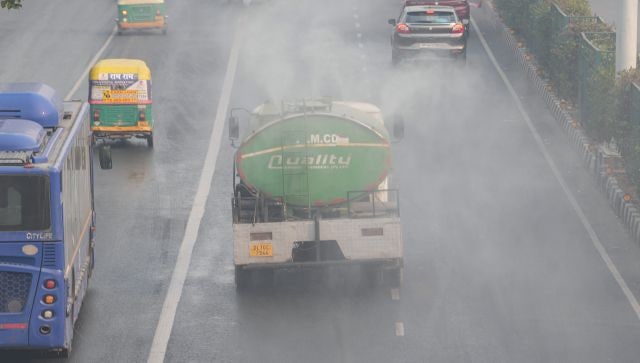 An MCD truck sprinkles water on a road to curb pollution, near Anand Vihar metro station in New Delhi on Monday. The Capital recorded a jump in pollution levels and a smoky haze returned on Monday following Diwali. PTI[/caption]Congress MP Manish Tewari also questioned the bursting of firecrackers in the national capital. “Last night in Lutyens Delhi, firecrackers were bursting till 2 AM in the morning with sparklers, bombs, rockets and every other firecracker used on Deepawali on full & ferocious display. Did the Supreme Court ban Firecrackers?” he wrote in a post on X on Monday.In Chhatarpur, several shopkeepers were seen flouting the ban and selling small firecrackers to children. Until 7:30 pm last night, very few firecrackers were burst in the Lalita Park area of Laxmi Nagar, according to a PTI report.Visuals posted by news agency ANI saw firecracker waste in several areas of Delhi like Gole Market, Paharganj, Ram Nagar Market and Mandir Marg.Before Diwali, the sale of banned firecrackers was thriving in Delhi. Markets in Kamla Nagar, Sadar Bazar, Rajouri Garden, Ramesh Nagar, and near Jama Masjid were going about their illicit business, not even attempting to be discreet, according to a report in Hindustan Times. Some of the sellers even had listings online.Shops were selling sparklers, chakra, flowerpots and rockets, all sold for anywhere between Rs 900 and Rs 1,000. The Delhi Police seized over 10,000 kg of firecrackers between 16 October and 8 November, reports HT.But that was not enough. The toxic air is proof.[caption id="attachment_13382212" align="alignnone" width="640"]
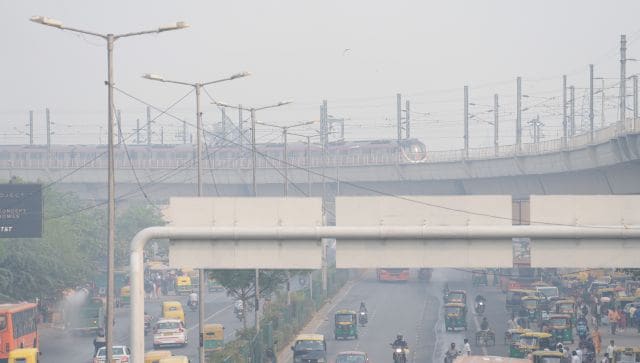 A metro train runs on its track as vehicles ply on a road amid low visibility due to smog, near Anand Vihar metro station in New Delh on Monday. PTI[/caption]What are authorities doing now?Delhi Environment Minister Gopal Rai said that he is conducting a meeting to review the pollution situation on Monday and added that this year people burst fewer crackers.Taking a dig at the Centre, he added that crackers were burnt in some targeted areas. “BJP has government in Centre, UP and Haryana… They didn’t appeal to anyone to not burst crackers… rather promoted cracker bursting.”With inputs from agencies
First Published:Nov 13, 2023, 12:39:15 IST
Advertisement
Advertisement

Military drones & police check-ups: How Sri Lanka is fighting against worst dengue outbreak in a decade
Sri Lanka is fighting its most severe dengue outbreak in nearly a decade, with infections rising sharply across the nation. Military drones have been deployed to tackle the outbreak, which has claimed 56 lives. Health officials said the outbreak is being driven primarily by the DENV-2 variant of the virus
3 min read
How Facebook job ad lured 2 Karnataka men into Myanmar cyber scam camp
The Karnataka Cyber Command has rescued two youths from a scam compound in Myanmar operated by Chinese fraudsters. The duo from Karnataka were lured on the pretext of data-entry jobs. They were asked to work for 16 hours a day and were expected to sleep for six hours daily
4 min read
Why is India seeing 95% cloud cover despite a Super El Niño?
India is witnessing nearly 95 per cent cloud cover despite a Super El Niño, a climate event usually linked to weaker monsoons. Regional weather systems, cyclonic circulations, the monsoon trough and moisture from two seas are temporarily overpowering one of the world's strongest climate phenomena
5 min read
What is CJP’s fourth demand to the government as protests in Delhi intensify?
The protest by the Cockroach Janta Party at Delhi’s Jantar Mantar refuses to die down. The group have made a fourth demand to the Centre, asking that no FIRs are filed against the agitators and that no legal action be taken. The government has expressed willingness to speak to the protesters, but refused to accede on the resignation of Education Minister Dharmandra Pradhan
5 min read
The new geography of war: Why the Houthis can no longer be ignored
The rise of the Houthis marks the emergence of a new geography of war — one in which influence flows not only from capitals and conventional armies, but also from rugged mountains overlooking vital sea lanes
6 min read
Advertisement
Advertisement