
Advertisement


Sections
Hot Mess: How extreme heat is affecting flying in the US
In some parts of the US, airlines are being forced to alter operations in the hardest-hit cities due to extreme temperatures. This is because engine performance and the amount of lift that an aeroplane's wings can produce are both negatively impacted by the heat

Extreme weather is becoming more and more frequent. It is not only raising temperatures but also making flying difficult.In some parts of the United States and around the world, airlines are being forced to alter operations in the hardest-hit cities due to extreme temperatures.This includes cutting fuel loads, letting go of passengers or luggage, or even waiting for daytime temperatures to drop in the evenings to help aircraft fly.But how extreme heat is actually forcing airlines to reduce fuels, and even limit passengers? Let’s take a closer look.The reasonEngine performance and the amount of lift that an airplane's wings can produce are both negatively impacted by high temperatures.According to Federal Aviation Administration (FAA), in order for planes to take off during intense heat, their load must be reduced. This is because as it becomes hotter, air expands more, becoming less dense, making makes taking off more challenging. This impacts both smaller as well as larger passenger aircrafts.Airlines announce weight restriction days when it's really hot, according to USA Today. Therefore, fewer passengers, less luggage, or even less fuel must be carried on board. According to The Arizona Republic, a member of the USA Today Network, the most crucial aspect affecting an airplane's performance in extremely hot weather is its weight upon takeoff.[caption id="attachment_12925352" align="alignnone" width="640"]![]() A sign displays an unofficial temperature as jets taxi at Sky Harbor International Airport at dusk in Phoenix. AP[/caption]When at the gate, airplanes are connected to external cooling equipment, but intense heat might make them ineffective. When a plane stands idle on a tarmac, the mechanism that typically cools and circulates the air pushed into the engines as it leaves the gate is not ideal, explained Texas-based channel Khou.“When exposed to extreme heat exceeding its maximum operating temperature, passengers aboard the airplane could be at risk,” as per Monroe Aerospace.According to the FAA, the airline and the flight crew ultimately decide whether it is safe to fly based on the maximum temperatures and weather. The government organisation does not halt planes.Also read: The Deadly Summer of 2023: Why long heatwaves are here to stayUS airlines affectedEarlier this month, Bloomberg reported that numerous Delta passengers disembarked voluntarily from a trip from Las Vegas to Atlanta after delays due to aircraft weight concerns in the heat.Delta said in a statement, “Additional protocols have been put in place to address the operational impacts extreme heat has on aircraft, including loading less fuel to account for weight and balance and schedule refuelling along the route when needed."On 17 July, some passengers on a Delta flight from Las Vegas to Atlanta who had no air conditioning for four hours on the tarmac suffered from heat exhaustion. The incident was described as "shocking" by Pete Buttigieg, the US secretary of transportation.[caption id="attachment_12925322" align="alignnone" width="640"]
A sign displays an unofficial temperature as jets taxi at Sky Harbor International Airport at dusk in Phoenix. AP[/caption]When at the gate, airplanes are connected to external cooling equipment, but intense heat might make them ineffective. When a plane stands idle on a tarmac, the mechanism that typically cools and circulates the air pushed into the engines as it leaves the gate is not ideal, explained Texas-based channel Khou.“When exposed to extreme heat exceeding its maximum operating temperature, passengers aboard the airplane could be at risk,” as per Monroe Aerospace.According to the FAA, the airline and the flight crew ultimately decide whether it is safe to fly based on the maximum temperatures and weather. The government organisation does not halt planes.Also read: The Deadly Summer of 2023: Why long heatwaves are here to stayUS airlines affectedEarlier this month, Bloomberg reported that numerous Delta passengers disembarked voluntarily from a trip from Las Vegas to Atlanta after delays due to aircraft weight concerns in the heat.Delta said in a statement, “Additional protocols have been put in place to address the operational impacts extreme heat has on aircraft, including loading less fuel to account for weight and balance and schedule refuelling along the route when needed."On 17 July, some passengers on a Delta flight from Las Vegas to Atlanta who had no air conditioning for four hours on the tarmac suffered from heat exhaustion. The incident was described as "shocking" by Pete Buttigieg, the US secretary of transportation.[caption id="attachment_12925322" align="alignnone" width="640"]![]() Travelers queue up at the Delta Airlines ticket counter at Denver International Airport. AP[/caption]In response to the problem, American Airlines has also stated that it is taking extra precautions to ensure that the jet bridges connected to the aircraft are cooled and that auxiliary power units (the smaller engines that provide power when larger engines are shut down) are receiving early maintenance.“Though we’ve had a very small number of diversions and delays related to high temperatures, the plan we have in place has allowed us to avoid significant impact,” an American Airlines spokesperson told Bloomberg.Also read: Record heatwaves sweep the world, from US to Europe and AsiaAirlines workers in extremely hot weatherSome employees of airlines, such as ground staff and baggage handlers, work outside. In really hot weather, that may be risky.According to Delta, American, and United Airlines Holdings Inc., those working outside, such as baggage handlers and those on airport ramps, are given more frequent breaks, more water, access to shaded places with air conditioning, and cooling towels.In a New York Times article, a Phoenix airport employee's experience was mentioned on how working in high heat affects workers. Prospect Airport Services not allowing employees to bring water with them had attracted massive criticism on social media.Responding to the concerns, Sky Harbor tweeted, "We work closely with our airport vendors and stakeholders to ensure their employees have access to water and receive proper information about staying hydrated."A Southwest Airlines representative told The Republic, the company's staff are "trained and experienced in operating during heat conditions," adding that they keep everyone safe by routinely hydrating, donning protective gear, and watching out for one another.Also read: Heat is On: How 3 July becomes the world's hottest day and the worst is yet to comeHeat dome over the USTemperatures in Las Vegas reached 116 degrees Fahrenheit (47 degrees Celsius) on 16 July, while in Phoenix reached 119 degrees Fahrenheit (48.33 degrees Celsius) due to a heat dome across the US south-west.Because safety calculations were not calibrated for 120 degrees Fahrenheit (48.88 degrees Celsius) temperatures, Phoenix's extreme temperatures in 2017 also necessitated the cancellation of 60 flights, mostly by smaller regional jets and older aircraft, over the course of three days.[caption id="attachment_12925332" align="alignnone" width="640"]
Travelers queue up at the Delta Airlines ticket counter at Denver International Airport. AP[/caption]In response to the problem, American Airlines has also stated that it is taking extra precautions to ensure that the jet bridges connected to the aircraft are cooled and that auxiliary power units (the smaller engines that provide power when larger engines are shut down) are receiving early maintenance.“Though we’ve had a very small number of diversions and delays related to high temperatures, the plan we have in place has allowed us to avoid significant impact,” an American Airlines spokesperson told Bloomberg.Also read: Record heatwaves sweep the world, from US to Europe and AsiaAirlines workers in extremely hot weatherSome employees of airlines, such as ground staff and baggage handlers, work outside. In really hot weather, that may be risky.According to Delta, American, and United Airlines Holdings Inc., those working outside, such as baggage handlers and those on airport ramps, are given more frequent breaks, more water, access to shaded places with air conditioning, and cooling towels.In a New York Times article, a Phoenix airport employee's experience was mentioned on how working in high heat affects workers. Prospect Airport Services not allowing employees to bring water with them had attracted massive criticism on social media.Responding to the concerns, Sky Harbor tweeted, "We work closely with our airport vendors and stakeholders to ensure their employees have access to water and receive proper information about staying hydrated."A Southwest Airlines representative told The Republic, the company's staff are "trained and experienced in operating during heat conditions," adding that they keep everyone safe by routinely hydrating, donning protective gear, and watching out for one another.Also read: Heat is On: How 3 July becomes the world's hottest day and the worst is yet to comeHeat dome over the USTemperatures in Las Vegas reached 116 degrees Fahrenheit (47 degrees Celsius) on 16 July, while in Phoenix reached 119 degrees Fahrenheit (48.33 degrees Celsius) due to a heat dome across the US south-west.Because safety calculations were not calibrated for 120 degrees Fahrenheit (48.88 degrees Celsius) temperatures, Phoenix's extreme temperatures in 2017 also necessitated the cancellation of 60 flights, mostly by smaller regional jets and older aircraft, over the course of three days.[caption id="attachment_12925332" align="alignnone" width="640"]![]() A new study, on 25 July, finds these intense and deadly hot spells gripping much of the globe in the American Southwest and Southern Europe could not have occurred without climate change. AP[/caption]Flights "have to wait until the sun goes down, the temperature drops, and they can take off," industry analyst Robert Mann told The Guardian last year, adding, “As temperatures increase, there are going to be more occasions, at more places, where certain flights are going to have to take payload limitations or stop en route because they had to short-load the fuel.”For decades, scientists have warned that a warming planet will result in more intense storms, more heat waves, and other disruptions. Scientific American quoted Rob Britton, a former executive at American Airlines who now teaches at Georgetown University, as saying that airlines have a history of being adept at long-term change planning, but any adaptation approach will incur costs.According to a 2020 report from the International Civil Aviation Organisation, a United Nations organisation, climate change poses a variety of challenges to aviation and will have an impact on the entire system. Airports along the coast will be in danger from rising seas, and stronger storms will cause schedule disruptions and infrastructure damage.The paper warned, “If one airport is directly impacted by climate change, other parts of the network may be affected indirectly, which can cause ripple effects across multiple business and economic sectors."Scientific American also cited a 2017 paper by academics at Columbia University and other institutions as suggesting that increasingly frequent heat waves would force certain airlines to reduce the number of passengers they carry because it is more difficult for aircraft to take off in hotter, thinner air. In some locations, during the hottest weather, aircraft will need to cut their weight by 10 per cent to 30 per cent.With inputs from agencies
A new study, on 25 July, finds these intense and deadly hot spells gripping much of the globe in the American Southwest and Southern Europe could not have occurred without climate change. AP[/caption]Flights "have to wait until the sun goes down, the temperature drops, and they can take off," industry analyst Robert Mann told The Guardian last year, adding, “As temperatures increase, there are going to be more occasions, at more places, where certain flights are going to have to take payload limitations or stop en route because they had to short-load the fuel.”For decades, scientists have warned that a warming planet will result in more intense storms, more heat waves, and other disruptions. Scientific American quoted Rob Britton, a former executive at American Airlines who now teaches at Georgetown University, as saying that airlines have a history of being adept at long-term change planning, but any adaptation approach will incur costs.According to a 2020 report from the International Civil Aviation Organisation, a United Nations organisation, climate change poses a variety of challenges to aviation and will have an impact on the entire system. Airports along the coast will be in danger from rising seas, and stronger storms will cause schedule disruptions and infrastructure damage.The paper warned, “If one airport is directly impacted by climate change, other parts of the network may be affected indirectly, which can cause ripple effects across multiple business and economic sectors."Scientific American also cited a 2017 paper by academics at Columbia University and other institutions as suggesting that increasingly frequent heat waves would force certain airlines to reduce the number of passengers they carry because it is more difficult for aircraft to take off in hotter, thinner air. In some locations, during the hottest weather, aircraft will need to cut their weight by 10 per cent to 30 per cent.With inputs from agencies
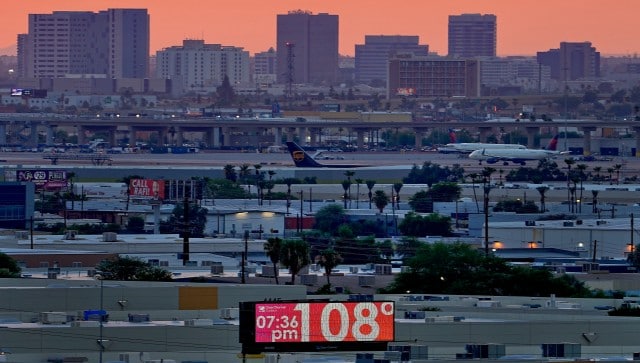 A sign displays an unofficial temperature as jets taxi at Sky Harbor International Airport at dusk in Phoenix. AP[/caption]When at the gate, airplanes are connected to external cooling equipment, but intense heat might make them ineffective. When a plane stands idle on a tarmac, the mechanism that typically cools and circulates the air pushed into the engines as it leaves the gate is not ideal, explained Texas-based channel Khou.“When exposed to extreme heat exceeding its maximum operating temperature, passengers aboard the airplane could be at risk,” as per Monroe Aerospace.According to the FAA, the airline and the flight crew ultimately decide whether it is safe to fly based on the maximum temperatures and weather. The government organisation does not halt planes.Also read: The Deadly Summer of 2023: Why long heatwaves are here to stayUS airlines affectedEarlier this month, Bloomberg reported that numerous Delta passengers disembarked voluntarily from a trip from Las Vegas to Atlanta after delays due to aircraft weight concerns in the heat.Delta said in a statement, “Additional protocols have been put in place to address the operational impacts extreme heat has on aircraft, including loading less fuel to account for weight and balance and schedule refuelling along the route when needed."On 17 July, some passengers on a Delta flight from Las Vegas to Atlanta who had no air conditioning for four hours on the tarmac suffered from heat exhaustion. The incident was described as "shocking" by Pete Buttigieg, the US secretary of transportation.[caption id="attachment_12925322" align="alignnone" width="640"]
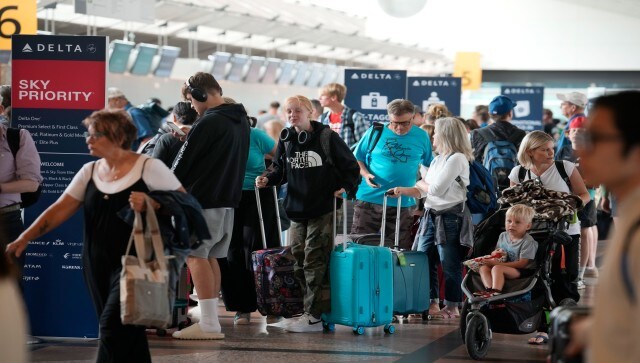 Travelers queue up at the Delta Airlines ticket counter at Denver International Airport. AP[/caption]In response to the problem, American Airlines has also stated that it is taking extra precautions to ensure that the jet bridges connected to the aircraft are cooled and that auxiliary power units (the smaller engines that provide power when larger engines are shut down) are receiving early maintenance.“Though we’ve had a very small number of diversions and delays related to high temperatures, the plan we have in place has allowed us to avoid significant impact,” an American Airlines spokesperson told Bloomberg.Also read: Record heatwaves sweep the world, from US to Europe and AsiaAirlines workers in extremely hot weatherSome employees of airlines, such as ground staff and baggage handlers, work outside. In really hot weather, that may be risky.According to Delta, American, and United Airlines Holdings Inc., those working outside, such as baggage handlers and those on airport ramps, are given more frequent breaks, more water, access to shaded places with air conditioning, and cooling towels.In a New York Times article, a Phoenix airport employee's experience was mentioned on how working in high heat affects workers. Prospect Airport Services not allowing employees to bring water with them had attracted massive criticism on social media.Responding to the concerns, Sky Harbor tweeted, "We work closely with our airport vendors and stakeholders to ensure their employees have access to water and receive proper information about staying hydrated."A Southwest Airlines representative told The Republic, the company's staff are "trained and experienced in operating during heat conditions," adding that they keep everyone safe by routinely hydrating, donning protective gear, and watching out for one another.Also read: Heat is On: How 3 July becomes the world's hottest day and the worst is yet to comeHeat dome over the USTemperatures in Las Vegas reached 116 degrees Fahrenheit (47 degrees Celsius) on 16 July, while in Phoenix reached 119 degrees Fahrenheit (48.33 degrees Celsius) due to a heat dome across the US south-west.Because safety calculations were not calibrated for 120 degrees Fahrenheit (48.88 degrees Celsius) temperatures, Phoenix's extreme temperatures in 2017 also necessitated the cancellation of 60 flights, mostly by smaller regional jets and older aircraft, over the course of three days.[caption id="attachment_12925332" align="alignnone" width="640"]
 A new study, on 25 July, finds these intense and deadly hot spells gripping much of the globe in the American Southwest and Southern Europe could not have occurred without climate change. AP[/caption]Flights "have to wait until the sun goes down, the temperature drops, and they can take off," industry analyst Robert Mann told The Guardian last year, adding, “As temperatures increase, there are going to be more occasions, at more places, where certain flights are going to have to take payload limitations or stop en route because they had to short-load the fuel.”For decades, scientists have warned that a warming planet will result in more intense storms, more heat waves, and other disruptions. Scientific American quoted Rob Britton, a former executive at American Airlines who now teaches at Georgetown University, as saying that airlines have a history of being adept at long-term change planning, but any adaptation approach will incur costs.According to a 2020 report from the International Civil Aviation Organisation, a United Nations organisation, climate change poses a variety of challenges to aviation and will have an impact on the entire system. Airports along the coast will be in danger from rising seas, and stronger storms will cause schedule disruptions and infrastructure damage.The paper warned, “If one airport is directly impacted by climate change, other parts of the network may be affected indirectly, which can cause ripple effects across multiple business and economic sectors."Scientific American also cited a 2017 paper by academics at Columbia University and other institutions as suggesting that increasingly frequent heat waves would force certain airlines to reduce the number of passengers they carry because it is more difficult for aircraft to take off in hotter, thinner air. In some locations, during the hottest weather, aircraft will need to cut their weight by 10 per cent to 30 per cent.With inputs from agencies
First Published:Jul 27, 2023, 18:04:22 IST
Advertisement
Advertisement

Military drones & police check-ups: How Sri Lanka is fighting against worst dengue outbreak in a decade
Sri Lanka is fighting its most severe dengue outbreak in nearly a decade, with infections rising sharply across the nation. Military drones have been deployed to tackle the outbreak, which has claimed 56 lives. Health officials said the outbreak is being driven primarily by the DENV-2 variant of the virus
3 min read
How Facebook job ad lured 2 Karnataka men into Myanmar cyber scam camp
The Karnataka Cyber Command has rescued two youths from a scam compound in Myanmar operated by Chinese fraudsters. The duo from Karnataka were lured on the pretext of data-entry jobs. They were asked to work for 16 hours a day and were expected to sleep for six hours daily
4 min read
Why is India seeing 95% cloud cover despite a Super El Niño?
India is witnessing nearly 95 per cent cloud cover despite a Super El Niño, a climate event usually linked to weaker monsoons. Regional weather systems, cyclonic circulations, the monsoon trough and moisture from two seas are temporarily overpowering one of the world's strongest climate phenomena
5 min read
What is CJP’s fourth demand to the government as protests in Delhi intensify?
The protest by the Cockroach Janta Party at Delhi’s Jantar Mantar refuses to die down. The group have made a fourth demand to the Centre, asking that no FIRs are filed against the agitators and that no legal action be taken. The government has expressed willingness to speak to the protesters, but refused to accede on the resignation of Education Minister Dharmandra Pradhan
5 min read
The new geography of war: Why the Houthis can no longer be ignored
The rise of the Houthis marks the emergence of a new geography of war — one in which influence flows not only from capitals and conventional armies, but also from rugged mountains overlooking vital sea lanes
6 min read
Advertisement
Advertisement