


History Today: 2 Sikh bodyguards, over 30 bullets… The tale of Indira Gandhi’s gruesome assassination
Forty-one years ago, on this day (October 31), India’s Prime Minister Indira Gandhi was killed as she stepped out of her New Delhi residence by two of her Sikh bodyguards. The assassins pumped more than 30 bullets into her before other security arrived at the scene and killed one and grievously injured the other. It’s also on this day in 1941 that 12 years of labour resulted in the completion of Mount Rushmore in the US

Forty-one years ago, in 1984, on this day, India was stunned into silence and shock when India’s Prime Minister Indira Gandhi was assassinated on the lawn of her residence by none other than her own two bodyguards.
The assassination of Indira Gandhi also spurred what is described as perhaps the worst riots the country has ever seen, with more than 1,000 innocent Sikhs being killed in indiscriminate attacks over the course of two days. It also led to Gandhi’s son, Rajiv, succeeding her as prime minister.
In this edition of Firstpost’s ongoing series of History Today, we explore the events that led to Indira Gandhi’s assassination and the aftermath of it.
The assassination of Indira Gandhi
It was like any ordinary day for Indira Gandhi on October 31, 1984. The ‘Iron Lady’ as she was often referred to, had stepped out of her 1 Safdarjung Road residence in Delhi when she received news that an Irish television team led by the renowned British actor, Peter Ustinov, was ready for their scheduled meeting.
 More from Explainers
As Gandhi came out and began walking towards the lawns of the adjoining 1, Akbar Road bungalow forming part of the Prime Minister’s house complex, tragedy struck when her two Sikh bodyguards — Satwant Singh and Beant Singh — pulled out their guns and shot her.
https://youtube.com/shorts/NblJOYtsnvM?si=L8kaSXAmOvuOBSgl
Narain Singh, the man carrying an umbrella for Gandhi at the time, threw the umbrella shouting for help. But before he and other guards of the Indo-Tibetan Border Force could reach the spot, the assassins had pumped over 30 bullets into Gandhi’s body.
When Sonia Gandhi, her daughter-in-law, heard the commotion, she rushed out of her house even though she had just washed her hair and sprinted towards Gandhi, screaming ‘Mummy, mummy’.
Sonia cradled Indira’s head on her lap as the white ambassador raced the three kilometre distance to Delhi’s All India Medical Institute of Medical Sciences (AIIMS). Indira was perhaps dead on arrival but doctors laboured for hours to revive her, giving her uninterrupted blood transfusions.
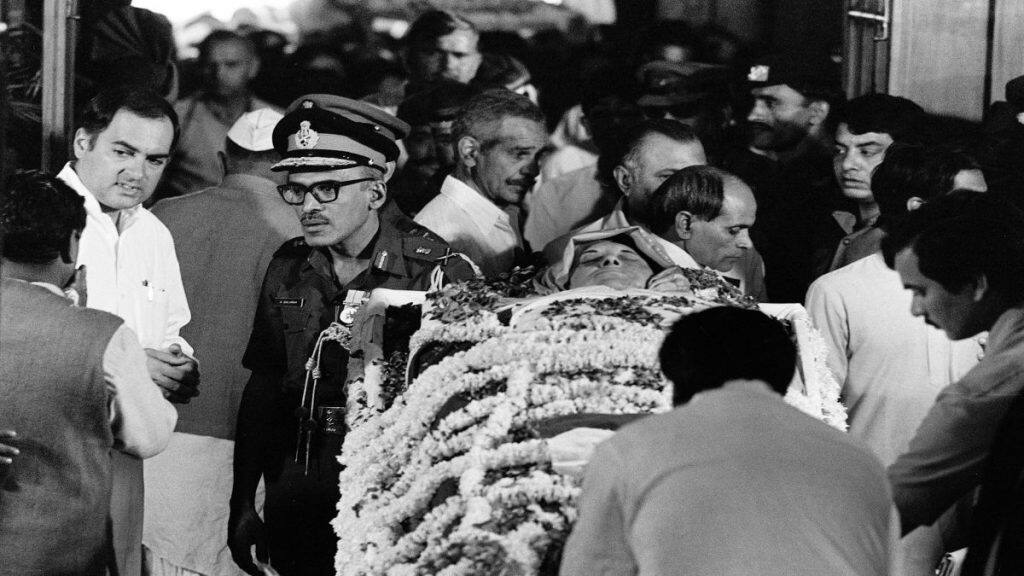
Meanwhile, her assassins were taken down by the other security at the spot. While Beant Singh, died on the spot, the other, Satwant Singh, was hospitalised with serious gunshot wounds. He later stood trial and was convicted in 1986 and executed in 1989.
No one had imagined that Gandhi would be assassinated, no less at the hands of her bodyguards. After all, just weeks earlier, she rather proudly pointed at Beant Singh saying, “When I have Sikhs like him around me, then I do not have to fear anything.”
Experts and the public note that Indira Gandhi’s assassination was a direct consequence of the tensions from Operation Blue Star. Earlier, PM Gandhi had mandated the Indian Army in June to remove Jarnail Singh Bhindranwale, a militant Sikh leader and his followers, all of whom were hiding at the temple.
Following her assassination, violent riots broke out in the Capital, which saw the deaths of many Sikhs.
Till date, Gandhi’s assassination and the aftermath are remembered with grief and shock.
Mount Rushmore is completed
Today, Mount Rushmore is one of America’s most famous tourist sites, attracting over two million visitors each year. But all of this was only possible after work on this sculpture within the Black Hills National Forest in South Dakota was completed on October 31, 1941.
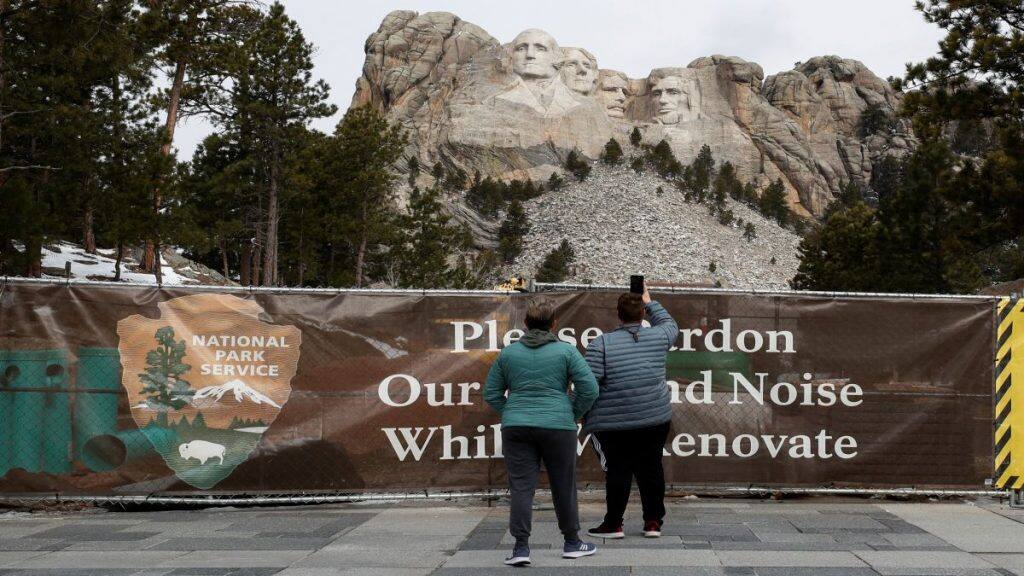
Formally known as the Mount Rushmore National Memorial, it pays tribute to four United States presidents — George Washington, Thomas Jefferson, Theodore Roosevelt, and Abraham Lincoln. The idea of creating a monumental sculpture in the Black Hills was first suggested in 1923 by South Dakota state historian Doane Robinson, who had proposed creating likenesses of famous Native American and American Old West personalities on a needlelike rock formation in Custer State Park.
However, American sculptor Gutzon Borglum, who was hired to design and execute the project, chose nearby Mount Rushmore with its solid granite rock face and proposed the four presidents to symbolise the first 150 years of the country — Washington to represent the country’s founding; Jefferson, its expansion across the continent; Roosevelt, its development domestically and as a global power; and Lincoln, its preservation through the ordeal of civil war.
Work on this began on October 4, 1927 and it took another 12 years and multiple challenges to complete work on this mountain of a tribute.
Bitcoin is first introduced through a paper
Before Bitcoin became famous, it was on October 31, 2008, Satoshi Nakamoto, the mysterious and anonymous inventor of Bitcoin, released the Bitcoin white paper, introducing the cryptocurrency—and how it could be used — to the world. By design, only 21 million Bitcoins will ever be “mined,” or released into the market.
Titled Bitcoin: A Peer-to-Peer Electronic Cash System, the nine-page thesis paper established the basic structure for the Bitcoin network. It also presented the idea of the decentralised cryptocurrency, or an electronic currency (think “digital cash”) that can make transactions with low costs while using no financial institutions or third parties.

When the white paper was released, the central idea of cryptocurrency itself had already existed. The paper’s major breakthrough, however, was convincing Bitcoin users to trust each other — and the Bitcoin network — without the presence of gatekeepers like a centralised bank or government. According to Emin Gün Sirer, a computer science professor at Cornell University, “Satoshi opened the door to revamping the entire finance industry.”
Since then, Bitcoin has risen from a fringe idea to global popularity, as investors began to see it as a place to park wealth or hedge against inflation, and as institutions found ways to create crypto-focused financial instruments.
This Day, That Year
In 1864, US President Abraham Lincoln signed a proclamation making Nevada the 36th state, eight days before the presidential election.
In 1961, the body of Josef Stalin was removed from Lenin’s Tomb as part of the Soviet Union’s “de-Stalinisation” drive.
In 1999, EgyptAir Flight 990, bound from New York to Cairo, crashed off the Massachusetts coast, killing all 217 people aboard.
With inputs from agencies

Military drones & police check-ups: How Sri Lanka is fighting against worst dengue outbreak in a decade
How Facebook job ad lured 2 Karnataka men into Myanmar cyber scam camp
Why is India seeing 95% cloud cover despite a Super El Niño?
What is CJP’s fourth demand to the government as protests in Delhi intensify?
The new geography of war: Why the Houthis can no longer be ignored