
Advertisement


Sections
Gyanvapi: What is the ASI’s scientific survey that Allahabad High Court has now allowed?
The Allahabad High Court has dismissed the Muslim side’s petition, allowing for the Archaeological Survey of India’s scientific survey at the Gyanvapi Mosque premises. The investigation will include the use of Ground Penetrating Radar and carbon dating at the disputed religious site

The Archaeological Survey of India’s ‘scientific survey’ at the Gyanvapi Mosque in Uttar Pradesh will now go ahead, courtesy the Allahabad High Court’s ruling.On Thursday (3 August), bench of Chief Justice Pritinker Diwaker ruled, “Issue of a commission is permissible. The Varanasi Court was justified in ordering for ASI survey of the premises. Scientific survey is necessary in the interest of justice.”The ruling came after the Anjuman Mosque Committee had earlier petitioned the court on 25 July, challenging the ASI survey.Following the decision, Vishnu Shankar Jain, representing the Hindu side in the Gyanvapi mosque survey case, was quoted as saying: “Allahabad High Court has said that ASI survey of Gyanvapi mosque complex will start. Sessions court order is upheld by the High Court.”We take a closer look at what exactly is this ASI’s scientific survey all about and why had it been stopped earlier.What is the ASI’s scientific survey?Earlier, the Varanasi court had issued directions for a “scientific investigation/survey/excavation” of the mosque premises. District judge A K Vishvesh directed that a detailed scientific investigation by using GPR (Ground Penetrating Radar) survey, excavation, carbon dating method and other modern techniques of the present structure to find out as to whether same has been constructed over a pre-existing structure of Hindu temple.It specifically directed the use of GPR technology for survey “just below the three domes of the building in question”, and to conduct an excavation there “if required”.However, the wazukhana is to be excluded from the survey as it was sealed last year on the orders of the Supreme Court after the Hindu side had argued of the presence of a Shivling, while the Muslims said the object was a fountain.The ASI scientific survey will include carbon dating, a method used to determine the age of matter that was once living. Developed by American chemist Willard Libby in 1946, carbon dating can also be to determine the age of objects younger than 50,000 years.Radiocarbon dating works by comparing the three different isotopes of carbon. The most abundant, carbon-12, remains stable in the atmosphere. On the other hand, carbon-14 is radioactive and decays into nitrogen-14 over time.According to experts, the dead organisms within the inanimate objects can help in deciding when the particular object reached that place.However, carbon dating is not always precise. As science journal Nature explains, the method assumes the amount of carbon-14 in the atmosphere has been constant in time and space, which is not true.Moreover, carbon emissions from fossil fuels are disturbing the ratio of carbon-12 and carbon-14 in the atmosphere, reports Smithsonian magazine. “In a couple of decades, we will not be able to distinguish if any radiocarbon age we get out or carbon might be from the past or from the future,” fears Peter Köhler, a physicist at the Alfred Wegener Institute for Polar and Marine Research.However, despite its shortcomings, carbon dating is the most accurate dating tool at archaeologists’ disposal currently.Besides carbon dating, the scientific survey at the Gyanvapi premises is to also include the use of GPR technology. For the unaware, GPR is a method of surveying subsurface materials. Using electromagnetic radar pulses, GPR can image materials in the ground, concrete, rock, ice and other structures without disturbing the surface. This could be particularly helpful in the Gyanvapi mosque as it won’t disturb or damage anything at the surface level.[caption id="attachment_12952362" align="alignnone" width="640"]![]() Security personnel stand guard outside the Gyanvapi Mosque complex in Varanasi. File image/PTI[/caption]Why was the ASI survey stopped earlier?On 24 July, the ASI team, comprising of 30 members, had gathered at the premises of the disputed mosque and were all prepared to carry out their examinations on the basis of an ordered passed down by the Varanasi district court.However, just hours before they were to begin their probe, the mosque committee had moved the Supreme Court, challenging the order. The counsel for the mosque committee had expressed his apprehension that the survey and excavation would cause damage to the structure.Also read: History of the Gyanvapi mosque disputeThe apex court had then stayed the ASI survey until 5 pm on 26 July so as to allow some “breathing time” to the masjid committee to approach the high court. The high court then extended the stay on 27 July until today – 3 August.[caption id="attachment_12906712" align="alignnone" width="640"]
Security personnel stand guard outside the Gyanvapi Mosque complex in Varanasi. File image/PTI[/caption]Why was the ASI survey stopped earlier?On 24 July, the ASI team, comprising of 30 members, had gathered at the premises of the disputed mosque and were all prepared to carry out their examinations on the basis of an ordered passed down by the Varanasi district court.However, just hours before they were to begin their probe, the mosque committee had moved the Supreme Court, challenging the order. The counsel for the mosque committee had expressed his apprehension that the survey and excavation would cause damage to the structure.Also read: History of the Gyanvapi mosque disputeThe apex court had then stayed the ASI survey until 5 pm on 26 July so as to allow some “breathing time” to the masjid committee to approach the high court. The high court then extended the stay on 27 July until today – 3 August.[caption id="attachment_12906712" align="alignnone" width="640"]![]() The Gyanvapi Mosque row is a long disputed issue. The Hindu litigants argue of a presence of a shivling inside the premises, while the Muslim side argues that it is a fountain. PTI[/caption]What is the row exactly?The row in courts currently stems from a group of women approaching a lower court in Varanasi, seeking permission to worship Mata Shringar Gauri (a Hindu goddess) and other gods and goddesses inside the disputed Gyanvapi Mosque complex.Also read: The Hindu women petitioners fighting to pray at the Gyanvapi mosqueThe court then ordered a video survey of the complex based on this petition in 2022. During the survey, a structure was discovered that the petitioners claimed were a ‘shivling’. However, the mosque management committee said the structure was part of a fountain in the ‘wazukhana’, which is an area filled with water where people wash their hands and feet before praying.Considering the sensitivity of the case, the Supreme Court ordered the sealing of the alleged ‘shivling’ area. In September 2022, the Varanasi district Court dismissed a challenge by the mosque committee, which argued that the women’s request to worship Hindu deities inside the complex premises was not maintainable.With inputs from agencies
The Gyanvapi Mosque row is a long disputed issue. The Hindu litigants argue of a presence of a shivling inside the premises, while the Muslim side argues that it is a fountain. PTI[/caption]What is the row exactly?The row in courts currently stems from a group of women approaching a lower court in Varanasi, seeking permission to worship Mata Shringar Gauri (a Hindu goddess) and other gods and goddesses inside the disputed Gyanvapi Mosque complex.Also read: The Hindu women petitioners fighting to pray at the Gyanvapi mosqueThe court then ordered a video survey of the complex based on this petition in 2022. During the survey, a structure was discovered that the petitioners claimed were a ‘shivling’. However, the mosque management committee said the structure was part of a fountain in the ‘wazukhana’, which is an area filled with water where people wash their hands and feet before praying.Considering the sensitivity of the case, the Supreme Court ordered the sealing of the alleged ‘shivling’ area. In September 2022, the Varanasi district Court dismissed a challenge by the mosque committee, which argued that the women’s request to worship Hindu deities inside the complex premises was not maintainable.With inputs from agencies
 Security personnel stand guard outside the Gyanvapi Mosque complex in Varanasi. File image/PTI[/caption]Why was the ASI survey stopped earlier?On 24 July, the ASI team, comprising of 30 members, had gathered at the premises of the disputed mosque and were all prepared to carry out their examinations on the basis of an ordered passed down by the Varanasi district court.However, just hours before they were to begin their probe, the mosque committee had moved the Supreme Court, challenging the order. The counsel for the mosque committee had expressed his apprehension that the survey and excavation would cause damage to the structure.Also read: History of the Gyanvapi mosque disputeThe apex court had then stayed the ASI survey until 5 pm on 26 July so as to allow some “breathing time” to the masjid committee to approach the high court. The high court then extended the stay on 27 July until today – 3 August.[caption id="attachment_12906712" align="alignnone" width="640"]
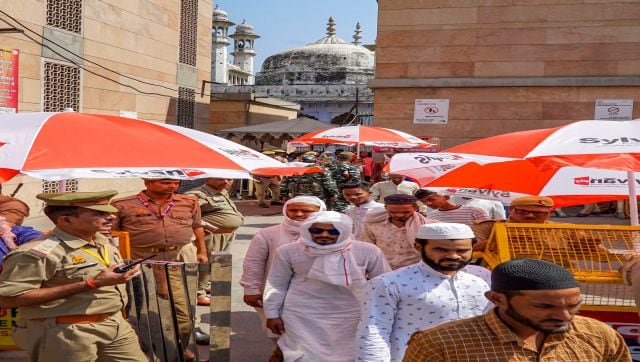 The Gyanvapi Mosque row is a long disputed issue. The Hindu litigants argue of a presence of a shivling inside the premises, while the Muslim side argues that it is a fountain. PTI[/caption]What is the row exactly?The row in courts currently stems from a group of women approaching a lower court in Varanasi, seeking permission to worship Mata Shringar Gauri (a Hindu goddess) and other gods and goddesses inside the disputed Gyanvapi Mosque complex.Also read: The Hindu women petitioners fighting to pray at the Gyanvapi mosqueThe court then ordered a video survey of the complex based on this petition in 2022. During the survey, a structure was discovered that the petitioners claimed were a ‘shivling’. However, the mosque management committee said the structure was part of a fountain in the ‘wazukhana’, which is an area filled with water where people wash their hands and feet before praying.Considering the sensitivity of the case, the Supreme Court ordered the sealing of the alleged ‘shivling’ area. In September 2022, the Varanasi district Court dismissed a challenge by the mosque committee, which argued that the women’s request to worship Hindu deities inside the complex premises was not maintainable.With inputs from agencies
First Published:Aug 03, 2023, 11:15:15 IST
Advertisement
Advertisement

Military drones & police check-ups: How Sri Lanka is fighting against worst dengue outbreak in a decade
Sri Lanka is fighting its most severe dengue outbreak in nearly a decade, with infections rising sharply across the nation. Military drones have been deployed to tackle the outbreak, which has claimed 56 lives. Health officials said the outbreak is being driven primarily by the DENV-2 variant of the virus
3 min read
How Facebook job ad lured 2 Karnataka men into Myanmar cyber scam camp
The Karnataka Cyber Command has rescued two youths from a scam compound in Myanmar operated by Chinese fraudsters. The duo from Karnataka were lured on the pretext of data-entry jobs. They were asked to work for 16 hours a day and were expected to sleep for six hours daily
4 min read
Why is India seeing 95% cloud cover despite a Super El Niño?
India is witnessing nearly 95 per cent cloud cover despite a Super El Niño, a climate event usually linked to weaker monsoons. Regional weather systems, cyclonic circulations, the monsoon trough and moisture from two seas are temporarily overpowering one of the world's strongest climate phenomena
5 min read
What is CJP’s fourth demand to the government as protests in Delhi intensify?
The protest by the Cockroach Janta Party at Delhi’s Jantar Mantar refuses to die down. The group have made a fourth demand to the Centre, asking that no FIRs are filed against the agitators and that no legal action be taken. The government has expressed willingness to speak to the protesters, but refused to accede on the resignation of Education Minister Dharmandra Pradhan
5 min read
The new geography of war: Why the Houthis can no longer be ignored
The rise of the Houthis marks the emergence of a new geography of war — one in which influence flows not only from capitals and conventional armies, but also from rugged mountains overlooking vital sea lanes
6 min read
Advertisement
Advertisement