
Advertisement


Sections
Why did Israel bomb Gaza’s largest refugee camp?
Israel’s airstrikes hit Jabalia refugee camp near Gaza City, the largest in the enclave, killing at least 50 people and leaving 150 injured. The Israeli military claims that Hamas had taken over civilian buildings in the area and the attack killed the ringleader of the Oct 7 assault

Israel has been accused of war crimes in Gaza. The airstrikes continue to pummel the Hamas-control enclave even as the military says it has expanded its ground operations. The latest attack has come on the largest refugee camp in the northern part of the territory. The strike on the Jabalia camp has led to several more deaths.Israel claims that it targeted a senior Hamas leader and destroyed a militant command centre and an underground tunnel network. But the Palestinian group has a different story to tell.We take a look at what happened at the Jabalia refugee camp.What do we know about the airstrikes at Jabalia?A barrage of Israeli airstrikes hit the Jabalia refugee camp near Gaza City, levelling several apartment buildings on Tuesday.An eyewitness, Mohammad Ibrahim, told CNN that he was in line to buy bread when “seven to eight missiles fell” without any warning. “There were seven to eight huge holes in the ground, full of killed people, body parts all over the place… It felt like the end of the world,” he said describing the scene of the attack.[caption id="attachment_13327082" align="alignnone" width="640"]![]() Palestinians look for survivors among the rubble of destroyed buildings following Israeli airstrikes on Jabalia refugee camp. AP[/caption]The Jabalia refugee camp is a densely built-up area of small streets on Gaza City's outskirts. The explosion left large craters in the area. It is now full of rubble, surrounded by damaged concrete buildings.Also read: How Israel’s ground offensive is unfolding in Gaza and what we can expect nextHow many people died in the Jabalia attack?The exact toll from the attack camp is not known. According to Gaza’s health ministry, 50 people were killed and 150 injured. “More than 50 martyrs and around 150 wounded and dozens under the rubble, in a heinous Israeli massacre that targeted a large area of homes in Jabalia camp in the northern [Gaza] Strip,” the Hamas-controlled ministry statement said.Another Hamas statement said there were 400 dead and injured in Jabalia, which houses families of refugees from wars with Israel dating back to 1948.[caption id="attachment_13327092" align="alignnone" width="640"]
Palestinians look for survivors among the rubble of destroyed buildings following Israeli airstrikes on Jabalia refugee camp. AP[/caption]The Jabalia refugee camp is a densely built-up area of small streets on Gaza City's outskirts. The explosion left large craters in the area. It is now full of rubble, surrounded by damaged concrete buildings.Also read: How Israel’s ground offensive is unfolding in Gaza and what we can expect nextHow many people died in the Jabalia attack?The exact toll from the attack camp is not known. According to Gaza’s health ministry, 50 people were killed and 150 injured. “More than 50 martyrs and around 150 wounded and dozens under the rubble, in a heinous Israeli massacre that targeted a large area of homes in Jabalia camp in the northern [Gaza] Strip,” the Hamas-controlled ministry statement said.Another Hamas statement said there were 400 dead and injured in Jabalia, which houses families of refugees from wars with Israel dating back to 1948.[caption id="attachment_13327092" align="alignnone" width="640"]![]() In this frame grab from a video, Palestinians are seen inside a heavily damaged apartment building following Israeli airstrikes at the Jabalia refugee camp. At least 50 people have been killed in the attack. AP[/caption]Al-Jazeera reported that one of its employees lost 19 members of his family in Tuesday’s airstrike. Al-Qumsan lost his father, two sisters, eight nephews and nieces, his brother, his brother’s wife and their four children, his sister-in-law, and one uncle.Firstpost cannot verify the casualty figures independently.Why did Israel attack a refugee camp?The Israeli military claimed to carry out a wide-scale strike in Jabalia on Hamas infrastructure “that had taken over civilian buildings”. The airstrikes killed dozens of militants, including a key Hamas commander for northern Gaza, it said.Israel aggressively defended the attack, with military spokesman Jonathan Conricus saying the targeted commander had also been a key planner of the bloody Oct 7 rampage that started the war. According to him, apartment buildings collapsed only because the vast underground Hamas complex had been destroyed. He later said the main strike had hit between buildings.An Israel Defense Forces (IDF) statement said the strike on the Jabalia camp killed Ibrahim Biari, who was a ringleader of what it called the “murderous terror attack” on 7 October.However, a Hamas spokesperson denied the presence of any senior commander at the camp and called the claim an Israeli pretext for killing civilians.[caption id="attachment_13327122" align="alignnone" width="640"]
In this frame grab from a video, Palestinians are seen inside a heavily damaged apartment building following Israeli airstrikes at the Jabalia refugee camp. At least 50 people have been killed in the attack. AP[/caption]Al-Jazeera reported that one of its employees lost 19 members of his family in Tuesday’s airstrike. Al-Qumsan lost his father, two sisters, eight nephews and nieces, his brother, his brother’s wife and their four children, his sister-in-law, and one uncle.Firstpost cannot verify the casualty figures independently.Why did Israel attack a refugee camp?The Israeli military claimed to carry out a wide-scale strike in Jabalia on Hamas infrastructure “that had taken over civilian buildings”. The airstrikes killed dozens of militants, including a key Hamas commander for northern Gaza, it said.Israel aggressively defended the attack, with military spokesman Jonathan Conricus saying the targeted commander had also been a key planner of the bloody Oct 7 rampage that started the war. According to him, apartment buildings collapsed only because the vast underground Hamas complex had been destroyed. He later said the main strike had hit between buildings.An Israel Defense Forces (IDF) statement said the strike on the Jabalia camp killed Ibrahim Biari, who was a ringleader of what it called the “murderous terror attack” on 7 October.However, a Hamas spokesperson denied the presence of any senior commander at the camp and called the claim an Israeli pretext for killing civilians.[caption id="attachment_13327122" align="alignnone" width="640"]![]() Palestinians look for survivors among the rubble of destroyed buildings in Jabalia on 31 October. Israel claims that Hamas has taken over civilian infrastructure in the area. AP[/caption]Israel’s Brig Gen Daniel Hagari said an underground Hamas installation beneath a targeted building collapsed, toppling other nearby buildings. “We don’t intend for the ground to collapse,” he told reporters. “But the issue is that Hamas built their tunnels there and that they're running their operations from there.”Conricus said the attack had involved more than one bomb, but he did not elaborate. The IDF, he said, was looking into reports of “collateral damage” and “non-combatant casualties”. According to him, northern Gaza was “the very heartland of Hamas”The account of neither camp could be independently confirmed.Also read: What will happen if Israel invades Gaza?What happened in the aftermath of the attack?Grey dust, apparently left by pulverised concrete, seemed to coat nearly everything. Rescuers clawed through the destruction to pull men, women, and children buried under the rubble, reports The Associated Press.Young men carried the limp forms of two children from the upper floors of the crumbling frame of one damaged apartment building while helping down another child and woman. It was unclear whether the children were alive or dead.“I went and saw the destruction… homes buried under the rubble and body parts and martyrs and wounded in huge numbers,” 41-year-old Jabalia resident Ragheb Aqal told the news outlet AFP.[caption id="attachment_13327132" align="alignnone" width="640"]
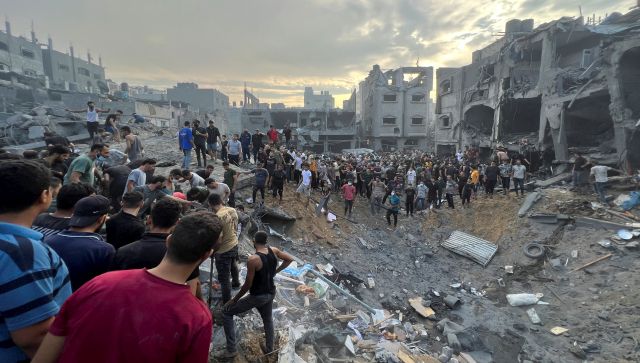
Palestinians look for survivors among the rubble of destroyed buildings in Jabalia on 31 October. Israel claims that Hamas has taken over civilian infrastructure in the area. AP[/caption]Israel’s Brig Gen Daniel Hagari said an underground Hamas installation beneath a targeted building collapsed, toppling other nearby buildings. “We don’t intend for the ground to collapse,” he told reporters. “But the issue is that Hamas built their tunnels there and that they're running their operations from there.”Conricus said the attack had involved more than one bomb, but he did not elaborate. The IDF, he said, was looking into reports of “collateral damage” and “non-combatant casualties”. According to him, northern Gaza was “the very heartland of Hamas”The account of neither camp could be independently confirmed.Also read: What will happen if Israel invades Gaza?What happened in the aftermath of the attack?Grey dust, apparently left by pulverised concrete, seemed to coat nearly everything. Rescuers clawed through the destruction to pull men, women, and children buried under the rubble, reports The Associated Press.Young men carried the limp forms of two children from the upper floors of the crumbling frame of one damaged apartment building while helping down another child and woman. It was unclear whether the children were alive or dead.“I went and saw the destruction… homes buried under the rubble and body parts and martyrs and wounded in huge numbers,” 41-year-old Jabalia resident Ragheb Aqal told the news outlet AFP.[caption id="attachment_13327132" align="alignnone" width="640"]![]() A Palestinian man walks at the site of Israeli strikes on houses in Jabalia in the northern Gaza Strip, on 19 October. Tuesday's attack caused further damage in the area. File photo/Reuters[/caption]Another eyewitness Mohammad Al Aswad described a “horrific scene” after the attack to CNN. “Children were carrying other injured children and running, with grey dust filling the air. Bodies were hanging on the rubble, many of them unrecognised. Some were bleeding and others were burnt,” he told the publication on the phone.Mohammed Hawajreh, a nurse with Doctors Without Borders (MSF) at the Al Shifa hospital in Gaza, said the group is “horrified” by the Israeli airstrike on Jabalia refugee camp, reports CNN.“Young children arrived at the hospital with deep wounds and severe burns. They came without their families. Many were screaming and asking for their parents. I stayed with them until we could find a place, as the hospital was full with patients,” Hawajreh said in a statement released Tuesday.[caption id="attachment_13327182" align="alignnone" width="640"]
A Palestinian man walks at the site of Israeli strikes on houses in Jabalia in the northern Gaza Strip, on 19 October. Tuesday's attack caused further damage in the area. File photo/Reuters[/caption]Another eyewitness Mohammad Al Aswad described a “horrific scene” after the attack to CNN. “Children were carrying other injured children and running, with grey dust filling the air. Bodies were hanging on the rubble, many of them unrecognised. Some were bleeding and others were burnt,” he told the publication on the phone.Mohammed Hawajreh, a nurse with Doctors Without Borders (MSF) at the Al Shifa hospital in Gaza, said the group is “horrified” by the Israeli airstrike on Jabalia refugee camp, reports CNN.“Young children arrived at the hospital with deep wounds and severe burns. They came without their families. Many were screaming and asking for their parents. I stayed with them until we could find a place, as the hospital was full with patients,” Hawajreh said in a statement released Tuesday.[caption id="attachment_13327182" align="alignnone" width="640"]![]() Palestinians search for casualties at the site of Israeli strikes on houses in Jabalia refugee camp in the northern Gaza Strip. Reuters[/caption]How has the world reacted to the attack?Palestinian ambassador to the United Nations has said the strike on the refugee camp was a crime. Ambassador Riyad Mansour, the Permanent Observer of the State of Palestine to the United Nations, urged the International Criminal Court (ICC) to take action.“Those who are responsible for giving the orders for that crime should hear something from Mr Khan from the ICC,” Mansour told CNN, referring to ICC prosecutor Karim Khan. “If he has the courage, and I hope he does.”Saudi Arabia has condemned Israel’s “inhumane targeting” of the Jabalia refugee camp. “The Kingdom of Saudi Arabia condemns in the strongest terms possible the inhumane targeting by the Israeli occupation forces of the Jabalia refugee camp in the besieged Gaza Strip,” a statement shared by Saudi Arabia’s foreign ministry said.Humanitarian groups have condemned Israel’s attack on the Jabalia refugee camp, saying the air raid should be a “wake-up call” to world leaders to secure a ceasefire in Gaza, reports Al-Jazeera.The attack comes as Bolivia is cutting diplomatic ties with Israel over the “aggressive and disproportionate” attacks on Gaza. Deputy foreign minister Freddy Mamani told reporters that their decision was “in repudiation and condemnation of the aggressive and disproportionate Israeli military offensive being carried out in the Gaza Strip”.Separately, the leaders of Colombia and Chile have recalled their ambassadors to Israel in protest, reports the BBC.With inputs from agencies
Palestinians search for casualties at the site of Israeli strikes on houses in Jabalia refugee camp in the northern Gaza Strip. Reuters[/caption]How has the world reacted to the attack?Palestinian ambassador to the United Nations has said the strike on the refugee camp was a crime. Ambassador Riyad Mansour, the Permanent Observer of the State of Palestine to the United Nations, urged the International Criminal Court (ICC) to take action.“Those who are responsible for giving the orders for that crime should hear something from Mr Khan from the ICC,” Mansour told CNN, referring to ICC prosecutor Karim Khan. “If he has the courage, and I hope he does.”Saudi Arabia has condemned Israel’s “inhumane targeting” of the Jabalia refugee camp. “The Kingdom of Saudi Arabia condemns in the strongest terms possible the inhumane targeting by the Israeli occupation forces of the Jabalia refugee camp in the besieged Gaza Strip,” a statement shared by Saudi Arabia’s foreign ministry said.Humanitarian groups have condemned Israel’s attack on the Jabalia refugee camp, saying the air raid should be a “wake-up call” to world leaders to secure a ceasefire in Gaza, reports Al-Jazeera.The attack comes as Bolivia is cutting diplomatic ties with Israel over the “aggressive and disproportionate” attacks on Gaza. Deputy foreign minister Freddy Mamani told reporters that their decision was “in repudiation and condemnation of the aggressive and disproportionate Israeli military offensive being carried out in the Gaza Strip”.Separately, the leaders of Colombia and Chile have recalled their ambassadors to Israel in protest, reports the BBC.With inputs from agencies
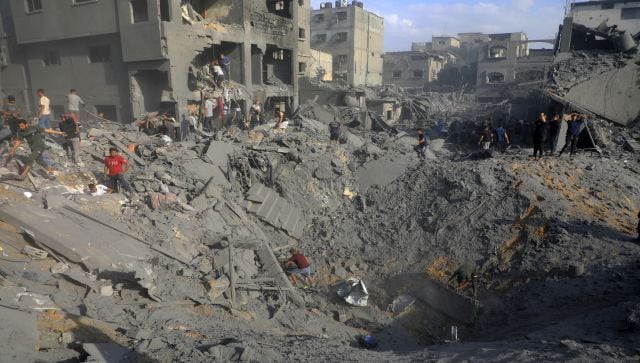 Palestinians look for survivors among the rubble of destroyed buildings following Israeli airstrikes on Jabalia refugee camp. AP[/caption]The Jabalia refugee camp is a densely built-up area of small streets on Gaza City's outskirts. The explosion left large craters in the area. It is now full of rubble, surrounded by damaged concrete buildings.Also read: How Israel’s ground offensive is unfolding in Gaza and what we can expect nextHow many people died in the Jabalia attack?The exact toll from the attack camp is not known. According to Gaza’s health ministry, 50 people were killed and 150 injured. “More than 50 martyrs and around 150 wounded and dozens under the rubble, in a heinous Israeli massacre that targeted a large area of homes in Jabalia camp in the northern [Gaza] Strip,” the Hamas-controlled ministry statement said.Another Hamas statement said there were 400 dead and injured in Jabalia, which houses families of refugees from wars with Israel dating back to 1948.[caption id="attachment_13327092" align="alignnone" width="640"]
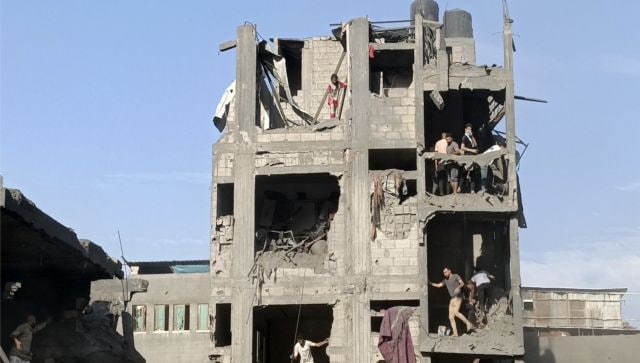 In this frame grab from a video, Palestinians are seen inside a heavily damaged apartment building following Israeli airstrikes at the Jabalia refugee camp. At least 50 people have been killed in the attack. AP[/caption]Al-Jazeera reported that one of its employees lost 19 members of his family in Tuesday’s airstrike. Al-Qumsan lost his father, two sisters, eight nephews and nieces, his brother, his brother’s wife and their four children, his sister-in-law, and one uncle.Firstpost cannot verify the casualty figures independently.Why did Israel attack a refugee camp?The Israeli military claimed to carry out a wide-scale strike in Jabalia on Hamas infrastructure “that had taken over civilian buildings”. The airstrikes killed dozens of militants, including a key Hamas commander for northern Gaza, it said.Israel aggressively defended the attack, with military spokesman Jonathan Conricus saying the targeted commander had also been a key planner of the bloody Oct 7 rampage that started the war. According to him, apartment buildings collapsed only because the vast underground Hamas complex had been destroyed. He later said the main strike had hit between buildings.An Israel Defense Forces (IDF) statement said the strike on the Jabalia camp killed Ibrahim Biari, who was a ringleader of what it called the “murderous terror attack” on 7 October.However, a Hamas spokesperson denied the presence of any senior commander at the camp and called the claim an Israeli pretext for killing civilians.[caption id="attachment_13327122" align="alignnone" width="640"]
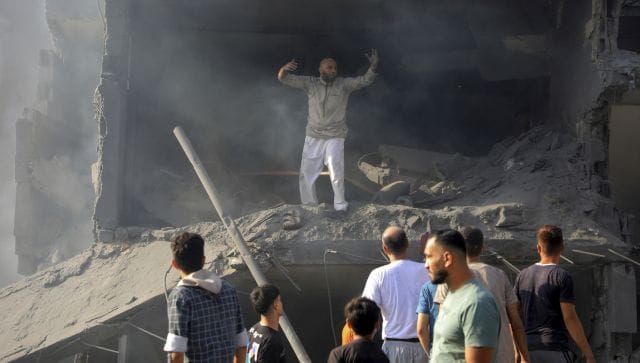 Palestinians look for survivors among the rubble of destroyed buildings in Jabalia on 31 October. Israel claims that Hamas has taken over civilian infrastructure in the area. AP[/caption]Israel’s Brig Gen Daniel Hagari said an underground Hamas installation beneath a targeted building collapsed, toppling other nearby buildings. “We don’t intend for the ground to collapse,” he told reporters. “But the issue is that Hamas built their tunnels there and that they're running their operations from there.”Conricus said the attack had involved more than one bomb, but he did not elaborate. The IDF, he said, was looking into reports of “collateral damage” and “non-combatant casualties”. According to him, northern Gaza was “the very heartland of Hamas”The account of neither camp could be independently confirmed.Also read: What will happen if Israel invades Gaza?What happened in the aftermath of the attack?Grey dust, apparently left by pulverised concrete, seemed to coat nearly everything. Rescuers clawed through the destruction to pull men, women, and children buried under the rubble, reports The Associated Press.Young men carried the limp forms of two children from the upper floors of the crumbling frame of one damaged apartment building while helping down another child and woman. It was unclear whether the children were alive or dead.“I went and saw the destruction… homes buried under the rubble and body parts and martyrs and wounded in huge numbers,” 41-year-old Jabalia resident Ragheb Aqal told the news outlet AFP.[caption id="attachment_13327132" align="alignnone" width="640"]
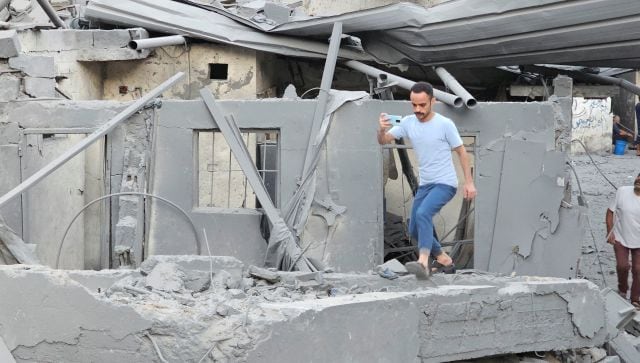 A Palestinian man walks at the site of Israeli strikes on houses in Jabalia in the northern Gaza Strip, on 19 October. Tuesday's attack caused further damage in the area. File photo/Reuters[/caption]Another eyewitness Mohammad Al Aswad described a “horrific scene” after the attack to CNN. “Children were carrying other injured children and running, with grey dust filling the air. Bodies were hanging on the rubble, many of them unrecognised. Some were bleeding and others were burnt,” he told the publication on the phone.Mohammed Hawajreh, a nurse with Doctors Without Borders (MSF) at the Al Shifa hospital in Gaza, said the group is “horrified” by the Israeli airstrike on Jabalia refugee camp, reports CNN.“Young children arrived at the hospital with deep wounds and severe burns. They came without their families. Many were screaming and asking for their parents. I stayed with them until we could find a place, as the hospital was full with patients,” Hawajreh said in a statement released Tuesday.[caption id="attachment_13327182" align="alignnone" width="640"]
 Palestinians search for casualties at the site of Israeli strikes on houses in Jabalia refugee camp in the northern Gaza Strip. Reuters[/caption]How has the world reacted to the attack?Palestinian ambassador to the United Nations has said the strike on the refugee camp was a crime. Ambassador Riyad Mansour, the Permanent Observer of the State of Palestine to the United Nations, urged the International Criminal Court (ICC) to take action.“Those who are responsible for giving the orders for that crime should hear something from Mr Khan from the ICC,” Mansour told CNN, referring to ICC prosecutor Karim Khan. “If he has the courage, and I hope he does.”Saudi Arabia has condemned Israel’s “inhumane targeting” of the Jabalia refugee camp. “The Kingdom of Saudi Arabia condemns in the strongest terms possible the inhumane targeting by the Israeli occupation forces of the Jabalia refugee camp in the besieged Gaza Strip,” a statement shared by Saudi Arabia’s foreign ministry said.Humanitarian groups have condemned Israel’s attack on the Jabalia refugee camp, saying the air raid should be a “wake-up call” to world leaders to secure a ceasefire in Gaza, reports Al-Jazeera.The attack comes as Bolivia is cutting diplomatic ties with Israel over the “aggressive and disproportionate” attacks on Gaza. Deputy foreign minister Freddy Mamani told reporters that their decision was “in repudiation and condemnation of the aggressive and disproportionate Israeli military offensive being carried out in the Gaza Strip”.Separately, the leaders of Colombia and Chile have recalled their ambassadors to Israel in protest, reports the BBC.With inputs from agencies
 First Published:Nov 01, 2023, 10:56:47 IST
Advertisement
Advertisement

Military drones & police check-ups: How Sri Lanka is fighting against worst dengue outbreak in a decade
Sri Lanka is fighting its most severe dengue outbreak in nearly a decade, with infections rising sharply across the nation. Military drones have been deployed to tackle the outbreak, which has claimed 56 lives. Health officials said the outbreak is being driven primarily by the DENV-2 variant of the virus
3 min read
How Facebook job ad lured 2 Karnataka men into Myanmar cyber scam camp
The Karnataka Cyber Command has rescued two youths from a scam compound in Myanmar operated by Chinese fraudsters. The duo from Karnataka were lured on the pretext of data-entry jobs. They were asked to work for 16 hours a day and were expected to sleep for six hours daily
4 min read
Why is India seeing 95% cloud cover despite a Super El Niño?
India is witnessing nearly 95 per cent cloud cover despite a Super El Niño, a climate event usually linked to weaker monsoons. Regional weather systems, cyclonic circulations, the monsoon trough and moisture from two seas are temporarily overpowering one of the world's strongest climate phenomena
5 min read
What is CJP’s fourth demand to the government as protests in Delhi intensify?
The protest by the Cockroach Janta Party at Delhi’s Jantar Mantar refuses to die down. The group have made a fourth demand to the Centre, asking that no FIRs are filed against the agitators and that no legal action be taken. The government has expressed willingness to speak to the protesters, but refused to accede on the resignation of Education Minister Dharmandra Pradhan
5 min read
The new geography of war: Why the Houthis can no longer be ignored
The rise of the Houthis marks the emergence of a new geography of war — one in which influence flows not only from capitals and conventional armies, but also from rugged mountains overlooking vital sea lanes
6 min read
Advertisement
Advertisement