


From K9 Vajra to missiles, how India and South Korea are becoming solid defence partners
Defence Minister Rajnath Singh’s visit to South Korea – where he is set to hold talks with his counterpart Ahn Gyu-back – is set to boost defence ties, particularly in areas such as manufacturing, the K9 Vajra-T artillery programme, and collaboration in missiles and air defence systems. Let’s take a closer look at how defence cooperation has evolved over the past decade

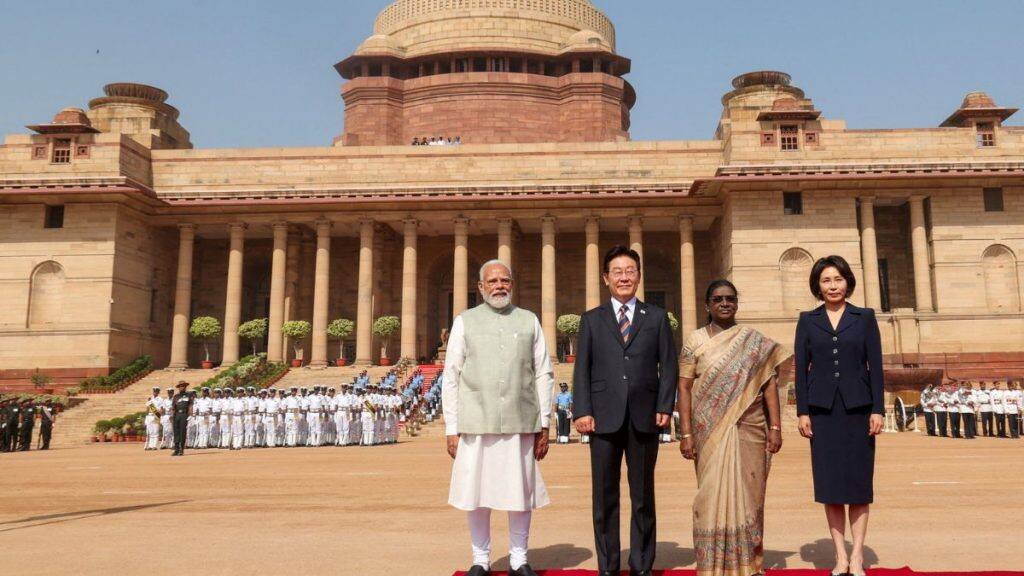
Defence Minister Rajnath Singh’s visit to South Korea is highlighting the deepening ties between the two nations. His trip comes after South Korean President Lee Jae Myung visited New Delhi in April, the first such state visit to India in nearly a decade.
Now, Rajnath’s visit to Seoul – where he is set to hold talks with his counterpart Ahn Gyu-back – is set to boost the relationship when it comes to defence. He will also meet Defence Acquisition Programme Administration (DAPA) Minister Lee Yong-cheol and chair the India–Korea business roundtable during his trip. Rajnath will also inaugurate the Indian War Memorial on May 21 alongside the South Korean Minister of Patriots and Veterans Affairs Kwon Oh-eul.
But how are defence ties between India and South Korea evolving?
Let’s take a closer look:
The relationship and trade in brief
First, let’s take a brief look at the relationship itself.
As per the Ministry of External Affairs, India and South Korea share “long-standing historical, cultural and economic ties,” which can be traced back nearly 2,000 years. In modern times, South Korea and India established consular relations in 1962. Diplomatic ties were established a little over a decade later in 1973. Nearly five decades passed before the countries established a “strategic partnership” in 2010. However, it was just five years later, in 2015, under Prime Minister Narendra Modi, that New Delhi and Seoul elevated ties to a “special strategic partnership”. This came as Modi undertook a state visit to Seoul.
 More from Explainers
Since then, Prime Minister Narendra Modi has visited South Korea twice as Prime Minister. Meanwhile, three South Korean heads of state have visited India over the past decade. The countries have also had a number of high-level engagements, including summits on the sidelines of multilateral events.
India and South Korea had already announced their intention to double bilateral trade from the current $27 billion (Rs 2.61 lakh crore) to $54 billion (Rs 5.23 lakh crore) by 2030. New Delhi exports mineral fuels, oil distillates (mainly naphtha), cereals, iron and steel to Seoul. South Korea, on the other hand, sends automobile parts, telecommunication equipment, hot-rolled iron products, petroleum refined products, base lubricating oils, mechanical appliances, electrical machinery and parts, and iron and steel products to India.
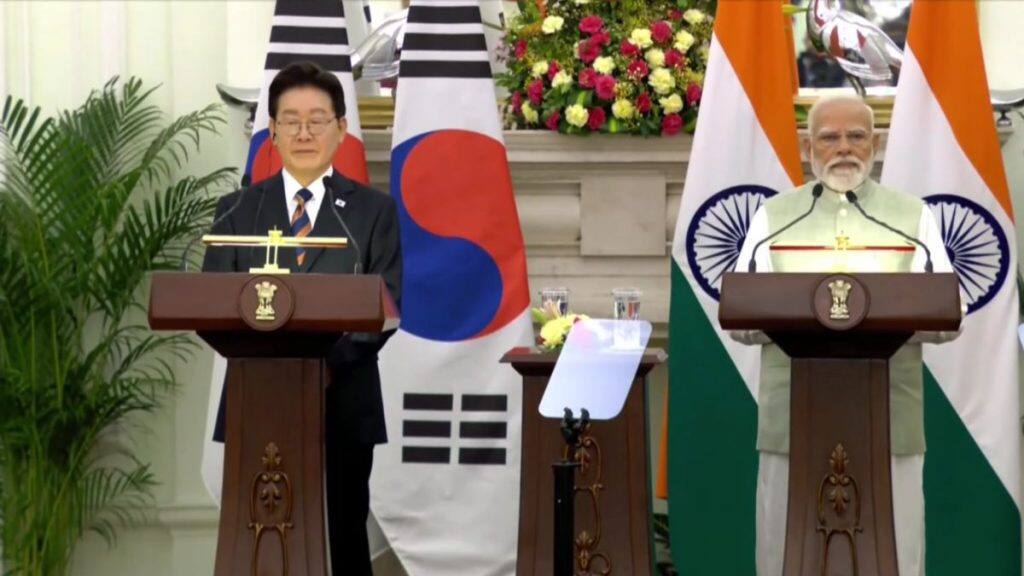
Lee, during his visit to India, was accompanied by around 200 South Korean businesspeople. “We decided to upgrade the framework of economic cooperation between the two countries to create a new engine for shared growth,” Lee told reporters after talks with Modi. “Today, we are laying the foundation for the success story of the next decade,” Modi said.
India’s role on the Korean peninsula
India has been playing a key role on the Korean peninsula since Korea’s independence in 1945. Until then, Korea had been under Japanese rule since 1910. After all, it was ex-Indian diplomat Shri KPS Menon who was appointed as the chair of the 9-member United Nations Temporary Commission on Korea (UNTCOK) to hold elections in the nation.
India also sent the 60th Parachute Field Ambulance of 627 medical personnel, commanded by Lt Colonel AG Rangaraj, during the Korean War as part of the UN Command. The unit ultimately treated about 220,000 patients. During the Korean War (1950–53), both North and South Korea accepted a UN resolution sponsored by India. This led to a ceasefire being declared on July 27, 1953. India’s Lt General KS Thimayya chaired the Neutral Nations Repatriation Commission (NNRC) after the truce and contributed to resolving humanitarian issues arising out of the war. India also sent the Custodian Forces-India (CFI), comprising 5,230 personnel, to Korea under Major General SSP Thorat. The CFI played a key role in resolving issues regarding prisoners of the Korean War. Now, let’s come to defence.
Defence ties over the past decade
When it comes to the past decade, defence ties between India and South Korea have intensified. Defence ministers have frequently met since 2015, and mechanisms such as the Joint Committee Meeting between India’s Ministry of Defence and South Korea’s Defence Acquisition Programme Administration (DAPA) have been established. The two nations hold annual service-level talks between their armies, navies and air forces.
New Delhi and Seoul, in 2019, signed a roadmap for defence industries, with India positioning itself as a production hub and South Korea as a technology partner. India has participated in South Korea’s ADEX-2023 defence expo, and bilateral industry seminars have drawn interest from Korean defence companies.
The two countries have cooperated in the maritime domain with regular port visits, joint exercises and Coast Guard engagements. The two countries have also seen army chiefs visit each other’s nations. Institutions such as the Manohar Parrikar Institute for Defence Studies and Analyses and the Korea Institute for Defense Analyses have engaged in dialogue on regional security.
The path ahead
Singh will hold talks with the South Korean Defence Minister and discuss the K9 Vajra-T artillery programme, anti-aircraft systems and missile collaboration.
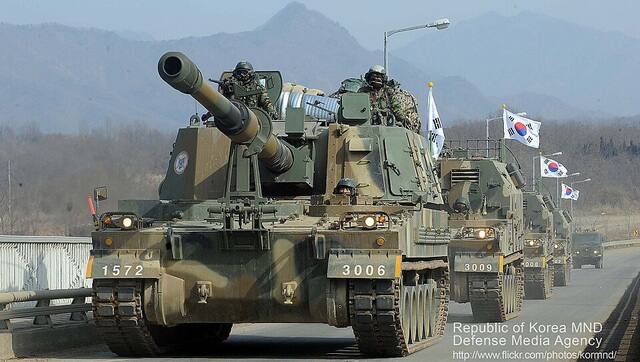
According to The Hindu, the K9 Vajra-T artillery programme, which is part of a Make in India initiative, has become the centrepiece of defence cooperation between the two countries. The K9 Vajra, which is manufactured in India by Larsen & Toubro, was developed by South Korea’s Hanwha Aerospace on the basis of the K9 Thunder platform. Initially, around half of the K9 Vajra’s components were made in India, which later rose to 60 per cent.
According to Moneycontrol, India had ordered 100 K9 Vajra for Rs 4,500 crore in 2017. While the guns had been designed for desert warfare, they were later deployed in high-altitude regions such as Ladakh during the India–China border stand-off. Following that, India ordered another 100 K9 Vajras for Rs 7,628.7 crore. Because of the success of the K9 Vajra, the countries are now looking to have greater technology transfer in the field of defence.
The Vajra has also resulted in both countries viewing the proposed KIND-X defence initiative in a more positive light. According to The Times of India, the KIND-X initiative is aimed at the countries developing and designing high-tech systems, including autonomous weapons, AI-driven military applications, next-generation missile defence and cyber security.
As per Moneycontrol, India is also eyeing South Korea’s K30 Biho, a self-propelled anti-aircraft system from Hanwha Defense. It is being proposed that Hanwha work with Larsen & Toubro to develop this light tank platform for operations in mountainous and high-altitude regions.
The two countries could also cooperate when it comes to submarine technology. Much of this is down to Seoul’s efficacy in conventional submarines, lithium-ion battery systems and air-independent propulsion technologies. South Korea’s advanced KF-21 fighter programme and the FA-50 light combat aircraft have also opened the door for India to seek collaboration in air defence.
FAQs
1. Why is the K9 Vajra-T programme important for India–South Korea defence ties?
The K9 Vajra-T programme is significant because it represents a shift from defence imports to local manufacturing and technology transfer under India’s Make in India initiative.
2. What is the current level of trade between India and South Korea?
Bilateral trade stands at about $27 billion (Rs 2.61 lakh crore), with both countries aiming to increase it to $54 billion (Rs 5.23 lakh crore) by 2030.
3. What are the key areas of future defence cooperation?
Future cooperation is expected in artillery systems, missile technology, air defence systems, submarines and advanced technologies such as AI-driven military systems and cyber security.
With inputs from agencies

Military drones & police check-ups: How Sri Lanka is fighting against worst dengue outbreak in a decade
How Facebook job ad lured 2 Karnataka men into Myanmar cyber scam camp
Why is India seeing 95% cloud cover despite a Super El Niño?
What is CJP’s fourth demand to the government as protests in Delhi intensify?
The new geography of war: Why the Houthis can no longer be ignored