
Advertisement


Sections
French pension reforms: It's Emmanuel Macron vs trade union, what happens next?
France’s mass protests against Emmanuel Macron’s pension reform appear to be petering out. The next stage is already taking shape: forcing the government to recognise what work represents today, and renounce its top-down way of exercising authority

Slowly but surely, France’s mass protests against Emmanuel Macron’s pension reform appear to be petering out. Following two months of unrest, the president’s flagship bill, which aims to raise the minimum retirement age from 62 to 64 years old starting from 2030, prompted 480,000 people (1,7 million according to the country’s main trade union, the CGT) to take to the streets on 15 March, versus 1.28 million people on 7 March (3.5 million people according to the CGT).Voted by the Senate as the last of Saturday’s protests were taking place, the national assembly is set to examine the bill from 3 pm today, Thursday 16 March. One scenario would have discussions until 26 March, while it is not excluded the government passes the reform without a vote - a procedure enabled by Article 49 Paragraph 3 of the French constitution. But whatever the outcome, the last few weeks will have demonstrated the country’s trade unions are still a force to be reckoned with.The national secretary of the CGT, Philippe Martinez, put it plainly when he stressed on 19 February that the protests’ scale had everything to do with unions and nothing to do with political parties. In a barely veiled pique to Jean-Luc Mélenchon, the leader of the left-wing party La France Insoumise (France Unbowed), Martinez railed against politicians who attempted to “take credit for the social movement and substitute themselves to trade unions, or make themselves bigger than those marching in the street”.Many in France will agree with the sentiment. In recent months, the parliamentary debate over the pension reform has been marred by insults and lies. Opposition MPs have called the labour minister, Olivier Dussopt, “assassin” and posted images of themselves stamping on his photograph, while the government has inflated the figure of the minimum pension income citizens would receive under the law. For the millions who have turned out into the streets, protests have failed to bear on the negotiations or the search for compromise in parliament because those who negotiate have no links with either trade unionism, or popular protest.[caption id="attachment_12310212" align="alignnone" width="640"]![]() A protester gestures during a demonstration after the French government pushed a pensions reform through parliament without a vote, using article 49.3 of the constitution, in Nantes, western France. AFP[/caption]By contrast, French trade unions have proved themselves to be organised and resolute, yet nonviolent. They have also shown unity for the first time since their opposition to proposed pension reforms in 2010. This is a sign of democratic and political vitality, the fragility of which should not be underestimated. However, what will remain of trade union unity once the reform is voted through, or on the contrary abandoned? And above all, can trade unions be decisive players in the long term without stronger roots in the places where it represents workers most closely?From the street to companiesAlthough protests are organised by trade unions, there is no automatic relationship between industrial action on the “street” and that which unfolds in the workplace.The rate of union membership in France is low, and in half a century, the presence of unions on the ground has generally declined. While France made unions compulsory within companies of 50 employees or more in 1968, this has failed to translate into stronger organisations in the workplace.The most effective strikes are being played out across a few strategic sectors, most notably public transport. The declining turnout against pension reform suggest not so much disinterest as a relocation of the struggle elsewhere. Until now, the main site of protest has been the street rather than the workplace. However, the demographic of the protesters is not the same as that of the strikers, or even workers. During the protests, entire families have been seen marching and shop owners often lower metal curtains in solidarity with the protests.The return of the "strike by proxy"?From November to December 1995, France saw massive demonstrations against the Juppé reforms – an austerity package known by the name of the then-prime minister, Alain Juppé. During this period, the notion of “strike by proxy” appeared. Even though the number of strikers wasn’t particularly high, the public felt affinity for those on strike and gave its blessing to action that gridlocked the country’s infrastructure. But times have changed.[caption id="attachment_12310232" align="alignnone" width="640"]
A protester gestures during a demonstration after the French government pushed a pensions reform through parliament without a vote, using article 49.3 of the constitution, in Nantes, western France. AFP[/caption]By contrast, French trade unions have proved themselves to be organised and resolute, yet nonviolent. They have also shown unity for the first time since their opposition to proposed pension reforms in 2010. This is a sign of democratic and political vitality, the fragility of which should not be underestimated. However, what will remain of trade union unity once the reform is voted through, or on the contrary abandoned? And above all, can trade unions be decisive players in the long term without stronger roots in the places where it represents workers most closely?From the street to companiesAlthough protests are organised by trade unions, there is no automatic relationship between industrial action on the “street” and that which unfolds in the workplace.The rate of union membership in France is low, and in half a century, the presence of unions on the ground has generally declined. While France made unions compulsory within companies of 50 employees or more in 1968, this has failed to translate into stronger organisations in the workplace.The most effective strikes are being played out across a few strategic sectors, most notably public transport. The declining turnout against pension reform suggest not so much disinterest as a relocation of the struggle elsewhere. Until now, the main site of protest has been the street rather than the workplace. However, the demographic of the protesters is not the same as that of the strikers, or even workers. During the protests, entire families have been seen marching and shop owners often lower metal curtains in solidarity with the protests.The return of the "strike by proxy"?From November to December 1995, France saw massive demonstrations against the Juppé reforms – an austerity package known by the name of the then-prime minister, Alain Juppé. During this period, the notion of “strike by proxy” appeared. Even though the number of strikers wasn’t particularly high, the public felt affinity for those on strike and gave its blessing to action that gridlocked the country’s infrastructure. But times have changed.[caption id="attachment_12310232" align="alignnone" width="640"]![]() A protester wearing a yellow vest reading "Fuck 49.3" holds smoke flares during a demonstration after the French government pushed a pensions reform through parliament without a vote, using the article 49,3 of the constitution, in Nantes. AFP[/caption]Questions of mobility is perceived by some as less important, especially because of telecommuting, while for others it is a vital issue, especially in areas outside of major city centres, when jobs, schools, hospitals, other public services, or even shops require travel by car. Targeting it can alienate those who must travel or aspire to do so, even if it’s only for leisure. Philippe Martinez has understood this well and accepted the railway unions’ choice to withdraw a strike called in early March when people set off on holiday.Laurent Berger, the national secretary of the France’s second largest trade-union, the CFDT, confirmed that opposition to the reform have boosted the organisation’s membership. While this is not negligible, a fundamental problem remains: can trade unionism put itself forward as the main representative of discontent – “the street” – without serving as a conduit for the demands that rise up from the shop floor and in the office, and bringing bargaining power at the local, company, branch, and possibly national and interprofessional level?Toward a new trade union spirit in companies?There certainly needs to be a new breath of fresh air, like the one provided by the current protests, but visible internally, in companies and administrations or at school. We also need measures that are favourable to it. However, President Macron has always shown great reservations, even contempt, toward trade unionism, including reformist ones like the CFDT.By portraying himself as the heir of Isaac René Le Chapelier, a jury of the revolutionary period who prohibited guilds and trade unions in 1791, the president will certainly not help to revitalise trade union action from the bottom up.Time and again, Macron has referred to “corporatism” - a political ideology whereby professional bodies seek to exclusively defend their interests - as “the French disease, the thing that reappeared the quickest following the 1789 Revolution”. In February, the Labour Minister Dussopt has employed similar language in the National Assembly:
A protester wearing a yellow vest reading "Fuck 49.3" holds smoke flares during a demonstration after the French government pushed a pensions reform through parliament without a vote, using the article 49,3 of the constitution, in Nantes. AFP[/caption]Questions of mobility is perceived by some as less important, especially because of telecommuting, while for others it is a vital issue, especially in areas outside of major city centres, when jobs, schools, hospitals, other public services, or even shops require travel by car. Targeting it can alienate those who must travel or aspire to do so, even if it’s only for leisure. Philippe Martinez has understood this well and accepted the railway unions’ choice to withdraw a strike called in early March when people set off on holiday.Laurent Berger, the national secretary of the France’s second largest trade-union, the CFDT, confirmed that opposition to the reform have boosted the organisation’s membership. While this is not negligible, a fundamental problem remains: can trade unionism put itself forward as the main representative of discontent – “the street” – without serving as a conduit for the demands that rise up from the shop floor and in the office, and bringing bargaining power at the local, company, branch, and possibly national and interprofessional level?Toward a new trade union spirit in companies?There certainly needs to be a new breath of fresh air, like the one provided by the current protests, but visible internally, in companies and administrations or at school. We also need measures that are favourable to it. However, President Macron has always shown great reservations, even contempt, toward trade unionism, including reformist ones like the CFDT.By portraying himself as the heir of Isaac René Le Chapelier, a jury of the revolutionary period who prohibited guilds and trade unions in 1791, the president will certainly not help to revitalise trade union action from the bottom up.Time and again, Macron has referred to “corporatism” - a political ideology whereby professional bodies seek to exclusively defend their interests - as “the French disease, the thing that reappeared the quickest following the 1789 Revolution”. In February, the Labour Minister Dussopt has employed similar language in the National Assembly:
 A protester gestures during a demonstration after the French government pushed a pensions reform through parliament without a vote, using article 49.3 of the constitution, in Nantes, western France. AFP[/caption]By contrast, French trade unions have proved themselves to be organised and resolute, yet nonviolent. They have also shown unity for the first time since their opposition to proposed pension reforms in 2010. This is a sign of democratic and political vitality, the fragility of which should not be underestimated. However, what will remain of trade union unity once the reform is voted through, or on the contrary abandoned? And above all, can trade unions be decisive players in the long term without stronger roots in the places where it represents workers most closely?From the street to companiesAlthough protests are organised by trade unions, there is no automatic relationship between industrial action on the “street” and that which unfolds in the workplace.The rate of union membership in France is low, and in half a century, the presence of unions on the ground has generally declined. While France made unions compulsory within companies of 50 employees or more in 1968, this has failed to translate into stronger organisations in the workplace.The most effective strikes are being played out across a few strategic sectors, most notably public transport. The declining turnout against pension reform suggest not so much disinterest as a relocation of the struggle elsewhere. Until now, the main site of protest has been the street rather than the workplace. However, the demographic of the protesters is not the same as that of the strikers, or even workers. During the protests, entire families have been seen marching and shop owners often lower metal curtains in solidarity with the protests.The return of the "strike by proxy"?From November to December 1995, France saw massive demonstrations against the Juppé reforms – an austerity package known by the name of the then-prime minister, Alain Juppé. During this period, the notion of “strike by proxy” appeared. Even though the number of strikers wasn’t particularly high, the public felt affinity for those on strike and gave its blessing to action that gridlocked the country’s infrastructure. But times have changed.[caption id="attachment_12310232" align="alignnone" width="640"]
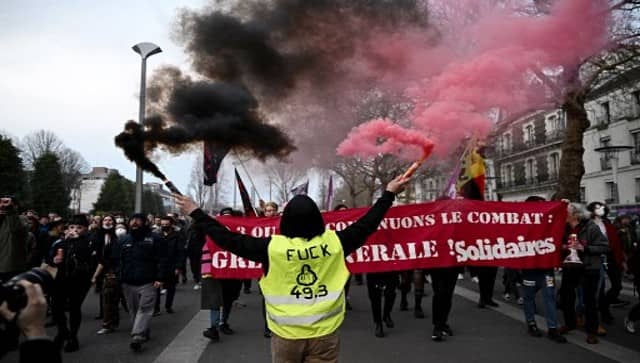 A protester wearing a yellow vest reading "Fuck 49.3" holds smoke flares during a demonstration after the French government pushed a pensions reform through parliament without a vote, using the article 49,3 of the constitution, in Nantes. AFP[/caption]Questions of mobility is perceived by some as less important, especially because of telecommuting, while for others it is a vital issue, especially in areas outside of major city centres, when jobs, schools, hospitals, other public services, or even shops require travel by car. Targeting it can alienate those who must travel or aspire to do so, even if it’s only for leisure. Philippe Martinez has understood this well and accepted the railway unions’ choice to withdraw a strike called in early March when people set off on holiday.Laurent Berger, the national secretary of the France’s second largest trade-union, the CFDT, confirmed that opposition to the reform have boosted the organisation’s membership. While this is not negligible, a fundamental problem remains: can trade unionism put itself forward as the main representative of discontent – “the street” – without serving as a conduit for the demands that rise up from the shop floor and in the office, and bringing bargaining power at the local, company, branch, and possibly national and interprofessional level?Toward a new trade union spirit in companies?There certainly needs to be a new breath of fresh air, like the one provided by the current protests, but visible internally, in companies and administrations or at school. We also need measures that are favourable to it. However, President Macron has always shown great reservations, even contempt, toward trade unionism, including reformist ones like the CFDT.By portraying himself as the heir of Isaac René Le Chapelier, a jury of the revolutionary period who prohibited guilds and trade unions in 1791, the president will certainly not help to revitalise trade union action from the bottom up.Time and again, Macron has referred to “corporatism” - a political ideology whereby professional bodies seek to exclusively defend their interests - as “the French disease, the thing that reappeared the quickest following the 1789 Revolution”. In February, the Labour Minister Dussopt has employed similar language in the National Assembly:
“We were elected to rid the French of corporatism, to make society more fluid, to drain the rents […] There is a great deal of conservatism on the part of the social partners”.As for the big employers, they have in no way conveyed any openness to compromise during the current conflict. Standing by reforms that do not require any particular effort from them, they have missed their chance to reinvent social dialogue at company level.The unions can emerge stronger from the January-February 2023 protests. Indeed, trade unionism has once again proved itself as a political force, but beyond the confines of parliament. It is the rediscovered pride of the people of the left, but outside the political parties, and it is not serious to consider transforming Laurent Berger into a future candidate for the presidency of the Republic.Whatever the outcome of the current strikes, the next stage is already taking shape: forcing the government to recognise what work represents today, renounce its top-down way of exercising authority, and learn to accept and even encourage the role of trade unions in mediation, be it within companies, public administration, the national education or health sectors.This article is republished from The Conversation under a Creative Commons license. Read the original article.Read all the Latest News, Trending News, Cricket News, Bollywood News,India News and Entertainment News here. Follow us on Facebook, Twitter and Instagram.
First Published:Mar 17, 2023, 17:33:33 IST
Advertisement
Advertisement

Military drones & police check-ups: How Sri Lanka is fighting against worst dengue outbreak in a decade
Sri Lanka is fighting its most severe dengue outbreak in nearly a decade, with infections rising sharply across the nation. Military drones have been deployed to tackle the outbreak, which has claimed 56 lives. Health officials said the outbreak is being driven primarily by the DENV-2 variant of the virus
3 min read
How Facebook job ad lured 2 Karnataka men into Myanmar cyber scam camp
The Karnataka Cyber Command has rescued two youths from a scam compound in Myanmar operated by Chinese fraudsters. The duo from Karnataka were lured on the pretext of data-entry jobs. They were asked to work for 16 hours a day and were expected to sleep for six hours daily
4 min read
Why is India seeing 95% cloud cover despite a Super El Niño?
India is witnessing nearly 95 per cent cloud cover despite a Super El Niño, a climate event usually linked to weaker monsoons. Regional weather systems, cyclonic circulations, the monsoon trough and moisture from two seas are temporarily overpowering one of the world's strongest climate phenomena
5 min read
What is CJP’s fourth demand to the government as protests in Delhi intensify?
The protest by the Cockroach Janta Party at Delhi’s Jantar Mantar refuses to die down. The group have made a fourth demand to the Centre, asking that no FIRs are filed against the agitators and that no legal action be taken. The government has expressed willingness to speak to the protesters, but refused to accede on the resignation of Education Minister Dharmandra Pradhan
5 min read
The new geography of war: Why the Houthis can no longer be ignored
The rise of the Houthis marks the emergence of a new geography of war — one in which influence flows not only from capitals and conventional armies, but also from rugged mountains overlooking vital sea lanes
6 min read
Advertisement
Advertisement