
Advertisement


Sections
Explained: Why Netherlands’ formal apology for slavery fell flat
Though Prime Minister Mark Rutte apologised posthumously to ‘all enslaved people worldwide and their descendants’, activists gave the speech the cold shoulder and said a discussion on reparations is needed

Sorry really does seem to be the most difficult word.Dutch prime minister Mark Rutte’s apology on Monday for the Netherlands’ role in slavery and the slave trade may have been long overdue, but it did not go over particularly well.Rutte’s 20-minute speech was met with silence by the invited audience at the National Archive.Let’s take a look at the country’s role in slavery and the slave trade, the apology itself and how activists reacted:Netherlands’ role in slaveryThe Dutch first became involved in the trans-Atlantic slave trade in the late 1500s.It was only in the mid-1600s that the Dutch began a major player – after seizing Portuguese fortresses along Africa’s west coast and plantations in northeastern Brazil.As per The Guardian, the Dutch West India Company made the first major move in 1634 by seizing 1,000 human beings from the Gold Coast (Ghana) to Brazil by to work on its plantations.Curaçao, the Caribbean island, fell the same year and the Dutch took Suriname in 1635.Historians say the practice accounted for 10 per cent of Holland’s GDP at the height of slavery in 1770s.Eventually, the Dutch West India Company became the largest trans-Atlantic slave trader, said Karwan Fatah-Black, an expert in Dutch colonial history and an assistant professor at Leiden University in the Netherlands.Hundreds of thousands of people were branded and forced to work in plantations in Suriname and other colonies.As per The New York Times, the Netherlands transported around 600,000 people over the Atlantic Ocean.It also traded people in Indonesia, India and South Africa under the East India Company.The New York Times piece noted that more than a million people were enslaved from the 17th to 19th Century and that Dutch colonies such as Brazil, Indonesia and Suriname relied on the institution.[caption id="attachment_11733251" align="alignnone" width="640"]![Slavery_in_Brazil]() Slavery in Brazil by Jean-Baptiste Debret. Wikipedia[/caption]In short, the Dutch colonizers kidnapped men, women and children and enslaved them on plantations growing sugar, coffee and other goods that built wealth at the price of misery.Portugal became the first European country to buy slaves in West Africa with help from the Catholic Church in the 1400s, followed by Spain.Some experts argue that large-scale sugar production in what is now Brazil then gave rise to the Atlantic slave trade that saw an estimated 12 million Africans transported to the Caribbean and the Americas over some 400 years, with at least 1 million dying en route.Britain was among the first countries to ban the slave trade, in 1807.
Slavery in Brazil by Jean-Baptiste Debret. Wikipedia[/caption]In short, the Dutch colonizers kidnapped men, women and children and enslaved them on plantations growing sugar, coffee and other goods that built wealth at the price of misery.Portugal became the first European country to buy slaves in West Africa with help from the Catholic Church in the 1400s, followed by Spain.Some experts argue that large-scale sugar production in what is now Brazil then gave rise to the Atlantic slave trade that saw an estimated 12 million Africans transported to the Caribbean and the Americas over some 400 years, with at least 1 million dying en route.Britain was among the first countries to ban the slave trade, in 1807.![]() King Charles III has expressed his sorrow over Britain's role in slavery. AP[/caption]In 2018, Denmark apologized to Ghana, which it colonized from the mid-17th Century to the mid-19th Century.In June, King Philippe of Belgium expressed “deepest regrets” for abuses in Congo. In 1992, Pope John Paul II apologized for the church’s role in slavery.Americans have had emotionally charged fights over taking down statues of slaveholders in the South.Now the Netherlands has joined their ranks. But the speech has left activists cold and people divided.Even before the speech, Waldo Koendjbiharie, a retiree who was born in Suriname but lived for years in the Netherlands, said an apology was not enough.“It’s about money. Apologies are words and with those words you can’t buy anything,” he said.Activists give speech cold shoulderRutte went ahead with the apology even though some activist groups in the Netherlands and its former colonies had urged him to wait until 1 July, the anniversary of the abolition of slavery 160 years ago and said they had not been sufficiently consulted in the process leading up to the speech.Activists consider next year the 150th anniversary because many enslaved people were forced to continue working in plantations for a decade after abolition.Mitchell Esajas, director of an organisation called The Black Archives and a member of activist group Black Manifest, did not attend the speech despite being invited because of what he called the “almost insulting” lack of consultations with the Black community.
King Charles III has expressed his sorrow over Britain's role in slavery. AP[/caption]In 2018, Denmark apologized to Ghana, which it colonized from the mid-17th Century to the mid-19th Century.In June, King Philippe of Belgium expressed “deepest regrets” for abuses in Congo. In 1992, Pope John Paul II apologized for the church’s role in slavery.Americans have had emotionally charged fights over taking down statues of slaveholders in the South.Now the Netherlands has joined their ranks. But the speech has left activists cold and people divided.Even before the speech, Waldo Koendjbiharie, a retiree who was born in Suriname but lived for years in the Netherlands, said an apology was not enough.“It’s about money. Apologies are words and with those words you can’t buy anything,” he said.Activists give speech cold shoulderRutte went ahead with the apology even though some activist groups in the Netherlands and its former colonies had urged him to wait until 1 July, the anniversary of the abolition of slavery 160 years ago and said they had not been sufficiently consulted in the process leading up to the speech.Activists consider next year the 150th anniversary because many enslaved people were forced to continue working in plantations for a decade after abolition.Mitchell Esajas, director of an organisation called The Black Archives and a member of activist group Black Manifest, did not attend the speech despite being invited because of what he called the “almost insulting” lack of consultations with the Black community.
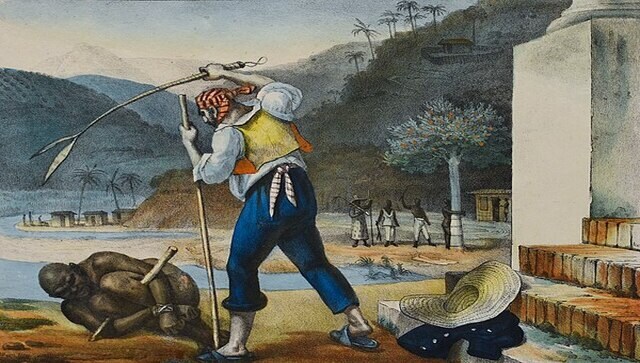 Slavery in Brazil by Jean-Baptiste Debret. Wikipedia[/caption]In short, the Dutch colonizers kidnapped men, women and children and enslaved them on plantations growing sugar, coffee and other goods that built wealth at the price of misery.Portugal became the first European country to buy slaves in West Africa with help from the Catholic Church in the 1400s, followed by Spain.Some experts argue that large-scale sugar production in what is now Brazil then gave rise to the Atlantic slave trade that saw an estimated 12 million Africans transported to the Caribbean and the Americas over some 400 years, with at least 1 million dying en route.Britain was among the first countries to ban the slave trade, in 1807.
Dutch slavery continued until 1863.As per The Guardian, the Netherlands was one of the last countries to ban slavery.Worse, the practice continued in Suriname due to a mandatory 10-year transition period.Like many nations, the Netherlands has been grappling with its colonial past, with the history of Dutch slavery added for the first time to local school curriculums in 2006.“There is a sector in society that really clings to colonial pride and finds it difficult to acknowledge that their beloved historical figures have played a part in this history,” Fatah-Black said, referring to seafarers and traders long revered as heroes of the 17th Century Dutch Golden Age when the country was a major world power.Rutte’s apology “Today I apologise,” Rutte began.Rutte apologised “for the actions of the Dutch state in the past: posthumously to all enslaved people worldwide who have suffered from those actions, to their daughters and sons, and to all their descendants into the here and now.”Describing how more than 600,000 African men, women and children were shipped, “like cattle” mostly to the former colony of Suriname, by Dutch slave traders, Rutte said that history often is “ugly, painful, and even downright shameful.”Rutte’s gave his speech at a time when many nations’ brutal colonial histories have received critical scrutiny because of the Black Lives Matter movement and the police killing of George Floyd, a Black man, in the US city of Minneapolis on 25 May, 2020.The prime minister’s address was a response to a report published last year by a government-appointed advisory board.Its recommendations included the government’s apology and recognition that the slave trade and slavery from the 17th Century until abolition “that happened directly or indirectly under Dutch authority were crimes against humanity.”The report said that what it called institutional racism in the Netherlands “cannot be seen separately from centuries of slavery and colonialism and the ideas that have arisen in this context.”Rutte told reporters after the speech that the government is not offering compensation to “people — grandchildren or great grandchildren of enslaved people.”Instead, it is establishing a 200 million-euro ($212 million) fund for initiatives to help tackle the legacy of slavery in the Netherlands and its former colonies and to boost education about the issue.The report said that what it called institutional racism in the Netherlands “cannot be seen separately from centuries of slavery and colonialism and the ideas that have arisen in this context.”
The Netherlands is hardly alone in apologising.As per the BBC, King Charles III and the Prince of Wales in separate speeches declared their "personal" and "profound" sorrow for Britain's part in the transatlantic slave trade.[caption id="attachment_11432391" align="alignnone" width="640"]
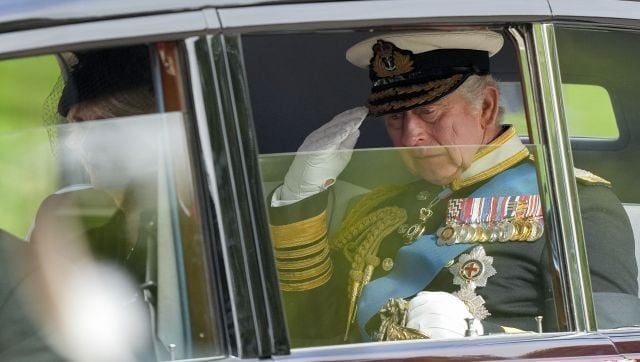 King Charles III has expressed his sorrow over Britain's role in slavery. AP[/caption]In 2018, Denmark apologized to Ghana, which it colonized from the mid-17th Century to the mid-19th Century.In June, King Philippe of Belgium expressed “deepest regrets” for abuses in Congo. In 1992, Pope John Paul II apologized for the church’s role in slavery.Americans have had emotionally charged fights over taking down statues of slaveholders in the South.Now the Netherlands has joined their ranks. But the speech has left activists cold and people divided.Even before the speech, Waldo Koendjbiharie, a retiree who was born in Suriname but lived for years in the Netherlands, said an apology was not enough.“It’s about money. Apologies are words and with those words you can’t buy anything,” he said.Activists give speech cold shoulderRutte went ahead with the apology even though some activist groups in the Netherlands and its former colonies had urged him to wait until 1 July, the anniversary of the abolition of slavery 160 years ago and said they had not been sufficiently consulted in the process leading up to the speech.Activists consider next year the 150th anniversary because many enslaved people were forced to continue working in plantations for a decade after abolition.Mitchell Esajas, director of an organisation called The Black Archives and a member of activist group Black Manifest, did not attend the speech despite being invited because of what he called the “almost insulting” lack of consultations with the Black community.
He said it was a historic moment but lamented the lack of a concrete plan for reparations.“Reparation wasn’t even mentioned,” Esajas said. “So, beautiful words, but it’s not clear what the next concrete steps will be.”“For a lot of people, it’s a very beautiful and historic moment but with — in Dutch we say — a bitter taste ... and it should have been a historic moment with a sweet taste,” Esajas said.In Suriname, the small South American nation where Dutch plantation owners generated huge profits through the use of enslaved labor, the largest opposition party, NDP, condemned the Dutch government for failing to adequately consult descendants of enslaved people in the country.Activists in the country say that what’s really needed is compensation.“The NDP therefore expresses its disapproval of this unilateral decision-making process and notes that the Netherlands is comfortably taking on the role of the mother country again,” the party said in a statement.Divided Netherlands grapples with racismBut many in the Netherlands simply don’t support an apology – much less reparations.The BBC quoted a poll as showing that nearly 70 per cent of the African-Caribbean community in the Netherlands consider an apology important.But nearly half of the Dutch don’t believe in offering it in the first place, as per the report.
The Netherlands is also grappling with racism.BBC quoted a Statistics Netherlands report as saying those with migrant backgrounds have smaller houses, lower educational achievements and incomes, and poorer health.“Migrants are treated as second class citizens from the get-go," Pepijn Brandon, professor of Global Economic and Social History at the Free University of Amsterdam, told the outlet. "This translates as an unequal starting position. And then racism as a justification for slavery, that's visible today.""We like to tell ourselves we are tolerant," said another. "We celebrate this tolerance, but tolerance inherently means accepting something you don't like, and that's how we feel, we are not welcome, only tolerated."The top civil servant at the Dutch foreign ministry earlier in December apologised after an independent investigation found widespread racism at the government department in the Netherlands and at its diplomatic outposts around the world.“Racism cannot and should not have a place in our organization,” the ministry’s secretary-general Paul Huijts said.“We are sorry that we have apparently not been able to offer a work environment in which there is no place for this sort of occurrence,” he said. “For that I offer, on behalf of the management board, our apologies.”Civil servants called in an independent research bureau to investigate racism at the ministry following Black Lives Matter protests across the world and in the Netherlands.The bureau’s report said that racism at the ministry ranges “from aggressive, direct, overt and conscious to subtle, indirect, hidden, unintentional or unconscious — and that bicultural employees and locally hired employees of color experience various forms of racism.”With inputs from inputsRead all the Latest News, Trending News, Cricket News, Bollywood News,India News and Entertainment News here. Follow us on Facebook, Twitter and Instagram.
First Published:Dec 20, 2022, 21:12:25 IST
Advertisement
Advertisement

Military drones & police check-ups: How Sri Lanka is fighting against worst dengue outbreak in a decade
Sri Lanka is fighting its most severe dengue outbreak in nearly a decade, with infections rising sharply across the nation. Military drones have been deployed to tackle the outbreak, which has claimed 56 lives. Health officials said the outbreak is being driven primarily by the DENV-2 variant of the virus
3 min read
How Facebook job ad lured 2 Karnataka men into Myanmar cyber scam camp
The Karnataka Cyber Command has rescued two youths from a scam compound in Myanmar operated by Chinese fraudsters. The duo from Karnataka were lured on the pretext of data-entry jobs. They were asked to work for 16 hours a day and were expected to sleep for six hours daily
4 min read
Why is India seeing 95% cloud cover despite a Super El Niño?
India is witnessing nearly 95 per cent cloud cover despite a Super El Niño, a climate event usually linked to weaker monsoons. Regional weather systems, cyclonic circulations, the monsoon trough and moisture from two seas are temporarily overpowering one of the world's strongest climate phenomena
5 min read
What is CJP’s fourth demand to the government as protests in Delhi intensify?
The protest by the Cockroach Janta Party at Delhi’s Jantar Mantar refuses to die down. The group have made a fourth demand to the Centre, asking that no FIRs are filed against the agitators and that no legal action be taken. The government has expressed willingness to speak to the protesters, but refused to accede on the resignation of Education Minister Dharmandra Pradhan
5 min read
The new geography of war: Why the Houthis can no longer be ignored
The rise of the Houthis marks the emergence of a new geography of war — one in which influence flows not only from capitals and conventional armies, but also from rugged mountains overlooking vital sea lanes
6 min read
Advertisement
Advertisement