
Advertisement


Sections
What's in a name? Why a storm is called hurricane in US and typhoon in East Asia
Once a storm reaches maximum sustained winds of 119 kmph or higher, it is classified as a hurricane, typhoon, or tropical cyclone. However, the moniker given to it depends on its location

With Canada reeling in the aftermath of Hurricane Fiona, Hurricane Ian becoming a storm early Tuesday and on a path that could see it hit Florida’s west coast, and Typhoon Noru leaving a trail of destruction in northern Philippine provinces, one might well wonder – what’s the difference between hurricanes, typhoons and cyclones?The truth is, they’re all essentially the same thing.Let’s take a closer look:"A tropical cyclone is a generic term used by meteorologists to describe a rotating, organised system of clouds and thunderstorms that originates over tropical or subtropical waters and has closed, low-level circulation," the US National Ocean Service website states.Once a storm reaches maximum sustained winds of 119 kmph or higher, it is then classified as a hurricane, typhoon, or tropical cyclone.However, the designation itself depends on its location.As per BBC, tropical storms over the North Atlantic Ocean and Northeast Pacific are designated hurricanes, those over the South Pacific and Indian Ocean are called cyclones and typhoons occur over the Northwest Pacific Ocean.A hurricane is measured on a scale of 1-5 (the Saffir-Simpson scale based on wind speed) as per National Geographic.A Category 1 hurricane will have winds of 110-153 kmph per hour while a Category 5 storm can exceed 252 kmph.![]() Hurricane Ian is on track to hit the west coast of Florida as a major hurricane as early as Wednesday. AP[/caption]As of Monday, Tampa and St. Petersburg appeared to be the among the most likely targets for their first direct hit by a major hurricane since 1921.
Hurricane Ian is on track to hit the west coast of Florida as a major hurricane as early as Wednesday. AP[/caption]As of Monday, Tampa and St. Petersburg appeared to be the among the most likely targets for their first direct hit by a major hurricane since 1921.![]() Rescuers run as they check residents living at the seaside slum district of Tondo ahead of Typhoon Noru hitting Manila. AP[/caption]Climate change to blame?Scientists say climate change may be leading to more intense extreme weather."Is this climate change?" President Ferdinand Marcos Jr, who took office in June, asked. "We have kept watched on these storms for a long time but it wasn't like this before... This is something I have to deal with."The Canadian Hurricane Centre tweeted that Fiona had the lowest pressure — a key sign of storm strength — ever recorded for a storm making landfall in Canada.
Rescuers run as they check residents living at the seaside slum district of Tondo ahead of Typhoon Noru hitting Manila. AP[/caption]Climate change to blame?Scientists say climate change may be leading to more intense extreme weather."Is this climate change?" President Ferdinand Marcos Jr, who took office in June, asked. "We have kept watched on these storms for a long time but it wasn't like this before... This is something I have to deal with."The Canadian Hurricane Centre tweeted that Fiona had the lowest pressure — a key sign of storm strength — ever recorded for a storm making landfall in Canada.
A Category 3 storm is considered ‘major’.In its final report on Fiona, the US hurricane center said it had maximum sustained winds of 110 kmph). It was centered about 130 kilomters northwest of Port aux Basques and moving northeast at 13 kmph.Tropical storm-force winds extended outward up to 890 kilometers.After surging north from the Caribbean, Fiona came ashore before dawn Saturday as a post-tropical cyclone, battering Nova Scotia, Prince Edward Island, Newfoundland and Quebec with hurricane-strength winds, rains and waves.Fiona was blamed for at least five deaths in the Caribbean, and one death in Canada.After passing over Cuba, Ian was forecast to strengthen further over warm Gulf of Mexico waters before reaching Florida as early as Wednesday as a Category 4 storm with top winds of 225 kmph.[caption id="attachment_11339561" align="alignnone" width="640"]
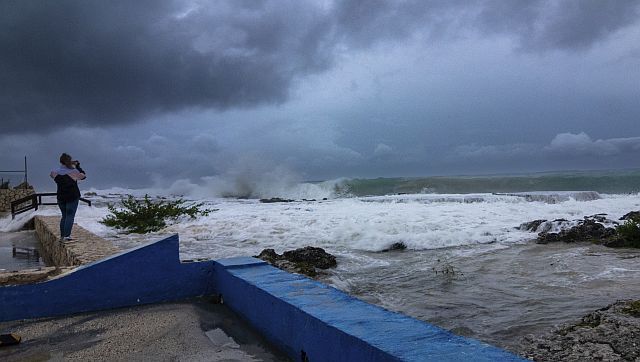 Hurricane Ian is on track to hit the west coast of Florida as a major hurricane as early as Wednesday. AP[/caption]As of Monday, Tampa and St. Petersburg appeared to be the among the most likely targets for their first direct hit by a major hurricane since 1921.
Typhoons, common between May and October, can form around the year.The most severe ones are classified ‘super typhoons’ as per the report. Cyclone season is between November and April, as per Al Jazeera.Noru underwent an "explosive intensification" over the open Pacific Ocean before it hit the Philippines, Vicente Malano, who heads the country's weather agency, told The Associated Press on Sunday.From sustained winds of 85 kmph on Saturday, Noru was a super typhoon just 24 hours later with sustained winds of 195 kmph and gusts of up to 240 kmph at its peak late Sunday.By Monday noon, Noru had sustained winds of 130 kmph and gusts of 160 kmph and was moving northwest in the South China Sea toward Vietnam, according to the weather agency.About 20 storms and typhoons batter the Philippines each year. The archipelago also lies in the "Pacific Ring of Fire," a region along most of the Pacific Ocean rim where many volcanic eruptions and earthquakes occur, making the Southeast Asian nation one of the world's most disaster-prone.In 2013, Typhoon Haiyan, one of the strongest recorded tropical cyclones in the world, left more than 7,300 people dead or missing, flattened entire villages, swept ships inland and displaced more than 5 million in the central Philippines — well to the south of Noru's path.[caption id="attachment_11329481" align="alignnone" width="640"]
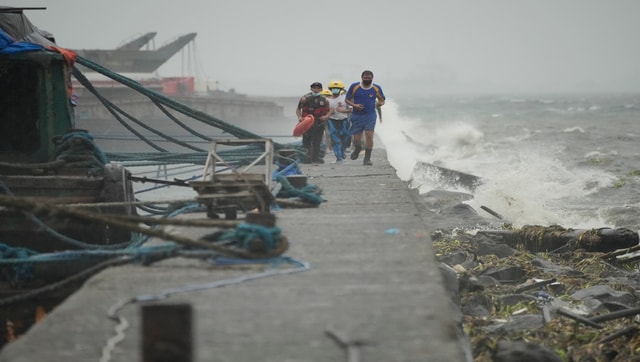 Rescuers run as they check residents living at the seaside slum district of Tondo ahead of Typhoon Noru hitting Manila. AP[/caption]Climate change to blame?Scientists say climate change may be leading to more intense extreme weather."Is this climate change?" President Ferdinand Marcos Jr, who took office in June, asked. "We have kept watched on these storms for a long time but it wasn't like this before... This is something I have to deal with."The Canadian Hurricane Centre tweeted that Fiona had the lowest pressure — a key sign of storm strength — ever recorded for a storm making landfall in Canada.
“We’re getting more severe storms more frequently,” said Prime Minister Justin Trudeau.He added that more resilient infrastructure is needed to withstand extreme weather events.As per National Geographic, the 2018 hurricane season was one of the most active in history with 22 major hurricanes in the Northern Hemisphere in under three months, and 2017 also saw seriously devastating Atlantic storms.While a slew of factors determine a hurricane's strength and impact, warmer temperatures in certain locations play an important role. In the Atlantic, warming in the Arctic could drive future hurricane tracks farther west, making a US landfall more likely, the report added.With inputs from agenciesRead all the Latest News, Trending News, Cricket News, Bollywood News,India News and Entertainment News here. Follow us on Facebook, Twitter and Instagram.
First Published:Sep 27, 2022, 15:34:52 IST
Advertisement
Advertisement

Military drones & police check-ups: How Sri Lanka is fighting against worst dengue outbreak in a decade
Sri Lanka is fighting its most severe dengue outbreak in nearly a decade, with infections rising sharply across the nation. Military drones have been deployed to tackle the outbreak, which has claimed 56 lives. Health officials said the outbreak is being driven primarily by the DENV-2 variant of the virus
3 min read
How Facebook job ad lured 2 Karnataka men into Myanmar cyber scam camp
The Karnataka Cyber Command has rescued two youths from a scam compound in Myanmar operated by Chinese fraudsters. The duo from Karnataka were lured on the pretext of data-entry jobs. They were asked to work for 16 hours a day and were expected to sleep for six hours daily
4 min read
Why is India seeing 95% cloud cover despite a Super El Niño?
India is witnessing nearly 95 per cent cloud cover despite a Super El Niño, a climate event usually linked to weaker monsoons. Regional weather systems, cyclonic circulations, the monsoon trough and moisture from two seas are temporarily overpowering one of the world's strongest climate phenomena
5 min read
What is CJP’s fourth demand to the government as protests in Delhi intensify?
The protest by the Cockroach Janta Party at Delhi’s Jantar Mantar refuses to die down. The group have made a fourth demand to the Centre, asking that no FIRs are filed against the agitators and that no legal action be taken. The government has expressed willingness to speak to the protesters, but refused to accede on the resignation of Education Minister Dharmandra Pradhan
5 min read
The new geography of war: Why the Houthis can no longer be ignored
The rise of the Houthis marks the emergence of a new geography of war — one in which influence flows not only from capitals and conventional armies, but also from rugged mountains overlooking vital sea lanes
6 min read
Advertisement
Advertisement