
Advertisement


Sections
Explained: What is Russia's Kinzhal missile that Ukraine claims to have shot down?
Russia fired hypersonic Kinzhal missiles at Kyiv on Tuesday, with Ukraine saying it shot down all six. The hypersonic aero-ballistic air-to-surface missile is capable of carrying nuclear or conventional warheads and is known for its ability to evade interception

The skies over Kyiv were lit up with thundering explosions early Tuesday as Ukrainian air defences slammed approaching Russian missiles, raining debris across the city. Ukraine now claims to have accomplished a unique military feat: the downing of advanced Russian hypersonic Kinzhal missiles.The Russian forces fired six Kh-47M2 Kinzhals at targets in Ukraine's capital Kyiv, early Tuesday, with Ukraine saying it had shot down all six, and Russia claiming one got through air defences to destroy a US-built Patriot surface-to-air anti-missile defence system."Six Kh-47M2 Kinzhal aeroballistic missiles were fired from six MiG-31K aircraft, nine Kalibr cruise missiles from ships in the Black Sea, and three land-based missiles (S-400, Iskander-M)," Ukrainian armed forces chief General Valerii Zaluzhnyi said on Twitter, adding that Moscow also launched attack drones, which were all destroyed.Here are some crucial facts about Russia's hypersonic missile Kinzhal.What is a Kinzhal?The Kh-47M2 Kinzhal is a Russian-made nuclear-capable hypersonic aero-ballistic air-to-surface missile capable of carrying nuclear or conventional warheads. Ukraine said six of them were fired on Tuesday.It has a reported range of 1,500 to 2,000 km (930 to 1,240 miles) while carrying a payload of 480 kg. It may reach speeds of up to Mach 10 (12,250 kph), which is 10 times faster than the speed of sound. The missile weighs 9,500 pounds (4,300 kilogrammes).[caption id="attachment_12607352" align="alignnone" width="640"]![]() On 6 May, Ukraine said for the first time that it had shot down a Kinzhal, using a Patriot system. File image/AFP[/caption]Once launched, a Kinzhal, which means “dagger” in Russian, rapidly achieves Mach 4 (3,000 miles per hour) and can reach speeds of up to Mach 10 (7,600mph). These speeds, combined with the missile’s erratic flight trajectory and its extreme manoeuvrability, make interception extremely difficult.A July 2018 report by the Russian TASS news agency suggested that a Kinzhal can achieve a range of over 1,800 miles (2,000 km) if launched from a Tupolev Tu-22M strategic bomber.What distinguishes the Kinzhal from other missiles?The Kinzhal is one of six "next generation" weapons unveiled by President Vladimir Putin in a speech in March 2018. He has said these weapons could penetrate both existing and any future missile defence systems.It is the cousin of the 9K720 Iskander-M — a short-range, ground-launched ballistic missile that Russia has used somewhat frequently throughout the war in Ukraine.Also Read: From pistols to cruise missiles: How Western weaponry supplied to Ukraine has evolved during the warPutin said in December 2021, two months before the invasion of Ukraine, that Russia was the global leader in hypersonic missiles and, by the time other countries caught up, was likely to have developed technology to counteract these new weapons."In our advanced developments, we are definitely the leaders," he said.Russia sent fighter jets armed with Kinzhal missiles to Syria for the first time in 2021, military analysts say.Russia's defence ministry claimed to have fired a Kinzhal missile at a munitions dump in southwestern Ukraine on 19 March, 2022, the first known use of the weapon in combat. It has since fired Kinzhal missiles on several other occasions in Ukraine.On 6 May, Ukraine said for the first time that it had shot down a Kinzhal, using a Patriot system. It was not clear whether the "Western" systems Kyiv said it used against Kinzhals on Tuesday were also Patriots.The aerial assault over Kyiv early on Tuesday was the eighth large-scale attack on the city this month; Ukrainian officials have said the attacks were aimed at exhausting their air defences. Tuesday’s barrage was extraordinary in the number of attacks launched at the capital over a short period of time.Why is it so difficult to take down? The Kinzhal's unique characteristic lies in its challenging interception capabilities.[caption id="attachment_12607362" align="alignnone" width="640"]
On 6 May, Ukraine said for the first time that it had shot down a Kinzhal, using a Patriot system. File image/AFP[/caption]Once launched, a Kinzhal, which means “dagger” in Russian, rapidly achieves Mach 4 (3,000 miles per hour) and can reach speeds of up to Mach 10 (7,600mph). These speeds, combined with the missile’s erratic flight trajectory and its extreme manoeuvrability, make interception extremely difficult.A July 2018 report by the Russian TASS news agency suggested that a Kinzhal can achieve a range of over 1,800 miles (2,000 km) if launched from a Tupolev Tu-22M strategic bomber.What distinguishes the Kinzhal from other missiles?The Kinzhal is one of six "next generation" weapons unveiled by President Vladimir Putin in a speech in March 2018. He has said these weapons could penetrate both existing and any future missile defence systems.It is the cousin of the 9K720 Iskander-M — a short-range, ground-launched ballistic missile that Russia has used somewhat frequently throughout the war in Ukraine.Also Read: From pistols to cruise missiles: How Western weaponry supplied to Ukraine has evolved during the warPutin said in December 2021, two months before the invasion of Ukraine, that Russia was the global leader in hypersonic missiles and, by the time other countries caught up, was likely to have developed technology to counteract these new weapons."In our advanced developments, we are definitely the leaders," he said.Russia sent fighter jets armed with Kinzhal missiles to Syria for the first time in 2021, military analysts say.Russia's defence ministry claimed to have fired a Kinzhal missile at a munitions dump in southwestern Ukraine on 19 March, 2022, the first known use of the weapon in combat. It has since fired Kinzhal missiles on several other occasions in Ukraine.On 6 May, Ukraine said for the first time that it had shot down a Kinzhal, using a Patriot system. It was not clear whether the "Western" systems Kyiv said it used against Kinzhals on Tuesday were also Patriots.The aerial assault over Kyiv early on Tuesday was the eighth large-scale attack on the city this month; Ukrainian officials have said the attacks were aimed at exhausting their air defences. Tuesday’s barrage was extraordinary in the number of attacks launched at the capital over a short period of time.Why is it so difficult to take down? The Kinzhal's unique characteristic lies in its challenging interception capabilities.[caption id="attachment_12607362" align="alignnone" width="640"]![]() The aerial assault over Kyiv early on Tuesday was the eighth large-scale attack on the city this month. Reuters[/caption]According to Sidharth Kaushal, a research fellow at the Royal United Services Institute, a defence and security think tank in London, the missile is difficult to intercept because of its altitude, which is between 30 and 40 km above ground.As a result of its altitude, the Kinzhal operates beyond the reach of numerous lower-tier air defence interceptors, while remaining within a lower altitude range compared to ballistic missile defence systems that operate at much higher altitudes.“The Kinzhal decreases in speed as it descends so there is a small window of opportunity to intercept it. A missile is fired from the Patriot to meet it and on the way it explodes, creating a barrier of explosive fragments through which the Kinzhal would fly, leading to its destruction,” explains Dr Marina Miron of King's College London's defence studies department, explaining how the missile could be intercepted, as reported by inews.Kaushal continues, as reported by CBC, that the challenges with intercepting the missile don't end there.When the Kinzhal is in its terminal phase and descending rapidly toward a target, it releases six decoys that "mimic the radar signature of the warhead itself," Kaushal said."If an air defence system on the ground is firing interceptors, in principle, it may eliminate decoys rather than the warhead they're actually going for," he said.With inputs from agencies Read all the Latest News, Trending News, Cricket News, Bollywood News,India News and Entertainment News here. Follow us on Facebook, Twitter and Instagram.
The aerial assault over Kyiv early on Tuesday was the eighth large-scale attack on the city this month. Reuters[/caption]According to Sidharth Kaushal, a research fellow at the Royal United Services Institute, a defence and security think tank in London, the missile is difficult to intercept because of its altitude, which is between 30 and 40 km above ground.As a result of its altitude, the Kinzhal operates beyond the reach of numerous lower-tier air defence interceptors, while remaining within a lower altitude range compared to ballistic missile defence systems that operate at much higher altitudes.“The Kinzhal decreases in speed as it descends so there is a small window of opportunity to intercept it. A missile is fired from the Patriot to meet it and on the way it explodes, creating a barrier of explosive fragments through which the Kinzhal would fly, leading to its destruction,” explains Dr Marina Miron of King's College London's defence studies department, explaining how the missile could be intercepted, as reported by inews.Kaushal continues, as reported by CBC, that the challenges with intercepting the missile don't end there.When the Kinzhal is in its terminal phase and descending rapidly toward a target, it releases six decoys that "mimic the radar signature of the warhead itself," Kaushal said."If an air defence system on the ground is firing interceptors, in principle, it may eliminate decoys rather than the warhead they're actually going for," he said.With inputs from agencies Read all the Latest News, Trending News, Cricket News, Bollywood News,India News and Entertainment News here. Follow us on Facebook, Twitter and Instagram.
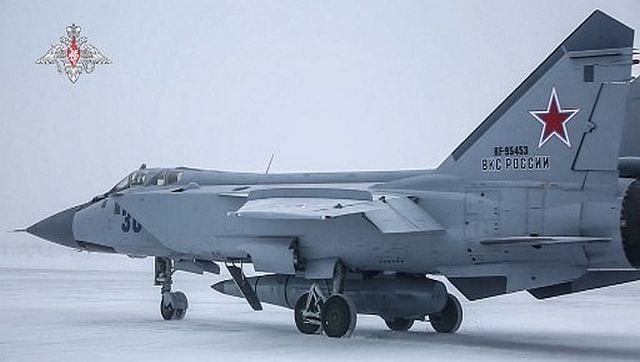 On 6 May, Ukraine said for the first time that it had shot down a Kinzhal, using a Patriot system. File image/AFP[/caption]Once launched, a Kinzhal, which means “dagger” in Russian, rapidly achieves Mach 4 (3,000 miles per hour) and can reach speeds of up to Mach 10 (7,600mph). These speeds, combined with the missile’s erratic flight trajectory and its extreme manoeuvrability, make interception extremely difficult.A July 2018 report by the Russian TASS news agency suggested that a Kinzhal can achieve a range of over 1,800 miles (2,000 km) if launched from a Tupolev Tu-22M strategic bomber.What distinguishes the Kinzhal from other missiles?The Kinzhal is one of six "next generation" weapons unveiled by President Vladimir Putin in a speech in March 2018. He has said these weapons could penetrate both existing and any future missile defence systems.It is the cousin of the 9K720 Iskander-M — a short-range, ground-launched ballistic missile that Russia has used somewhat frequently throughout the war in Ukraine.Also Read: From pistols to cruise missiles: How Western weaponry supplied to Ukraine has evolved during the warPutin said in December 2021, two months before the invasion of Ukraine, that Russia was the global leader in hypersonic missiles and, by the time other countries caught up, was likely to have developed technology to counteract these new weapons."In our advanced developments, we are definitely the leaders," he said.Russia sent fighter jets armed with Kinzhal missiles to Syria for the first time in 2021, military analysts say.Russia's defence ministry claimed to have fired a Kinzhal missile at a munitions dump in southwestern Ukraine on 19 March, 2022, the first known use of the weapon in combat. It has since fired Kinzhal missiles on several other occasions in Ukraine.
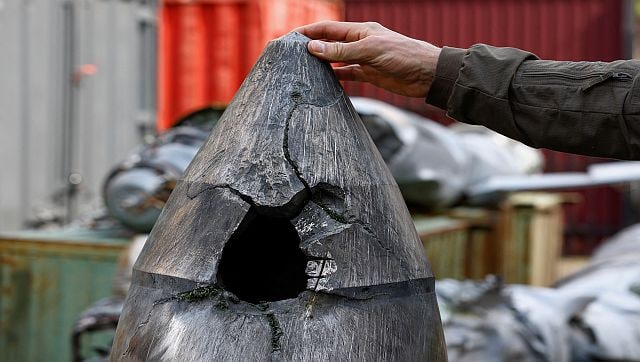 The aerial assault over Kyiv early on Tuesday was the eighth large-scale attack on the city this month. Reuters[/caption]According to Sidharth Kaushal, a research fellow at the Royal United Services Institute, a defence and security think tank in London, the missile is difficult to intercept because of its altitude, which is between 30 and 40 km above ground.As a result of its altitude, the Kinzhal operates beyond the reach of numerous lower-tier air defence interceptors, while remaining within a lower altitude range compared to ballistic missile defence systems that operate at much higher altitudes.“The Kinzhal decreases in speed as it descends so there is a small window of opportunity to intercept it. A missile is fired from the Patriot to meet it and on the way it explodes, creating a barrier of explosive fragments through which the Kinzhal would fly, leading to its destruction,” explains Dr Marina Miron of King's College London's defence studies department, explaining how the missile could be intercepted, as reported by inews.Kaushal continues, as reported by CBC, that the challenges with intercepting the missile don't end there.When the Kinzhal is in its terminal phase and descending rapidly toward a target, it releases six decoys that "mimic the radar signature of the warhead itself," Kaushal said."If an air defence system on the ground is firing interceptors, in principle, it may eliminate decoys rather than the warhead they're actually going for," he said.With inputs from agencies Read all the Latest News, Trending News, Cricket News, Bollywood News,India News and Entertainment News here. Follow us on Facebook, Twitter and Instagram.
First Published:May 17, 2023, 10:53:27 IST
Advertisement
Advertisement

Military drones & police check-ups: How Sri Lanka is fighting against worst dengue outbreak in a decade
Sri Lanka is fighting its most severe dengue outbreak in nearly a decade, with infections rising sharply across the nation. Military drones have been deployed to tackle the outbreak, which has claimed 56 lives. Health officials said the outbreak is being driven primarily by the DENV-2 variant of the virus
3 min read
How Facebook job ad lured 2 Karnataka men into Myanmar cyber scam camp
The Karnataka Cyber Command has rescued two youths from a scam compound in Myanmar operated by Chinese fraudsters. The duo from Karnataka were lured on the pretext of data-entry jobs. They were asked to work for 16 hours a day and were expected to sleep for six hours daily
4 min read
Why is India seeing 95% cloud cover despite a Super El Niño?
India is witnessing nearly 95 per cent cloud cover despite a Super El Niño, a climate event usually linked to weaker monsoons. Regional weather systems, cyclonic circulations, the monsoon trough and moisture from two seas are temporarily overpowering one of the world's strongest climate phenomena
5 min read
What is CJP’s fourth demand to the government as protests in Delhi intensify?
The protest by the Cockroach Janta Party at Delhi’s Jantar Mantar refuses to die down. The group have made a fourth demand to the Centre, asking that no FIRs are filed against the agitators and that no legal action be taken. The government has expressed willingness to speak to the protesters, but refused to accede on the resignation of Education Minister Dharmandra Pradhan
5 min read
The new geography of war: Why the Houthis can no longer be ignored
The rise of the Houthis marks the emergence of a new geography of war — one in which influence flows not only from capitals and conventional armies, but also from rugged mountains overlooking vital sea lanes
6 min read
Advertisement
Advertisement