


Explained: What Finland's entry into NATO means for the organisation
Finland becoming the 31st member of NATO is a strategic step that doubles the military alliance's border with Russia and provides the coalition with additional military capacity

Paris: Finland on Tuesday becoming the 31st member of NATO is a strategic step that doubles the military alliance's border with Russia and provides the coalition with additional military capacity.
Here are the key facts:
Russia 'more vulnerable'
Finland broke with decades of non-alignment to ask to join the North Atlantic Treaty Organisation after Russia invaded its pro-Western neighbour Ukraine in February last year.
For Moscow, which has repeatedly warned NATO against expanding, Finland's accession extends the bloc's presence right on its western doorstep.
Russia — which shares a 1,300-kilometre (800-mile) border with Finland — said on Monday it would boost its military presence in its west and northwest in response.
With Finland joining NATO, "Russia's northwestern flank becomes more vulnerable", security experts Nicholas Lokker and Heli Hautala wrote on Friday on defence-focused website War on the Rocks.
 More from Explainers
"Its border with the alliance will then extend from the Arctic Ocean to the Baltic Sea."
More NATO border to defend
As a NATO member, Finland is bound by the alliance's mutual defence clause, Article 5.
It will benefit not only from its allies' conventional military assistance but also from their nuclear deterrence.
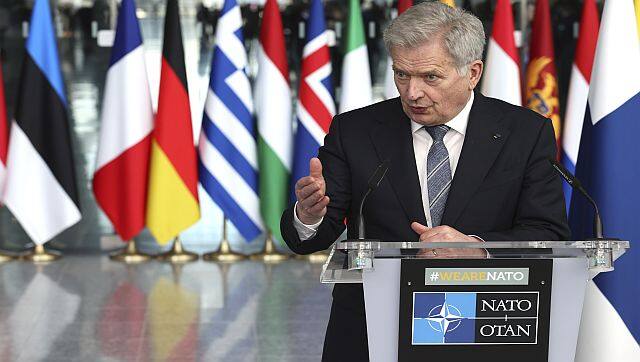
In return, the Nordic nation, which intends to boost its defence budget by 40 per cent by 2026, could contribute some of its military resources to defend the alliance.
The country of 5.5 million people counts just 12,000 professional soldiers.
But it trains more than 20,000 each year through its conscription service programme, giving the army a pool of 900,000 Finns as potential reserves.
This means that in case of war, the army can deploy 280,000 Finnish citizens at any one time.
It has a fleet of 55 F-18 US combat aircraft, which it plans to replace with more advanced F-35s from 2025 onwards, as well as 200 tanks and more than 700 artillery guns.
But the country joining NATO also means hundreds of extra kilometres of border to defend for the alliance.
Allied forces
The only military equipment that NATO actually owns are a fleet of Airborne Warning and Control System planes (AWACS) — which can monitor an area almost as big as Poland — and five Global Hawk high-altitude surveillance drones.
For all other military gear, each NATO member chooses what to contribute, though all have promised to reinforce the alliance's eastern flank.
Also Read: Finland gets a yes. But, why is Turkey sitting on Sweden’s NATO bid?
France dispatched 500 troops to join US soldiers in Romania last year right after Russia invaded Ukraine. Dutch and Belgian soldiers soon joined them.
As of December, some 5,000 foreign troops were stationed in Romania — the largest contingent of allied forces on the bloc's southeastern flank.
NATO conducted nine joint exercises last year, from the eastern Mediterranean to the Baltic Sea, the International Institute for Strategic Studies (IISS) says.
The troops
"Together NATO allies represent 50 per cent of the world's military might," NATO chief Jens Stoltenberg said on Tuesday welcoming Finland into the alliance. "As long as we stand together and protect each other... there will be no military attack against a NATO ally."
According to the Supreme Headquarters of Allied Powers in Europe (SHAPE), NATO can count on up to 3.5 million soldiers and personnel.

The three nations providing most military staff are the United States with 1.47 million active troops plus 800,000 reservists, Turkey with 425,000 soldiers and 200,000 reservists, and France with 210,000 troops and 40,000 reservists.
NATO has since 2004 had a multinational response force of some 40,000 soldiers on top of the 100,000 US troops already on European soil. It says it hopes to increase this to 300,000 soldiers.
It has also set up a "spearhead force" within it, dubbed the "Very High Readiness Joint Task Force" or VJTF, able to deploy 5,000 personnel in two to three days.
'Renewed unity'
NATO had in recent years faced an existential crisis.
French president Emmanuel Macron in 2019 famously said that NATO was experiencing "brain death" after it failed to respond to Turkey's unilateral invasion of northeast Syria.
But Russian president Vladimir Putin's "re-invasion of Ukraine has provided the fuel for the alliance's renewed unity and recommitment to cooperative security, crisis management, and collective defence," retired general Philip M Breedlove, who used to head US European Command, wrote in February.
According to IISS, the alliance has since doubled its deployment from four battle groups — in Estonia, Latvia, Lithuania and Poland — to eight, including Bulgaria, Hungary, Romania and Slovakia.
But "it is likely that most of the high-readiness forces will need to be European", it said in an annual assessment for 2023.
Read all the Latest News, Trending News, Cricket News, Bollywood News,
India News and Entertainment News here. Follow us on Facebook, Twitter and Instagram.

Military drones & police check-ups: How Sri Lanka is fighting against worst dengue outbreak in a decade
How Facebook job ad lured 2 Karnataka men into Myanmar cyber scam camp
Why is India seeing 95% cloud cover despite a Super El Niño?
What is CJP’s fourth demand to the government as protests in Delhi intensify?
The new geography of war: Why the Houthis can no longer be ignored