
Advertisement


Sections
Explained: The challenges that the UK faces in implementing new illegal migration bill
One of the most pressing concerns raised by the bill is where people would be relocated. If people continue to arrive in large numbers in the UK, not being able to process and resolve their asylum claims could cause significant operational and financial difficulties, in addition to the human cost
In its new illegal migration bill, the UK government has introduced some surprisingly radical proposals designed to discourage people from crossing the Channel in small boats to claim asylum.Chiefly, it targets people who arrive in Britain through irregular routes, barring them from seeking asylum. And the UK does not offer many legal routes, with exceptions such as the schemes for Ukrainian and Afghan refugees.Immigration lawyers are still picking over the details of the bill — initial debate is focused on whether it violates the UK’s legal obligations under international human rights or refugee law. While these questions are important, the practical and operational constraints are arguably the biggest obstacle to implementing it.On paper, the bill effectively opts the UK out of the global asylum system as we know it, by preventing people from claiming asylum if they have arrived through irregular routes.That global system is, after all, based on the principle that people must usually reach a country’s territory in order to claim asylum. And this often involves irregular entry, because people fleeing threatening or otherwise dire circumstances may not have proper documents.The UN has said the new UK bill represents a “clear breach” of the refugee convention, “which explicitly recognises that refugees may be compelled to enter a country of asylum irregularly”.[caption id="attachment_12270492" align="alignnone" width="640"]![]() The UK government says it is ready for legal challenges to a tough new law intended to stop tens of thousands of migrants a year reaching the country in small boats across the English Channel. AP[/caption]Instead of hearing asylum claims, the bill stipulates that people entering through irregular routes should be “detained and removed” from the UK. This applies regardless of nationality, including people from countries such as Afghanistan and Eritrea who would be very likely to be granted asylum in the UK under the current system.Will people actually be removed?But making something law does not mean it can be implemented. One of the biggest questions the bill raises is where people would be removed to.If people do not come from countries deemed “safe” by the UK, they cannot be sent back to their country of origin without a decision on their asylum claim. If this is the case, the bill says they should be sent to “safe third countries”.
The UK government says it is ready for legal challenges to a tough new law intended to stop tens of thousands of migrants a year reaching the country in small boats across the English Channel. AP[/caption]Instead of hearing asylum claims, the bill stipulates that people entering through irregular routes should be “detained and removed” from the UK. This applies regardless of nationality, including people from countries such as Afghanistan and Eritrea who would be very likely to be granted asylum in the UK under the current system.Will people actually be removed?But making something law does not mean it can be implemented. One of the biggest questions the bill raises is where people would be removed to.If people do not come from countries deemed “safe” by the UK, they cannot be sent back to their country of origin without a decision on their asylum claim. If this is the case, the bill says they should be sent to “safe third countries”.![]() Placards are pictured as local activists attempt to remove rocks placed by the townhall to avoid gatherings of migrants in Calais, northern France. AP[/caption]It’s hard to predict how much of a deterrent effect the provisions in the bill will have. They are more extreme than polices adopted in most other high-income countries, which is where most of the evidence on policy deterrence comes from.With that said, to date there is surprisingly little evidence that asylum deterrence policies put people off in large numbers, for the simple reason that asylum seekers often have little understanding of what policies they will face when they arrive.Also Read: How many asylum seekers are admitted to the UK in comparison to Europe?Indeed, this has been the finding of the Home Office’s own internal research, which was released to an NGO working on migration after a Freedom of Information request and shared with our team.There’s certainly a risk, therefore, that the UK would end up detaining (or otherwise housing and supporting) quite large numbers of people for indefinite periods if this bill is enacted.
Placards are pictured as local activists attempt to remove rocks placed by the townhall to avoid gatherings of migrants in Calais, northern France. AP[/caption]It’s hard to predict how much of a deterrent effect the provisions in the bill will have. They are more extreme than polices adopted in most other high-income countries, which is where most of the evidence on policy deterrence comes from.With that said, to date there is surprisingly little evidence that asylum deterrence policies put people off in large numbers, for the simple reason that asylum seekers often have little understanding of what policies they will face when they arrive.Also Read: How many asylum seekers are admitted to the UK in comparison to Europe?Indeed, this has been the finding of the Home Office’s own internal research, which was released to an NGO working on migration after a Freedom of Information request and shared with our team.There’s certainly a risk, therefore, that the UK would end up detaining (or otherwise housing and supporting) quite large numbers of people for indefinite periods if this bill is enacted.![The Conversation]() This article is republished from The Conversation under a Creative Commons license. Read the original article.Read all the Latest News, Trending News, Cricket News, Bollywood News,India News and Entertainment News here. Follow us on Facebook, Twitter and Instagram.
This article is republished from The Conversation under a Creative Commons license. Read the original article.Read all the Latest News, Trending News, Cricket News, Bollywood News,India News and Entertainment News here. Follow us on Facebook, Twitter and Instagram.
 The UK government says it is ready for legal challenges to a tough new law intended to stop tens of thousands of migrants a year reaching the country in small boats across the English Channel. AP[/caption]Instead of hearing asylum claims, the bill stipulates that people entering through irregular routes should be “detained and removed” from the UK. This applies regardless of nationality, including people from countries such as Afghanistan and Eritrea who would be very likely to be granted asylum in the UK under the current system.Will people actually be removed?But making something law does not mean it can be implemented. One of the biggest questions the bill raises is where people would be removed to.If people do not come from countries deemed “safe” by the UK, they cannot be sent back to their country of origin without a decision on their asylum claim. If this is the case, the bill says they should be sent to “safe third countries”.
There is currently just one third country, Rwanda, that is willing to take asylum seekers from the UK.But even if the Rwanda scheme gets up and running, it is only expected to have capacity for around 200 people at first, though more could perhaps be processed per year. Without other safe third countries to remove people to, it is not obvious that many people could be removed in practice.Past data illustrates this. Since 1 January 2021, the UK government has already had a policy in place to remove asylum seekers it believes could have applied for asylum in another country. This would presumably include most people arriving by small boat from France.
As of 30 September 2022, the government had assessed around 18,000 people for removal — but had removed just 21.Oddly, one strange quirk of the new bill is that it appears to make it harder, not easier, for the government to remove people who are not considered refugees.By preventing the government from considering asylum claims at all, it means that claims cannot be refused. People from “unsafe” countries who would have been refused cannot, under the new bill, be sent back to their countries of origin — instead, the UK will have to detain them (a costly endeavour) until a third country is willing to take them.Also Read: UK’s asylum plan to stop Channel crossings and why it is so controversialIn 2022, the UK’s detention facilities were estimated to have a total capacity of no more than 2,500, while in the month of August last year, small boat arrivals exceeded 8,000.To accommodate more people, there would need to be a major increase in the use of detention. This is a reversal of previous government policy, which over the last ten years has aimed to minimise the use of immigration detention.If people continue to arrive in the UK in substantial numbers, not being able to process and resolve their asylum claims could create considerable operational difficulties and financial costs — aside from the obvious human cost.The deterrent may not workAt the heart of the proposal is a gamble: that the UK will not actually need to impose this penalty on many people, because the deterrent effect will be so strong.While this may seem like a sort of policy catch-22 — “introduce a policy to deter arrivals so that you don’t need to implement the policy to deter arrivals” — it is the argument made by some government ministers.[caption id="attachment_12270502" align="alignnone" width="640"]
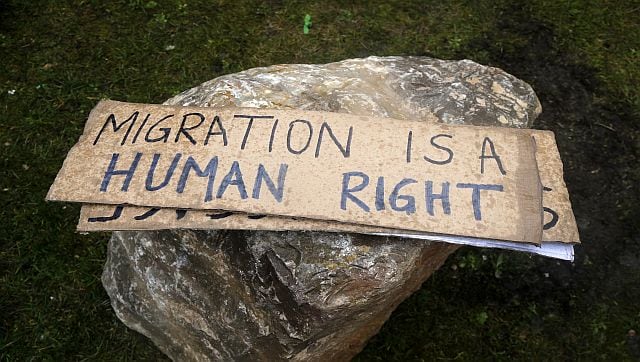 Placards are pictured as local activists attempt to remove rocks placed by the townhall to avoid gatherings of migrants in Calais, northern France. AP[/caption]It’s hard to predict how much of a deterrent effect the provisions in the bill will have. They are more extreme than polices adopted in most other high-income countries, which is where most of the evidence on policy deterrence comes from.With that said, to date there is surprisingly little evidence that asylum deterrence policies put people off in large numbers, for the simple reason that asylum seekers often have little understanding of what policies they will face when they arrive.Also Read: How many asylum seekers are admitted to the UK in comparison to Europe?Indeed, this has been the finding of the Home Office’s own internal research, which was released to an NGO working on migration after a Freedom of Information request and shared with our team.There’s certainly a risk, therefore, that the UK would end up detaining (or otherwise housing and supporting) quite large numbers of people for indefinite periods if this bill is enacted.
 This article is republished from The Conversation under a Creative Commons license. Read the original article.Read all the Latest News, Trending News, Cricket News, Bollywood News,India News and Entertainment News here. Follow us on Facebook, Twitter and Instagram.
First Published:Mar 10, 2023, 16:11:33 IST
Advertisement
Advertisement

Military drones & police check-ups: How Sri Lanka is fighting against worst dengue outbreak in a decade
Sri Lanka is fighting its most severe dengue outbreak in nearly a decade, with infections rising sharply across the nation. Military drones have been deployed to tackle the outbreak, which has claimed 56 lives. Health officials said the outbreak is being driven primarily by the DENV-2 variant of the virus
3 min read
How Facebook job ad lured 2 Karnataka men into Myanmar cyber scam camp
The Karnataka Cyber Command has rescued two youths from a scam compound in Myanmar operated by Chinese fraudsters. The duo from Karnataka were lured on the pretext of data-entry jobs. They were asked to work for 16 hours a day and were expected to sleep for six hours daily
4 min read
Why is India seeing 95% cloud cover despite a Super El Niño?
India is witnessing nearly 95 per cent cloud cover despite a Super El Niño, a climate event usually linked to weaker monsoons. Regional weather systems, cyclonic circulations, the monsoon trough and moisture from two seas are temporarily overpowering one of the world's strongest climate phenomena
5 min read
What is CJP’s fourth demand to the government as protests in Delhi intensify?
The protest by the Cockroach Janta Party at Delhi’s Jantar Mantar refuses to die down. The group have made a fourth demand to the Centre, asking that no FIRs are filed against the agitators and that no legal action be taken. The government has expressed willingness to speak to the protesters, but refused to accede on the resignation of Education Minister Dharmandra Pradhan
5 min read
The new geography of war: Why the Houthis can no longer be ignored
The rise of the Houthis marks the emergence of a new geography of war — one in which influence flows not only from capitals and conventional armies, but also from rugged mountains overlooking vital sea lanes
6 min read
Advertisement
Advertisement