


Explained: E-skin invented by scientists that mimics our sense of touch
Scientists at Stanford University in a breakthrough successfully tested a soft, flexible patch of electronic skin as thick as a piece of paper on a rat. While this offers a ray of hope to amputees and those with skin damage, experts say much more research is required

Soft and flexible, it can be wrapped around a human finger.Bao, who led the study, told the newspaper, “We’ve been working on a monolithic e-skin for some time.”“The hurdle was not so much finding mechanisms to mimic the remarkable sensory abilities of human touch, but bringing them together using only skin-like materials.”The prototype is about as thick as a piece of paper, as per The Independent.Weichen Wang, who has a PhD in engineering and is the first author of the study, added, “Much of that challenge came down to advancing the skin-like electronic materials so that they can be incorporated into integrated circuits with sufficient complexity to generate nerve-like pulse trains and low enough operating voltage to be used safely on the human body.”How does it work?By mimicking human skin.
In the human body, our nerves detect sensations and then transmit these signals to our brain.The research team tested the e-skin on a rat.According to New Scientist, the team connected the e-skin to the animal’s nervous system.They then attached electrodes to a patch of the rat’s brain that regulates touch and temperature.When they put pressure on the device, the rat’s brain sent signals to the region that controls movement.When the researchers sent signals to the rat’s leg through an insertable artificial synapse device, the leg moved.[caption id="attachment_12621812" align="alignnone" width="640"]
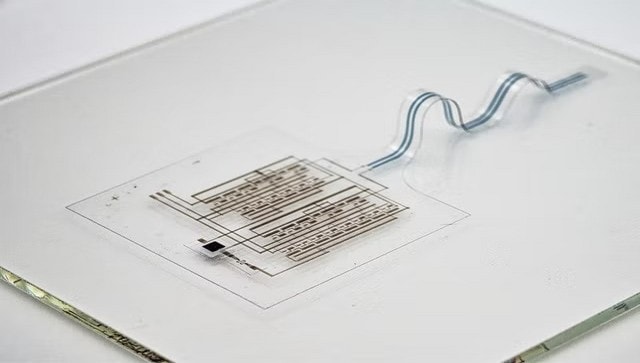
The components of a monolithically integrated, soft e-skin patch. Image courtesy: Bao Research Group[/caption]“This is a clear demonstration: based on sensation, there were movements. And this is not a small thing, it’s quite challenging work to get the electronics to work well enough for this,” Ravinder Dahiya at Northeastern University, told New Scientists.What does this mean?This could one day offer hope to those that have suffered skin damage, paralysis, or even lost their limbs.Wang told New Scientist the e-skin needed just a fraction of the power of older artificial devices.He added that this would make it more comfortable to use as it doesn’t heat up quite so much,
Experts are excited but cautious.“You can validate proof of concept into animal models, but that doesn’t mean it’s going to be implemented very quickly in humans,” Stéphanie Lacour, a neuroengineer working on stretchable biomaterials at the Swiss Federal Institute of Technology, told StatNews.Tsuyoshi Sekitani, an engineer at Osaka University, told StatNews it is extremely difficult to construct a sensory feedback loop with stretchable electronics.Sekitani said this points us to a future where “the boundary between living organisms and machines is disappearing.”Sekitani added that the question of how the e-skin would fare when it is combined with the human body.“The defence and rejection reactions of living tissues are extremely delicate, and as yet, the long-term stability of the interface between engineered materials and living tissues is far from satisfactory,” Sekitani told the website in an email.“Further development of biocompatible materials is essential.”With inputs from agenciesRead all the Latest News, Trending News, Cricket News, Bollywood News, India News and Entertainment News here. Follow us on Facebook, Twitter and Instagram.

Military drones & police check-ups: How Sri Lanka is fighting against worst dengue outbreak in a decade
How Facebook job ad lured 2 Karnataka men into Myanmar cyber scam camp
Why is India seeing 95% cloud cover despite a Super El Niño?
What is CJP’s fourth demand to the government as protests in Delhi intensify?
The new geography of war: Why the Houthis can no longer be ignored