


Explained: Can fish sense one another's fear?
The new study shows that a relaxed fish can detect fear in other fish, and then become afraid itself — and that this ability is regulated by oxytocin, the same brain chemical that underlies the capacity for empathy in humans

Washington: Our capacity to care about others may have very, very ancient origins, a new study suggests.
It might have been deep-rooted in prehistoric animals that lived millions of years ago, before fish and mammals like us diverged on the tree of life, according to researchers who published their study Thursday in the journal Science.Also Read: How smog is wreaking havoc on insects' mating rituals"Some of the mechanisms that underlie our ability to experience fear, or fall in and out of love, are clearly very ancient pathways," said Hans Hofmann, an evolutionary neuroscientist at the University of Texas at Austin, who was not involved in the research.
The new study shows that fish can detect fear in other fish, and then become afraid too — and that this ability is regulated by oxytocin, the same brain chemical that underlies the capacity for empathy in humans.But it's generally accepted that many animals have moods, including fish.
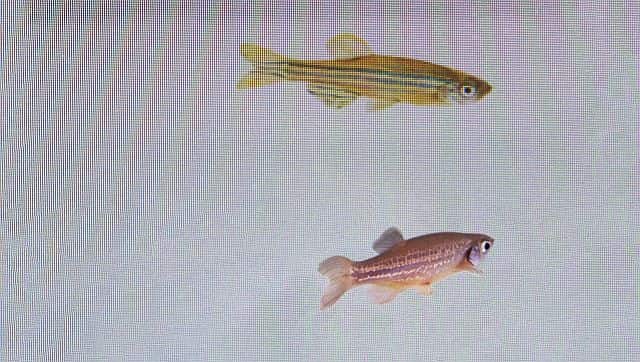
The photo provided by researcher Rui F Oliveira, a zebrafish, bottom, is monitored to see its reaction to a video of another at a laboratory in Oeiras, Portugal. AP[/caption]But when some of the altered fish received oxytocin injections, their ability to sense and mirror the feelings of other fish was restored — what scientists call "emotional contagion."
"They respond to other individuals being frightened. In that regard, they behave just like us," said University of Calgary neuroscientist Ibukun Akinrinade, a co-author of the study.
The new research illustrates "the ancestral role" of oxytocin in transmitting emotion, said Rui Oliveira, a behavioural biologist at Portugal's Gulbenkian Institute of Science and a study co-author.Previous research has shown that oxytocin plays a similar role in transmitting fear in mice.
This brain processing "may have already been in place around 450 million years ago, when you and me and these little fish last had a common ancestor," explained Hofmann.
 More from Explainers
Oxytocin is sometimes thought of as a "love" hormone, but Hofmann said it's actually more like "a thermostat that determines what is socially salient in a particular situation — activating neural circuits that may make you run from danger, or engage in courtship behaviour."Also Read: Their Time To Slime: Who will win 'Mollusc of the Year'?That could be fundamental to the survival of many animals, especially those who live in groups, said Stony Brook University ecologist Carl Safina, who was not involved in the study.
"The most basic form of empathy is contagious fear — that's a very valuable thing to have to stay alive, if any member of your group spots a predator or some other danger."Read all the Latest News, Trending News, Cricket News, Bollywood News,India News and Entertainment News here. Follow us on Facebook, Twitter and Instagram.

Military drones & police check-ups: How Sri Lanka is fighting against worst dengue outbreak in a decade
How Facebook job ad lured 2 Karnataka men into Myanmar cyber scam camp
Why is India seeing 95% cloud cover despite a Super El Niño?
What is CJP’s fourth demand to the government as protests in Delhi intensify?
The new geography of war: Why the Houthis can no longer be ignored