
Advertisement


Sections
Explained: Are Chinese vaccines to blame for its COVID-19 surge?
China’s homemade vaccines are far less efficient against COVID-19 than the Western-made mRNA vaccines. This, as Beijing has exported its vaccines to over 40 countries including Pakistan, Zimbabwe, Cambodia and Philippines

China’s COVID-19 surge has set the world on edge.With China limiting how it defines COVID-19 tests, and some estimating it may be witnessing a million new infections and 5,000 deaths every day, questions being asked about the efficacy of their homemade vaccines.So which vaccines does China use? How have they fared? And which countries use these vaccines?Let’s take a closer look:Which vaccines does China use?China has administered at least five different vaccines to its citizens.![]() Graphic: Pranay Bhardwaj[/caption]China Daily quoted its officials as saying that Beijing has thus far sent its vaccines to more than 40 countries including Pakistan, Zimbabwe, Cambodia and Philippines.‘China must important mRNA vaccines’Experts, politicos and industrialists are calling on China to import mRNA vaccines.Ali Mokdad, a professor at the University of Washington’s Institute for Health Metrics and Evaluation, told SCMP he thinks China could witness half a million deaths by April in the absence of mRNA vaccines and mitigation measures.Speaking to the newspaper, Dr Jennifer Huang Bouey, an epidemiologist and specialist in China policy at the RAND Corporation, said mRNA vaccines are a critical piece in China solving its COVID-19 problem.Mahindra Group chairman Anand Mahindra, taking to Twitter, said it was clear that China’s vaccines clearly did not provide the immunity necessary.Bloomberg quoted US secretary of state Antony Blinken as saying that Washington is prepared to assist Beijing with vaccines."We want to see China get this outbreak under control. The US is worried about the rise of new coronavirus variants and China’s outbreak has clear implications for the global economy because of China being shut down on multiple levels," Blinken said.But Chinese embassy spokesperson Liu Pengyu on Wednesday said its vaccine stock “can generally meet demand" and that boosters were being rolled out.But some disagree.“These are not bad vaccines. They’re just vaccines that haven’t been optimised yet,” Gagandeep Kang, a virologist at the Christian Medical College in Vellore, India, was quoted as saying by the journal Nature.Will China see the light on mRNA vaccines?Maybe.The Global Times in April that Chinese company Fosun Pharma is working with authorities as it awaits clearance to distribute manufacture the mRNA vaccines made by Pfizer and BioNTech.There is also hope for a Chinese-made mRNA vaccine by Abogen Biosciences, a start-up founded in 2019 by Bo Ying, an American-trained scientist who once worked for Moderna.[caption id="attachment_11373171" align="alignnone" width="640"]
Graphic: Pranay Bhardwaj[/caption]China Daily quoted its officials as saying that Beijing has thus far sent its vaccines to more than 40 countries including Pakistan, Zimbabwe, Cambodia and Philippines.‘China must important mRNA vaccines’Experts, politicos and industrialists are calling on China to import mRNA vaccines.Ali Mokdad, a professor at the University of Washington’s Institute for Health Metrics and Evaluation, told SCMP he thinks China could witness half a million deaths by April in the absence of mRNA vaccines and mitigation measures.Speaking to the newspaper, Dr Jennifer Huang Bouey, an epidemiologist and specialist in China policy at the RAND Corporation, said mRNA vaccines are a critical piece in China solving its COVID-19 problem.Mahindra Group chairman Anand Mahindra, taking to Twitter, said it was clear that China’s vaccines clearly did not provide the immunity necessary.Bloomberg quoted US secretary of state Antony Blinken as saying that Washington is prepared to assist Beijing with vaccines."We want to see China get this outbreak under control. The US is worried about the rise of new coronavirus variants and China’s outbreak has clear implications for the global economy because of China being shut down on multiple levels," Blinken said.But Chinese embassy spokesperson Liu Pengyu on Wednesday said its vaccine stock “can generally meet demand" and that boosters were being rolled out.But some disagree.“These are not bad vaccines. They’re just vaccines that haven’t been optimised yet,” Gagandeep Kang, a virologist at the Christian Medical College in Vellore, India, was quoted as saying by the journal Nature.Will China see the light on mRNA vaccines?Maybe.The Global Times in April that Chinese company Fosun Pharma is working with authorities as it awaits clearance to distribute manufacture the mRNA vaccines made by Pfizer and BioNTech.There is also hope for a Chinese-made mRNA vaccine by Abogen Biosciences, a start-up founded in 2019 by Bo Ying, an American-trained scientist who once worked for Moderna.[caption id="attachment_11373171" align="alignnone" width="640"]![Moderna]() Experts are saying China should import the mRNA vaccines. News18[/caption]The company has partnered with more established companies in the country such as Walvax, a private company founded in 2001, and the Academy of Military Medical Sciences, the military's medical research facility. Abogen has raised more than $1.7 billion since 2020.The company's vaccine candidate succeeded in eliciting an immune response in a small, preliminary test in humans designed to evaluate safety, according to a study published in the journal Lancet Microbe.The results were "promising," said Dr Vineeta Bal, who studies immune systems at the Indian Institute of Science Education and Research in Pune.But she also said that a direct comparison of the immune response triggered by the test shot with the response triggered by the Pfizer and Moderna vaccines would have helped scientists better evaluate its performance.But large studies that are needed to show whether the shot works to prevent infections or symptoms have not been completed. Abogen did not respond to requests for an interview.Even if the studies can be completed and the vaccine proves effective, manufacturing the millions of doses required will be a challenge, experts say. Abogen built a manufacturing facility in December 2020 with a projected capacity of up to 120 million doses a year.Manufacturing that vaccine and ensuring quality at scale will be a difficult hurdle to clear because mRNA is still a new technology, said Scott Wheelwright, chief operating officer at BioInno Bioscience, a Chinese biopharmaceutical contract manufacturer, who has held conversations with Abogen.In the meantime, Chen, the Yale health policy expert, said the Chinese government should better protect its elderly population by approving the Pfizer vaccine and encouraging booster shots.With inputs from agenciesRead all the Latest News, Trending News, Cricket News, Bollywood News, India News and Entertainment News here. Follow us on Facebook, Twitter and Instagram.
Experts are saying China should import the mRNA vaccines. News18[/caption]The company has partnered with more established companies in the country such as Walvax, a private company founded in 2001, and the Academy of Military Medical Sciences, the military's medical research facility. Abogen has raised more than $1.7 billion since 2020.The company's vaccine candidate succeeded in eliciting an immune response in a small, preliminary test in humans designed to evaluate safety, according to a study published in the journal Lancet Microbe.The results were "promising," said Dr Vineeta Bal, who studies immune systems at the Indian Institute of Science Education and Research in Pune.But she also said that a direct comparison of the immune response triggered by the test shot with the response triggered by the Pfizer and Moderna vaccines would have helped scientists better evaluate its performance.But large studies that are needed to show whether the shot works to prevent infections or symptoms have not been completed. Abogen did not respond to requests for an interview.Even if the studies can be completed and the vaccine proves effective, manufacturing the millions of doses required will be a challenge, experts say. Abogen built a manufacturing facility in December 2020 with a projected capacity of up to 120 million doses a year.Manufacturing that vaccine and ensuring quality at scale will be a difficult hurdle to clear because mRNA is still a new technology, said Scott Wheelwright, chief operating officer at BioInno Bioscience, a Chinese biopharmaceutical contract manufacturer, who has held conversations with Abogen.In the meantime, Chen, the Yale health policy expert, said the Chinese government should better protect its elderly population by approving the Pfizer vaccine and encouraging booster shots.With inputs from agenciesRead all the Latest News, Trending News, Cricket News, Bollywood News, India News and Entertainment News here. Follow us on Facebook, Twitter and Instagram.
But Sinopharm and Sinovac, two vaccines developed by SinoPharm, have been given to the vast majority of citizens.While China says 90 per cent of the population has been vaccinated, only around 60 per cent have received a booster – with the elderly most likely to miss out.More than nine million people above the age of 80 have not received the third vaccine, as per China’s official Xinhua News Agency.How have the vaccines fared against COVID-19?Not as well as the messenger RNA( mRNA) vaccines developed by the West.The Western mRNA vaccines order the body’s cells to build a replica of a key coronavirus protein to trigger an immune response, while China’s jabs are based on using an inactivated form of the virus – a tried and tested method that has been used to develop flu and polio vaccines – to trigger an immune response.The World Health Organization said in June said the US-made Moderna and Pfizer vaccines have a 95 percent efficacy rate against COVID-19.
Sinopharm’s efficacy is around 79 per cent, while the Sinovac-CoronaVac clocks in far lower at 51 per cent.A study conducted in Hong Kong, which has administered both an mRNA vaccine and Sinovac’s CoronaVac suggested that CoronaVac requires a third shot to provide comparable protection, especially for the elderly.An ordinary course of the vaccine is two shots, with an optional booster later.***China's COVID-19 surge: Will a deadlier variant emerge as the virus spreads?It feels a lot like 2020: What India is doing to avoid a China-like COVID surgeIt’s not over yet! How worried should India be as China battles a surge in COVID infections?Omicron subvariant BF.7 behind China Covid spike already existed in India. Do we need to be scared?Can India fight the BF.7 COVID variant, behind China's big wave, through booster doses?***It also remains unclear how the Chinese vaccines will fare against newer variants like BF.7, which is currently driving the surge in China – though experts say the low level of immunity among the wider populace as a result of the zero-COVID strategy could also be to blame.Which leads us to a bigger problem – Chinese vaccines being used around the world.[caption id="attachment_11863081" align="alignnone" width="640"]
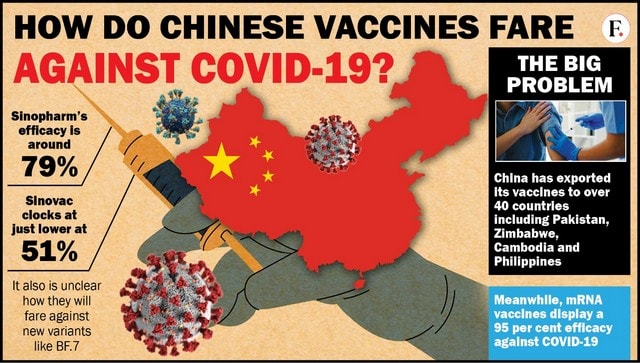 Graphic: Pranay Bhardwaj[/caption]China Daily quoted its officials as saying that Beijing has thus far sent its vaccines to more than 40 countries including Pakistan, Zimbabwe, Cambodia and Philippines.‘China must important mRNA vaccines’Experts, politicos and industrialists are calling on China to import mRNA vaccines.Ali Mokdad, a professor at the University of Washington’s Institute for Health Metrics and Evaluation, told SCMP he thinks China could witness half a million deaths by April in the absence of mRNA vaccines and mitigation measures.Speaking to the newspaper, Dr Jennifer Huang Bouey, an epidemiologist and specialist in China policy at the RAND Corporation, said mRNA vaccines are a critical piece in China solving its COVID-19 problem.Mahindra Group chairman Anand Mahindra, taking to Twitter, said it was clear that China’s vaccines clearly did not provide the immunity necessary.Bloomberg quoted US secretary of state Antony Blinken as saying that Washington is prepared to assist Beijing with vaccines."We want to see China get this outbreak under control. The US is worried about the rise of new coronavirus variants and China’s outbreak has clear implications for the global economy because of China being shut down on multiple levels," Blinken said.But Chinese embassy spokesperson Liu Pengyu on Wednesday said its vaccine stock “can generally meet demand" and that boosters were being rolled out.But some disagree.“These are not bad vaccines. They’re just vaccines that haven’t been optimised yet,” Gagandeep Kang, a virologist at the Christian Medical College in Vellore, India, was quoted as saying by the journal Nature.Will China see the light on mRNA vaccines?Maybe.The Global Times in April that Chinese company Fosun Pharma is working with authorities as it awaits clearance to distribute manufacture the mRNA vaccines made by Pfizer and BioNTech.There is also hope for a Chinese-made mRNA vaccine by Abogen Biosciences, a start-up founded in 2019 by Bo Ying, an American-trained scientist who once worked for Moderna.[caption id="attachment_11373171" align="alignnone" width="640"]
 Experts are saying China should import the mRNA vaccines. News18[/caption]The company has partnered with more established companies in the country such as Walvax, a private company founded in 2001, and the Academy of Military Medical Sciences, the military's medical research facility. Abogen has raised more than $1.7 billion since 2020.The company's vaccine candidate succeeded in eliciting an immune response in a small, preliminary test in humans designed to evaluate safety, according to a study published in the journal Lancet Microbe.The results were "promising," said Dr Vineeta Bal, who studies immune systems at the Indian Institute of Science Education and Research in Pune.But she also said that a direct comparison of the immune response triggered by the test shot with the response triggered by the Pfizer and Moderna vaccines would have helped scientists better evaluate its performance.But large studies that are needed to show whether the shot works to prevent infections or symptoms have not been completed. Abogen did not respond to requests for an interview.Even if the studies can be completed and the vaccine proves effective, manufacturing the millions of doses required will be a challenge, experts say. Abogen built a manufacturing facility in December 2020 with a projected capacity of up to 120 million doses a year.Manufacturing that vaccine and ensuring quality at scale will be a difficult hurdle to clear because mRNA is still a new technology, said Scott Wheelwright, chief operating officer at BioInno Bioscience, a Chinese biopharmaceutical contract manufacturer, who has held conversations with Abogen.In the meantime, Chen, the Yale health policy expert, said the Chinese government should better protect its elderly population by approving the Pfizer vaccine and encouraging booster shots.With inputs from agenciesRead all the Latest News, Trending News, Cricket News, Bollywood News, India News and Entertainment News here. Follow us on Facebook, Twitter and Instagram.
First Published:Dec 23, 2022, 16:17:41 IST
Advertisement
Advertisement

Military drones & police check-ups: How Sri Lanka is fighting against worst dengue outbreak in a decade
Sri Lanka is fighting its most severe dengue outbreak in nearly a decade, with infections rising sharply across the nation. Military drones have been deployed to tackle the outbreak, which has claimed 56 lives. Health officials said the outbreak is being driven primarily by the DENV-2 variant of the virus
3 min read
How Facebook job ad lured 2 Karnataka men into Myanmar cyber scam camp
The Karnataka Cyber Command has rescued two youths from a scam compound in Myanmar operated by Chinese fraudsters. The duo from Karnataka were lured on the pretext of data-entry jobs. They were asked to work for 16 hours a day and were expected to sleep for six hours daily
4 min read
Why is India seeing 95% cloud cover despite a Super El Niño?
India is witnessing nearly 95 per cent cloud cover despite a Super El Niño, a climate event usually linked to weaker monsoons. Regional weather systems, cyclonic circulations, the monsoon trough and moisture from two seas are temporarily overpowering one of the world's strongest climate phenomena
5 min read
What is CJP’s fourth demand to the government as protests in Delhi intensify?
The protest by the Cockroach Janta Party at Delhi’s Jantar Mantar refuses to die down. The group have made a fourth demand to the Centre, asking that no FIRs are filed against the agitators and that no legal action be taken. The government has expressed willingness to speak to the protesters, but refused to accede on the resignation of Education Minister Dharmandra Pradhan
5 min read
The new geography of war: Why the Houthis can no longer be ignored
The rise of the Houthis marks the emergence of a new geography of war — one in which influence flows not only from capitals and conventional armies, but also from rugged mountains overlooking vital sea lanes
6 min read
Advertisement
Advertisement