
Advertisement


Sections
Egypt is selling citizenship: How economic turmoil has left the Arab nation desperate
To address its foreign currency shortages, Egypt is offering citizenship to foreign investors on certain conditions. The Arab country has been reeling from an economic crisis that pushed its annual inflation to 26.5 per cent in January. It is expected to rise further

Reeling from economic turmoil, Egypt has decided to grant citizenship to foreign investors who will spend at least $2,50,000 in the Arab country.Citing state newspaper Al-Ahram, news agency AFP reported that the regulations outlined in the official gazette say that Prime Minister Mostafa Madbouli will offer “Egyptian nationality" to applicants if they meet any of the four criteria.Foreigners can get citizenship if they either purchase real estate not less than $3,00,000 in Egypt or deposit $5,00,000 in cash in an Egyptian bank account.The other two conditions include investing at least $3,50,000 in a project or making a “non-refundable $2,50,000 deposit in direct revenues in foreign currency into the state's public treasury", reported AFP.This is the latest measure undertaken by cash-strapped Egypt to increase its foreign exchange.Let’s take a look at Egypt’s financial woes and the factors that fuelled the crisis.Egypt’s struggling economyEgypt's economy has been struggling for the past years due to a number of internal and external factors.Annual inflation in the country touched 26.5 per cent this January, the highest in five years, reported Associated Press (AP).Reuters has predicted this can rise to 26.7 per cent in February.![egypt economic crisis]() The food prices in urban areas of Egypt surged to 48 per cent in January. AP File Photo[/caption]"Instead of buying 3 kilograms of rice when we go shopping, we just buy a kilo or a half kilo," 40-year-old Ahmed Hassan, an accountant and father of three from the Shoubra neighborhood in Cairo, was quoted as saying by Deutsche Welle (DW) in January."We're trying to reduce our expenditures. Unfortunately, we can't limit everything because our children need certain things," he added.As per Al Jazeera, Shaimaa al-Abed, who came from a low-income neighbourhood of central Cairo, asked holding back tears: “Even the cheapest food has doubled and tripled. What are we supposed to eat?”Egypt’s currency has also taken a series of tumblings against the US dollar.As per Reuters, the Egyptian pound weakened by nearly 24 per cent against the dollar in January, a plunge of about 50 per cent since March of last year.By February end, Egypt’s foreign reserves stood at $34.35 billion, down from $41 billion in February 2022.Moreover, the Arab country's foreign debt has more than tripled in the last decade to $157 billion.Amid these economic struggles, the European Bank for Reconstruction and Development in February forecasted Egypt’s economic growth to be at 4.3 per cent this year.Internal issuesAccording to DW, a number of internal factors, such as corruption, “government mismanagement” and political unrest, have contributed to Egypt's economic worries.President Abdel-Fattah el-Sissi's government has been promoting national "mega-projects" since 2014, which include the expansion of the Suez Canal and building a whole new city – the $50 billion New Administrative Capital – near Cairo.Many of these projects spearheaded by the military have been questioned by critics as they come at a time when the country is grappling to contain its debt burden and provide public services to its expanding population.Notably, about 60 per cent of Egypt's 104 million population is expected to be below, or close to the poverty line, as per The Arab Weekly.DW noted that the overbearing state and military-owned enterprises in Egypt have deterred foreign investments, “depressed the private sector” and made the most populous Arab nation heavily dependent on foreign credit.However, last December, the country adopted a privatisation initiative with an aim to enhance the private sector’s contribution to the economy to 65 per cent by 2025, as per AP.Furthermore, besides external factors, Sisi has blamed the 2011 Arab Spring popular uprising that overthrew former President Hosni Mubarak for destabilising Egypt and hindering its economic development, reported Reuters.External factorsRussia’s war in Ukraine, the COVID-19 pandemic and the threat of a global recession also worsened the economic situation in Egypt.Egypt, the world’s biggest importer of wheat, was hit hard after Russia invaded Ukraine last February, which ramped up food and energy prices globally.
The food prices in urban areas of Egypt surged to 48 per cent in January. AP File Photo[/caption]"Instead of buying 3 kilograms of rice when we go shopping, we just buy a kilo or a half kilo," 40-year-old Ahmed Hassan, an accountant and father of three from the Shoubra neighborhood in Cairo, was quoted as saying by Deutsche Welle (DW) in January."We're trying to reduce our expenditures. Unfortunately, we can't limit everything because our children need certain things," he added.As per Al Jazeera, Shaimaa al-Abed, who came from a low-income neighbourhood of central Cairo, asked holding back tears: “Even the cheapest food has doubled and tripled. What are we supposed to eat?”Egypt’s currency has also taken a series of tumblings against the US dollar.As per Reuters, the Egyptian pound weakened by nearly 24 per cent against the dollar in January, a plunge of about 50 per cent since March of last year.By February end, Egypt’s foreign reserves stood at $34.35 billion, down from $41 billion in February 2022.Moreover, the Arab country's foreign debt has more than tripled in the last decade to $157 billion.Amid these economic struggles, the European Bank for Reconstruction and Development in February forecasted Egypt’s economic growth to be at 4.3 per cent this year.Internal issuesAccording to DW, a number of internal factors, such as corruption, “government mismanagement” and political unrest, have contributed to Egypt's economic worries.President Abdel-Fattah el-Sissi's government has been promoting national "mega-projects" since 2014, which include the expansion of the Suez Canal and building a whole new city – the $50 billion New Administrative Capital – near Cairo.Many of these projects spearheaded by the military have been questioned by critics as they come at a time when the country is grappling to contain its debt burden and provide public services to its expanding population.Notably, about 60 per cent of Egypt's 104 million population is expected to be below, or close to the poverty line, as per The Arab Weekly.DW noted that the overbearing state and military-owned enterprises in Egypt have deterred foreign investments, “depressed the private sector” and made the most populous Arab nation heavily dependent on foreign credit.However, last December, the country adopted a privatisation initiative with an aim to enhance the private sector’s contribution to the economy to 65 per cent by 2025, as per AP.Furthermore, besides external factors, Sisi has blamed the 2011 Arab Spring popular uprising that overthrew former President Hosni Mubarak for destabilising Egypt and hindering its economic development, reported Reuters.External factorsRussia’s war in Ukraine, the COVID-19 pandemic and the threat of a global recession also worsened the economic situation in Egypt.Egypt, the world’s biggest importer of wheat, was hit hard after Russia invaded Ukraine last February, which ramped up food and energy prices globally.![egypt economic crisis]() Egypt, the world’s biggest importer of wheat, was hit hard after Russia invaded Ukraine last February. AP File Photo[/caption]"The reason why the pandemic and the Ukraine war have had such a big impact is because of the investment strategy led by Sissi for nine years: Massive spending on huge projects, some of which were totally unnecessary or poorly conceived," Yezid Sayigh, a senior fellow at the Carnegie Middle East Center in Beirut, told DW. "This made Egyptian finances very vulnerable, without providing the economy with real gains."Sayigh also said that foreign governments, including Germany and the United States, are “partially to blame” for the current situation."He [el-Sissi] couldn't have increased Egypt's debt by 400 per cent without their direct involvement."All these factors combined together have brought Egypt "on the brink of a financial and economic abyss," Rabah Arezki, a former chief economist at the World Bank's Middle East and North Africa Region, wrote in an article in January.Last December, Egypt secured a $3 billion bailout loan from the International Monetary Fund (IMF), the fourth in six years, subject to certain conditions.It is expected that the loan will help in raising another $14 billion from the country’s international and regional partners, including wealthy Gulf nations, as per AP.Meanwhile, some have compared Egypt’s woes to the Middle Eastern country of Lebanon, which is burdened by its own economic crisis since 2019.Timothy Kaldas, an expert on Egypt's political economy and a policy fellow at the Tahrir Institute for Middle East Policy has rejected the comparison between the economic crises of the two countries, saying Egypt is not “on the verge of total collapse in the way that Lebanon was”, reported DW.With inputs from agenciesRead all the Latest News, Trending News, Cricket News, Bollywood News,India News and Entertainment News here. Follow us on Facebook, Twitter and Instagram.
Egypt, the world’s biggest importer of wheat, was hit hard after Russia invaded Ukraine last February. AP File Photo[/caption]"The reason why the pandemic and the Ukraine war have had such a big impact is because of the investment strategy led by Sissi for nine years: Massive spending on huge projects, some of which were totally unnecessary or poorly conceived," Yezid Sayigh, a senior fellow at the Carnegie Middle East Center in Beirut, told DW. "This made Egyptian finances very vulnerable, without providing the economy with real gains."Sayigh also said that foreign governments, including Germany and the United States, are “partially to blame” for the current situation."He [el-Sissi] couldn't have increased Egypt's debt by 400 per cent without their direct involvement."All these factors combined together have brought Egypt "on the brink of a financial and economic abyss," Rabah Arezki, a former chief economist at the World Bank's Middle East and North Africa Region, wrote in an article in January.Last December, Egypt secured a $3 billion bailout loan from the International Monetary Fund (IMF), the fourth in six years, subject to certain conditions.It is expected that the loan will help in raising another $14 billion from the country’s international and regional partners, including wealthy Gulf nations, as per AP.Meanwhile, some have compared Egypt’s woes to the Middle Eastern country of Lebanon, which is burdened by its own economic crisis since 2019.Timothy Kaldas, an expert on Egypt's political economy and a policy fellow at the Tahrir Institute for Middle East Policy has rejected the comparison between the economic crises of the two countries, saying Egypt is not “on the verge of total collapse in the way that Lebanon was”, reported DW.With inputs from agenciesRead all the Latest News, Trending News, Cricket News, Bollywood News,India News and Entertainment News here. Follow us on Facebook, Twitter and Instagram.
The prices of food and fuels have soared, burning a hole in the pocket of Egyptians.Last Thursday (3 March), the government increased the rates of some types of gasoline, which is expected to further drive up the prices of other goods and services across the country.However, the price of diesel – the most used fuel for transporting people and goods in Egypt – remains untouched, reported AP.The food prices in urban areas of the country surged to 48 per cent in January, an all-time high.The cost of basic food items such as rice, cooking oil, bread and eggs, have doubled in Cairo’s supermarkets, as per AP.These eye-watering rates have led to many people cutting back on costs and even compromising on even essential food items.[caption id="attachment_12265642" align="alignnone" width="640"]
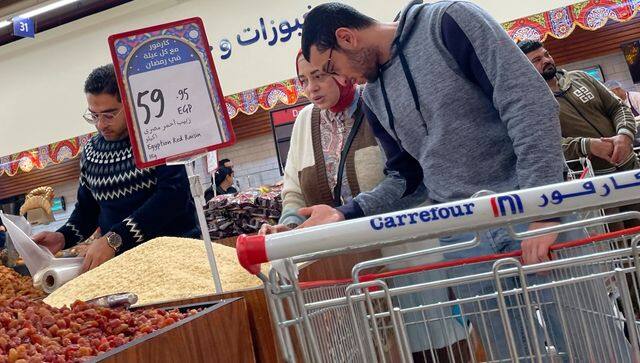 The food prices in urban areas of Egypt surged to 48 per cent in January. AP File Photo[/caption]"Instead of buying 3 kilograms of rice when we go shopping, we just buy a kilo or a half kilo," 40-year-old Ahmed Hassan, an accountant and father of three from the Shoubra neighborhood in Cairo, was quoted as saying by Deutsche Welle (DW) in January."We're trying to reduce our expenditures. Unfortunately, we can't limit everything because our children need certain things," he added.As per Al Jazeera, Shaimaa al-Abed, who came from a low-income neighbourhood of central Cairo, asked holding back tears: “Even the cheapest food has doubled and tripled. What are we supposed to eat?”Egypt’s currency has also taken a series of tumblings against the US dollar.As per Reuters, the Egyptian pound weakened by nearly 24 per cent against the dollar in January, a plunge of about 50 per cent since March of last year.By February end, Egypt’s foreign reserves stood at $34.35 billion, down from $41 billion in February 2022.Moreover, the Arab country's foreign debt has more than tripled in the last decade to $157 billion.Amid these economic struggles, the European Bank for Reconstruction and Development in February forecasted Egypt’s economic growth to be at 4.3 per cent this year.Internal issuesAccording to DW, a number of internal factors, such as corruption, “government mismanagement” and political unrest, have contributed to Egypt's economic worries.President Abdel-Fattah el-Sissi's government has been promoting national "mega-projects" since 2014, which include the expansion of the Suez Canal and building a whole new city – the $50 billion New Administrative Capital – near Cairo.Many of these projects spearheaded by the military have been questioned by critics as they come at a time when the country is grappling to contain its debt burden and provide public services to its expanding population.Notably, about 60 per cent of Egypt's 104 million population is expected to be below, or close to the poverty line, as per The Arab Weekly.DW noted that the overbearing state and military-owned enterprises in Egypt have deterred foreign investments, “depressed the private sector” and made the most populous Arab nation heavily dependent on foreign credit.However, last December, the country adopted a privatisation initiative with an aim to enhance the private sector’s contribution to the economy to 65 per cent by 2025, as per AP.Furthermore, besides external factors, Sisi has blamed the 2011 Arab Spring popular uprising that overthrew former President Hosni Mubarak for destabilising Egypt and hindering its economic development, reported Reuters.External factorsRussia’s war in Ukraine, the COVID-19 pandemic and the threat of a global recession also worsened the economic situation in Egypt.Egypt, the world’s biggest importer of wheat, was hit hard after Russia invaded Ukraine last February, which ramped up food and energy prices globally.
The Arab nation buys 65 per cent of its food from other countries to feed its population.Callee Davis, an economist at Oxford Economics Africa, told AP that the country’s import bill first skyrocketed because of “higher global prices for commodities like fuel and wheat that are purchased in dollars, and this led to foreign currency shortages”.This propelled the Central Bank of Egypt to resort to policies to save the country’s foreign reserves, such as limiting imports, which further fuelled inflation, Davis added.[caption id="attachment_12265672" align="alignnone" width="640"]
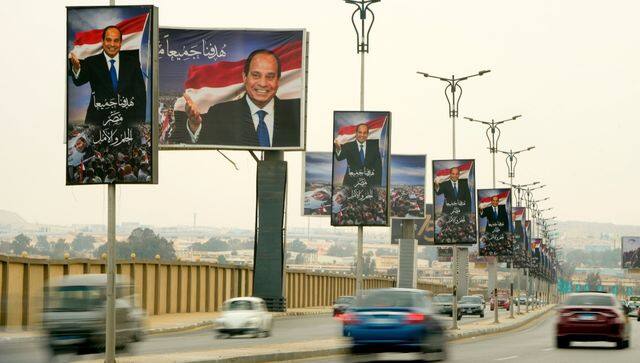 Egypt, the world’s biggest importer of wheat, was hit hard after Russia invaded Ukraine last February. AP File Photo[/caption]"The reason why the pandemic and the Ukraine war have had such a big impact is because of the investment strategy led by Sissi for nine years: Massive spending on huge projects, some of which were totally unnecessary or poorly conceived," Yezid Sayigh, a senior fellow at the Carnegie Middle East Center in Beirut, told DW. "This made Egyptian finances very vulnerable, without providing the economy with real gains."Sayigh also said that foreign governments, including Germany and the United States, are “partially to blame” for the current situation."He [el-Sissi] couldn't have increased Egypt's debt by 400 per cent without their direct involvement."All these factors combined together have brought Egypt "on the brink of a financial and economic abyss," Rabah Arezki, a former chief economist at the World Bank's Middle East and North Africa Region, wrote in an article in January.Last December, Egypt secured a $3 billion bailout loan from the International Monetary Fund (IMF), the fourth in six years, subject to certain conditions.It is expected that the loan will help in raising another $14 billion from the country’s international and regional partners, including wealthy Gulf nations, as per AP.Meanwhile, some have compared Egypt’s woes to the Middle Eastern country of Lebanon, which is burdened by its own economic crisis since 2019.Timothy Kaldas, an expert on Egypt's political economy and a policy fellow at the Tahrir Institute for Middle East Policy has rejected the comparison between the economic crises of the two countries, saying Egypt is not “on the verge of total collapse in the way that Lebanon was”, reported DW.With inputs from agenciesRead all the Latest News, Trending News, Cricket News, Bollywood News,India News and Entertainment News here. Follow us on Facebook, Twitter and Instagram.
Sub-Editor at Firstpost. Writing Explainers on everything from politics to space.
First Published:Mar 09, 2023, 17:49:20 IST
Advertisement
Advertisement

Military drones & police check-ups: How Sri Lanka is fighting against worst dengue outbreak in a decade
Sri Lanka is fighting its most severe dengue outbreak in nearly a decade, with infections rising sharply across the nation. Military drones have been deployed to tackle the outbreak, which has claimed 56 lives. Health officials said the outbreak is being driven primarily by the DENV-2 variant of the virus
3 min read
How Facebook job ad lured 2 Karnataka men into Myanmar cyber scam camp
The Karnataka Cyber Command has rescued two youths from a scam compound in Myanmar operated by Chinese fraudsters. The duo from Karnataka were lured on the pretext of data-entry jobs. They were asked to work for 16 hours a day and were expected to sleep for six hours daily
4 min read
Why is India seeing 95% cloud cover despite a Super El Niño?
India is witnessing nearly 95 per cent cloud cover despite a Super El Niño, a climate event usually linked to weaker monsoons. Regional weather systems, cyclonic circulations, the monsoon trough and moisture from two seas are temporarily overpowering one of the world's strongest climate phenomena
5 min read
What is CJP’s fourth demand to the government as protests in Delhi intensify?
The protest by the Cockroach Janta Party at Delhi’s Jantar Mantar refuses to die down. The group have made a fourth demand to the Centre, asking that no FIRs are filed against the agitators and that no legal action be taken. The government has expressed willingness to speak to the protesters, but refused to accede on the resignation of Education Minister Dharmandra Pradhan
5 min read
The new geography of war: Why the Houthis can no longer be ignored
The rise of the Houthis marks the emergence of a new geography of war — one in which influence flows not only from capitals and conventional armies, but also from rugged mountains overlooking vital sea lanes
6 min read
Advertisement
Advertisement