
Advertisement


Sections
Credit Suisse Troubles: What's happening at the Swiss bank and how has it renewed banking crisis fears?
Credit Suisse shares plunged to record lows of 30 per cent, prompting it to borrow $54 billion from the Swiss central bank. This plummet comes just days after the collapse of Silicon Valley Bank and Signature Bank in the US, sparking concerns about the health of the global financial system

It’s not a good week for global banking stocks. After being hit by the collapse of the United States’ Silicon Valley Bank last weekend, fresh panic was triggered on Wednesday over the stability of major European bank Credit Suisse.While everyone buzzes about on the matter, we try to simplify it all for you. Here’s what happened on Wednesday and its cascading effects the world over.What happened at Credit Suisse?On Wednesday, Credit Suisse shares nosedived to historic lows, plunging more than 30 per cent to a record low of 1.55 Swiss francs (Rs 137.7). The bank regained some ground by the close, ending the day’s trading 24.24 per cent down at 1.697 Swiss francs (Rs 150).The drop in value came after its main shareholder — Saudi National Bank (SNB) — said it would not invest any more money in the Swiss bank. Saudi National Bank became Credit Suisse’s largest shareholder, owning a 9.8 per cent stake, in November after the bank launched a capital raise to finance a major restructuring of the Zurich-based lender.SNB chairman Ammar Al Khudairy speaking to Bloomberg on the sidelines of a conference in Saudi Arabia said: “The answer is absolutely not, for many reasons,” when asked if the bank would increase its stake in Credit Suisse. “I’ll cite the simplest reason, which is regulatory and statutory. We now own 9.8 per cent of the bank — if we go above 10 per cent all kinds of new rules kick in, whether be it by our regulator or the European regulator or the Swiss regulator,” he said. “We’re not inclined to get into a new regulatory regime.”His funding cap comments spooked investors, who feared it could limit emergency cash from investors in the Middle East.Moreover, Switzerland’s second-biggest bank, founded in 1869 and considered as one of the biggest financial institutions in the world and categorised as a “global systemically important bank,” has been facing a credibility issue in the past two years.In February 2021, Credit Suisse shares were worth 12.78 Swiss francs (Rs 1,136), but since then the bank has been hit by a series of missteps and compliance failures, damaging its reputation, and even cost their top executives their job.Earlier this month, Swiss regulators had rebuked Credit Suisse for “seriously breaching its supervisory obligations” in the context of its business relationship with financier Lex Greensill and his companies.On Wednesday when shares plummeted, banks that trade with Credit Suisse snapped up contracts. According to reports, BNP Paribas SA went a step further and informed clients it will no longer accept requests to take over their derivatives contracts when Credit Suisse is the counterparty.What were the aftereffects?The trouble at Credit Suisse sent shares of other European banks tumbling, some by double digits. That fanned new fears about the health of financial institutions following the recent collapse of Silicon Valley Bank and Signature Bank in the US.Barclays’ shares dropped by more than eight per cent, and European banks including Societe Generale and BNP Paribas showing losses of around 10 per cent. Spanish bank Banco de Sabadell dropped nine per cent and Germany’s Commerzbank fell nearly 10 per cent while Deutsche Bank shares were down 8.4 per cent. Natwest was down by nearly five per cent and HSBC slipped by around four per cent. Trading in the two French banks was briefly suspended.[caption id="attachment_12300922" align="alignnone" width="640"]![]() A display shows most indicators down on the floor at the New York Stock Exchange in New York on Wednesday. Stocks are falling on Wall Street as worries worsen about the strength of banks on both sides of the Atlantic. AP[/caption]Andrew Kenningham of Capital Economics, as per a BBC report, said, “The problems in Credit Suisse once more raise the question whether this is the beginning of a global crisis or just another ‘idiosyncratic’ case.”He further was quoted as saying, “(Credit Suisse) is much more globally interconnected, with multiple subsidiaries outside Switzerland including in the US. Credit Suisse is not just a Swiss problem but a global one.How worried should we be?The Bank of England in a statement said that the UK banking system is not at risk and “remains safe, sound, and well-capitalised”.Karen Petrou at Federal Financial Analytics said that Credit Suisse doesn’t pose a systemic risk to the US financial system the way Silicon Valley Bank did. However, she noted that as Credit Suisse is a systemic-level global player, the financial system as a whole is facing yet another point of significant fragility.When asked if it could cause a global contagion, she said, “I hate to say it. I think the answer is yes.”Robert Halver, head of capital markets at Germany’s Baader Bank told the BBC, “This banking crisis came from America. And now people are watching how the whole thing could also cause problems in Europe.”Also read: Will Silicon Valley Bank collapse impact India?In India, the Credit Suisse issue affected the share market on Thursday. Trading in the morning was muted, with eight of the 13 major sectoral indexes logging losses.What next?In a bid to calm investors, the Swiss central bank on Thursday said that it would provide Credit Suisse up to $54 billion (Rs 4.4 lakh crore) as a lifeline. The bank called the loan a “decisive action to pre-emptively strengthen its liquidity.”[caption id="attachment_12300942" align="alignnone" width="640"]
A display shows most indicators down on the floor at the New York Stock Exchange in New York on Wednesday. Stocks are falling on Wall Street as worries worsen about the strength of banks on both sides of the Atlantic. AP[/caption]Andrew Kenningham of Capital Economics, as per a BBC report, said, “The problems in Credit Suisse once more raise the question whether this is the beginning of a global crisis or just another ‘idiosyncratic’ case.”He further was quoted as saying, “(Credit Suisse) is much more globally interconnected, with multiple subsidiaries outside Switzerland including in the US. Credit Suisse is not just a Swiss problem but a global one.How worried should we be?The Bank of England in a statement said that the UK banking system is not at risk and “remains safe, sound, and well-capitalised”.Karen Petrou at Federal Financial Analytics said that Credit Suisse doesn’t pose a systemic risk to the US financial system the way Silicon Valley Bank did. However, she noted that as Credit Suisse is a systemic-level global player, the financial system as a whole is facing yet another point of significant fragility.When asked if it could cause a global contagion, she said, “I hate to say it. I think the answer is yes.”Robert Halver, head of capital markets at Germany’s Baader Bank told the BBC, “This banking crisis came from America. And now people are watching how the whole thing could also cause problems in Europe.”Also read: Will Silicon Valley Bank collapse impact India?In India, the Credit Suisse issue affected the share market on Thursday. Trading in the morning was muted, with eight of the 13 major sectoral indexes logging losses.What next?In a bid to calm investors, the Swiss central bank on Thursday said that it would provide Credit Suisse up to $54 billion (Rs 4.4 lakh crore) as a lifeline. The bank called the loan a “decisive action to pre-emptively strengthen its liquidity.”[caption id="attachment_12300942" align="alignnone" width="640"]![]() Switzerland's national flag flies above a logo of Swiss bank Credit Suisse. Credit Suisse is the first major global bank to be given an emergency lifeline since the 2008 financial crisis. File image/Reuters[/caption]“This additional liquidity would support Credit Suisse’s core businesses and clients as Credit Suisse takes the necessary steps to create a simpler and more focused bank built around client needs,” the bank said in a statement.In addition to the loan from the central bank, Credit Suisse also said it repurchased billions of dollars of its own debt to manage its liabilities and interest payment expenses. The offer covers $2.5 billion of US dollar bonds and €500 million ($529 million) of euro bonds.Credit Suisse is the first major global bank to be given an emergency lifeline since the 2008 financial crisis, reported Reuters.While the future seems uncertain, it appears that Wall Street expert Robert Kiyosaki’s prediction is closer to reality than we hoped.With inputs from agenciesRead all the Latest News, Trending News, Cricket News, Bollywood News,India News and Entertainment News here. Follow us on Facebook, Twitter and Instagram.
Switzerland's national flag flies above a logo of Swiss bank Credit Suisse. Credit Suisse is the first major global bank to be given an emergency lifeline since the 2008 financial crisis. File image/Reuters[/caption]“This additional liquidity would support Credit Suisse’s core businesses and clients as Credit Suisse takes the necessary steps to create a simpler and more focused bank built around client needs,” the bank said in a statement.In addition to the loan from the central bank, Credit Suisse also said it repurchased billions of dollars of its own debt to manage its liabilities and interest payment expenses. The offer covers $2.5 billion of US dollar bonds and €500 million ($529 million) of euro bonds.Credit Suisse is the first major global bank to be given an emergency lifeline since the 2008 financial crisis, reported Reuters.While the future seems uncertain, it appears that Wall Street expert Robert Kiyosaki’s prediction is closer to reality than we hoped.With inputs from agenciesRead all the Latest News, Trending News, Cricket News, Bollywood News,India News and Entertainment News here. Follow us on Facebook, Twitter and Instagram.
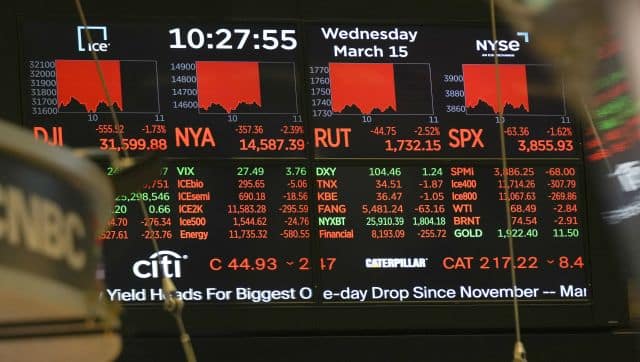 A display shows most indicators down on the floor at the New York Stock Exchange in New York on Wednesday. Stocks are falling on Wall Street as worries worsen about the strength of banks on both sides of the Atlantic. AP[/caption]Andrew Kenningham of Capital Economics, as per a BBC report, said, “The problems in Credit Suisse once more raise the question whether this is the beginning of a global crisis or just another ‘idiosyncratic’ case.”He further was quoted as saying, “(Credit Suisse) is much more globally interconnected, with multiple subsidiaries outside Switzerland including in the US. Credit Suisse is not just a Swiss problem but a global one.How worried should we be?The Bank of England in a statement said that the UK banking system is not at risk and “remains safe, sound, and well-capitalised”.Karen Petrou at Federal Financial Analytics said that Credit Suisse doesn’t pose a systemic risk to the US financial system the way Silicon Valley Bank did. However, she noted that as Credit Suisse is a systemic-level global player, the financial system as a whole is facing yet another point of significant fragility.When asked if it could cause a global contagion, she said, “I hate to say it. I think the answer is yes.”Robert Halver, head of capital markets at Germany’s Baader Bank told the BBC, “This banking crisis came from America. And now people are watching how the whole thing could also cause problems in Europe.”Also read: Will Silicon Valley Bank collapse impact India?In India, the Credit Suisse issue affected the share market on Thursday. Trading in the morning was muted, with eight of the 13 major sectoral indexes logging losses.What next?In a bid to calm investors, the Swiss central bank on Thursday said that it would provide Credit Suisse up to $54 billion (Rs 4.4 lakh crore) as a lifeline. The bank called the loan a “decisive action to pre-emptively strengthen its liquidity.”[caption id="attachment_12300942" align="alignnone" width="640"]
 Switzerland's national flag flies above a logo of Swiss bank Credit Suisse. Credit Suisse is the first major global bank to be given an emergency lifeline since the 2008 financial crisis. File image/Reuters[/caption]“This additional liquidity would support Credit Suisse’s core businesses and clients as Credit Suisse takes the necessary steps to create a simpler and more focused bank built around client needs,” the bank said in a statement.In addition to the loan from the central bank, Credit Suisse also said it repurchased billions of dollars of its own debt to manage its liabilities and interest payment expenses. The offer covers $2.5 billion of US dollar bonds and €500 million ($529 million) of euro bonds.Credit Suisse is the first major global bank to be given an emergency lifeline since the 2008 financial crisis, reported Reuters.While the future seems uncertain, it appears that Wall Street expert Robert Kiyosaki’s prediction is closer to reality than we hoped.With inputs from agenciesRead all the Latest News, Trending News, Cricket News, Bollywood News,India News and Entertainment News here. Follow us on Facebook, Twitter and Instagram.
First Published:Mar 16, 2023, 10:53:48 IST
Advertisement
Advertisement

Military drones & police check-ups: How Sri Lanka is fighting against worst dengue outbreak in a decade
Sri Lanka is fighting its most severe dengue outbreak in nearly a decade, with infections rising sharply across the nation. Military drones have been deployed to tackle the outbreak, which has claimed 56 lives. Health officials said the outbreak is being driven primarily by the DENV-2 variant of the virus
3 min read
How Facebook job ad lured 2 Karnataka men into Myanmar cyber scam camp
The Karnataka Cyber Command has rescued two youths from a scam compound in Myanmar operated by Chinese fraudsters. The duo from Karnataka were lured on the pretext of data-entry jobs. They were asked to work for 16 hours a day and were expected to sleep for six hours daily
4 min read
Why is India seeing 95% cloud cover despite a Super El Niño?
India is witnessing nearly 95 per cent cloud cover despite a Super El Niño, a climate event usually linked to weaker monsoons. Regional weather systems, cyclonic circulations, the monsoon trough and moisture from two seas are temporarily overpowering one of the world's strongest climate phenomena
5 min read
What is CJP’s fourth demand to the government as protests in Delhi intensify?
The protest by the Cockroach Janta Party at Delhi’s Jantar Mantar refuses to die down. The group have made a fourth demand to the Centre, asking that no FIRs are filed against the agitators and that no legal action be taken. The government has expressed willingness to speak to the protesters, but refused to accede on the resignation of Education Minister Dharmandra Pradhan
5 min read
The new geography of war: Why the Houthis can no longer be ignored
The rise of the Houthis marks the emergence of a new geography of war — one in which influence flows not only from capitals and conventional armies, but also from rugged mountains overlooking vital sea lanes
6 min read
Advertisement
Advertisement