


COP27 to deal with loss and damage: What does this mean for poor nations? What does compensation look like?
Developing nations have been demanding that the developed world compensate for losses suffered due to climate change. Now, all eyes are on COP27, being held in Egypt, to see how world leaders respond

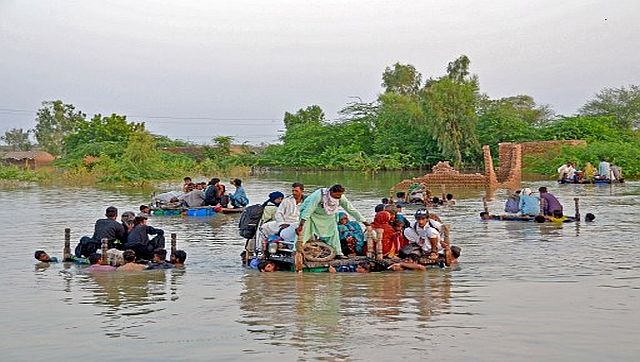
A warming climate intensifies rainfall, and studies suggest climate change may have increased Pakistan’s rainfall intensity by as much as 50 per cent. AFP[/caption]Pakistan contributes only about one per cent of the global greenhouse gas emissions driving climate change. But greenhouse gases don’t stay within national borders — emissions anywhere affect the global climate.A warming climate intensifies rainfall, and studies suggest climate change may have increased Pakistan’s rainfall intensity by as much as 50 per cent.The question of payments for loss and damage has been a long-standing point of negotiation at United Nations climate conferences, held nearly every year since 1995, but there has been little progress toward including a financial mechanism for these payments in international climate agreements.Many developing countries are looking to this year’s conference, COP27, as a crucial moment for making progress on establishing that formal mechanism.Africa’s climate conferenceWith Egypt hosting this year’s UN climate conference, it’s not surprising that loss and damage will take centre stage.Countries in Africa have some of the lowest national greenhouse gas emissions, and yet the continent is home to many of the world’s most climate-vulnerable countries.To deal with climate change, these countries — many of them among the world’s poorest — will have to invest in adaptation measures, such as seawalls, climate-smart agriculture and infrastructure that’s more resilient to high heat and extreme storms.The UN Environment Program’s Adaptation Gap Report, released on 3 November, 2022, found that developing countries need five to 10 times more international adaptation finance than wealthier countries are providing.When climate disasters strike, countries also need more financial help to cover relief efforts, infrastructure repairs and recovery. This is loss and damage.Egypt is emphasising the need for wealthy countries to make more progress on providing financial support for both adaptation and loss and damage.Climate injustice and loss and damageThe conversation on loss and damage is inherently about equity. It evokes the question: Why should countries that have done little to cause global warming be responsible for the damage resulting from the emissions of wealthy countries?That also makes it contentious. Negotiators know that the idea of payments for loss and damage has the potential to lead to further discussions about financial compensation for historical injustices, such as slavery in the United States or colonial exploitation by European powers.At COP26, held in 2021 in Glasgow, Scotland, negotiators made progress on some key issues, such as stronger emissions targets and pledges to double adaptation finance for developing countries.But COP26 was seen as a disappointment by advocates trying to establish a financial mechanism for wealthier nations to provide finance for loss and damage in developing countries.What loss and damage payments might look likeThe lack of resolution at COP26, combined with Egypt’s commitment to focus on financing for adaptation and loss and damage, means the issue will be on the table this year.The nonprofit Center for Climate and Energy Solutions expects discussions to focus on institutional arrangements for the Santiago Network for Loss and Damage, which focuses on providing technical assistance to help developing countries minimise loss and damage; and on fine-tuning the Glasgow Dialogue, a formal process developed in 2021 to bring countries together to discuss funding for loss and damage.The V20 group of finance ministers, representing 58 countries highly vulnerable to climate change, and the G-7 group of wealthy nations also reached an agreement in October 2022 on a financial mechanism called the Global Shield Against Climate Risks.The Global Shield is focused on providing risk insurance and rapid financial assistance to countries after disasters, but it’s unclear how it will fit into the international discussions.Some groups have raised concerns that relying on insurance systems can overlook the poorest people and distract from the larger discussion of establishing a dedicated fund for loss and damage.Two elements of developed countries’ reluctance to formalise a loss and damage mechanism involve how to determine which countries or communities are eligible for compensation and what the limitations of such a mechanism would be.What would a threshold for loss and damage eligibility look like? Limiting countries or communities from receiving compensation for loss and damage based on their current emissions or gross domestic product could become a problematic and complicated process.Most experts recommend determining eligibility based on climate vulnerability, but this can also prove difficult.How will world leaders respond?Over a decade ago, developed countries committed to provide US$100 billion per year to fund adaptation and mitigation in developing countries. But they have been slow to meet that commitment, and it does not cover the damages from the climate impacts the world is already seeing today.Establishing a loss and damage mechanism is considered one avenue to provide recourse for global climate injustice. All eyes will be on Egypt 6-18 November, 2022, to see how world leaders respond.This article is republished from The Conversation under a Creative Commons license. Read the original article.Read all the Latest News, Trending News, Cricket News, Bollywood News,India News and Entertainment News here. Follow us on Facebook, Twitter and Instagram.

Who is Sandeep Lamba, the Delhi cop removed from protest site duty after slapping female protester?
Explorers discover wreckage of plane 72 years later. Will this help in finding MH370?
Cruise missiles, drones and more... The deadly arsenal of the Houthis
Why India may not witness a medal rush at 2026 Commonwealth Games
Delhi Police asks personnel to wear uniform: What the law says on cops in plainclothes during protests