


No Dissent: China unveils new electromagnetic weapon to quell protests
China has launched what it says is a ‘non-lethal’ electromagnetic gun to quell violent demonstrations without causing serious injuries. This comes after the country, which cracks down on any form of dissent, saw widespread protests last November against the now-scrapped stringent zero-COVID policy

It also has a double-chamber magazine for continuous firing and quick reloading.“The gun is designed like coil guns, which use electric power to accelerate the projectile. When the nine-level coil is electrified, corresponding magnetic fields are formed, which allow the bullet to be sucked out by a relay race method,” the gun’s designer, Lei Fengqiao, was quoted as saying by SCMP.“It is powered by a built-in lithium-ion battery that can continuously fire hundreds of rounds when fully charged. The charging time is also very short, with little influence from temperature.”The gun also offers a trajectory with superior control and “multiple point hits”, as per the SCMP report.The coin-shaped bullets are also advantageous as they are cheaper and easier to store and transport.The gun emits a low firing sound and does not have flash, smoke, or shells. With its small recoil, the weapon can be used in populated areas, where traditional firearms may trigger panic or more violence, the report added.ALSO READ: A Brush with Revolution: How ‘Teacher Li’ brought China’s COVID protests to the limelight‘Non-lethal’ weaponThe weapon has been called "non-lethal" as its round-shaped bullets reduce the risk of killing civilians during riots.The device is designed in a way to reduce the chances of seriously hurting people while dispersing crowds during violent demonstrations.These bullets do not penetrate the body, thus lessening the risk of injuries. During field tests, the coin projectiles penetrated double-layered 3mm-thick plywood and damaged cola and beer bottles, reported SCMP.As per Bloomberg, in electromagnetic weapons, users can select the intensity and frequency of the firing gun.However, the device can still be used to cause grave injury if the bullets are exchanged with pointed ammunition that can pierce the body.ALSO READ: Rise of the People: As COVID protests spread, a brief history of rare acts of dissent in ChinaProtests in ChinaWidespread protests are not common in China, where the government heavily cracks down on any form of dissent.So, last November’s large-scale demonstrations against nearly three years of snap lockdowns, with some raising slogans like “Xi Jinping, step down” and “Communist party, step down” were surprising.[caption id="attachment_12473092" align="alignnone" width="640"]
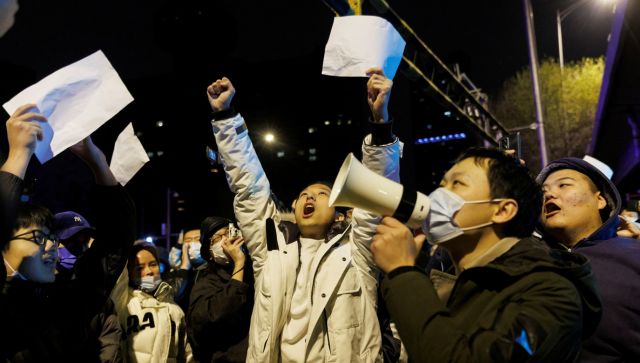
China saw largerly peaceful protests in November last year. Reuters File Photo[/caption]A blaze at an apartment block in Urumqi, the capital of the western Xinjiang region, was behind the unusual wave of protests which spread across Beijing, Shanghai and other regions.Many demonstrators held blank pieces of white paper – a symbol of defiance against the ruling party’s censorship – which led some to describing it as the “A4 Revolution.”The biggest protests in decades in the country, which saw urban Chinese, students, young people and workers hit the streets, were mostly peaceful. However, some incidents of violence where people clashed with the police were reported.The protests which eventually petered out had an impact as the government relaxed some lockdown protocols before abruptly scrapping the zero-COVID policy.As per Time magazine, the government did not resort to repressive measures to quell these protests but adopted other "nuisance measures" such as checking phones and identity papers to discourage people from joining the marches.The agitation showed that the “state has learned valuable lessons about how most effectively to deter or demobilise protesters without resort to costly (in terms of both resources and reputation) and dangerous repression”, William Hurst, the Chong Hua Professor of Chinese Development at the University of Cambridge, wrote for Time magazine in December 2022.Notably, NPR reported in January that the police were tacitly rounding up people they believed were behind the demonstrations.“They have also shown us that grievances have likely not been assuaged and, if anything, deeper issues have taken root in the hearts of many that could lead them to take bigger risks in challenging the CCP (Chinese Communist Party) in the future,” Hurst wrote for Time magazine.With inputs from agenciesRead all the Latest News, Trending News, Cricket News, Bollywood News,India News and Entertainment News here. Follow us on Facebook, Twitter and Instagram.

Who is Sandeep Lamba, the Delhi cop removed from protest site duty after slapping female protester?
Explorers discover wreckage of plane 72 years later. Will this help in finding MH370?
Cruise missiles, drones and more... The deadly arsenal of the Houthis
Why India may not witness a medal rush at 2026 Commonwealth Games
Delhi Police asks personnel to wear uniform: What the law says on cops in plainclothes during protests