


China has built the deepest laboratory on Earth. Here's what it's looking for
The Deep Underground and Ultra-low Radiation Background Facility for Frontier Physics Experiments (DURF) is the second phase of the China Jinping Underground Laboratory. Scientists said its location provides them with a ‘clean space’ to study dark matter – a mysterious, unseen force

China has built the deepest laboratory on Earth.
The Deep Underground and Ultra-low Radiation Background Facility for Frontier Physics Experiments (DURF) has been built nearly 2.5 kilometres below ground in southwest China.
But what do we know about the facility? Why has China built it?
Let’s take a closer look:
What do we know about it?
As per Xinhua News Agency, the facility has been constructed in Sichuan Province's Liangshan Yi Autonomous Prefecture.
The DURF is the second phase of the China Jinping Underground Laboratory.
As per Space Daily, the first phase of the lab was finished in 2010.
The lab has had ‘considerable success’ in dark matter experiments.
 More from Explainers
China News Service reported that a team from Sichuan Medical University’s West China Medical Centre learned that molecular targets adapted to extremely low background radiation. The discovery could potentially improve tumour treatment, the report stated.
It had a capacity of around 4,000 cubic metres, as per SCMP.
The lab is an underground research facility with the deepest rock overburden and the largest space by volume in the world, as per Global Times.
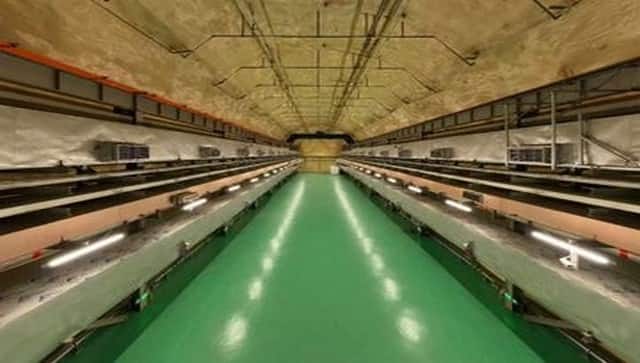
It is located in the Jinping tunnel.
The DURF has a total capacity of 330,000 cubic meters – or 120 Olympic-sized swimming pools.
Work on the laboratory, jointly constructed by Tsinghua University and Yalong River Hydropower Development Company, began in December 2020.
As per The Sun, the facility is nearly double the size of the previous largest underground lab – Italy’s Gran Sasso National Laboratory.
It can be accessed by vehicles.
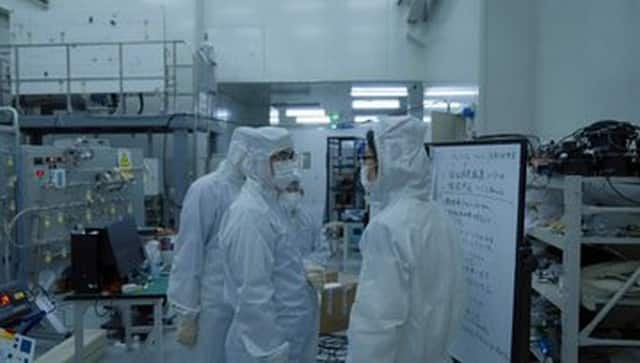
Ten teams of scientists from Tsinghua, Shanghai Jiao Tong and Beijing Normal University, the China Institute of Atomic Energy, and the Institute of Rock and Soil Mechanics of the Chinese Academy of Sciences area are already working at the facility, as per China Daily.
Why has China built it?
Scientists told Xinhua the laboratory is a “clean space” for them to investigate dark matter.
Dark matter and dark energy comprise 95 per cent of the universe.
They are arguably among the greatest mysteries yet to be solved by scientists.
As per European Organisation for Nuclear Research (CERN) dark matter is extremely difficult to detect as it does not absorb, reflect or emit light.
Scientist have only been able to deduce its presence via its gravitational effect on visible matter.
Dark matter seems to outweigh visible matter by around six to one – making it making around 27 per cent of the universe.
Dark energy, meanwhile, accounts for another 68 per cent of the universe.
It seems to be related with the vacuum in space.
Researchers said the laboratory being constructed far beneath the Earth leaves it shielded from cosmic rays that hinder experiments.
The CERN’s Large Hadron Collider by comparison is located just 100 metres underground near Geneva.
Yue Qian, a professor at Tsinghua University, was quoted as saying by Space Daily, “Thanks to its location, the DURF is exposed to a tiny flux of cosmic rays, which is only one hundred-millionth of that on the Earth's surface.”
Khmer Times quoted Yue as saying the lab also had other advantages including extremely low environmental radiation, extremely low radon concentration and an ultra-clean space.
Yue told Xinhua that the facility would “become a world-class interdisciplinary deep underground scientific research center integrating multiple disciplines including particle physics, nuclear astrophysics and life sciences, to facilitate the development of China's research in relevant frontier fields.”
With inputs from agencies

Military drones & police check-ups: How Sri Lanka is fighting against worst dengue outbreak in a decade
How Facebook job ad lured 2 Karnataka men into Myanmar cyber scam camp
Why is India seeing 95% cloud cover despite a Super El Niño?
What is CJP’s fourth demand to the government as protests in Delhi intensify?
The new geography of war: Why the Houthis can no longer be ignored