


Hot seat: What are Chandigarh chairs pulled out of Paris auction after Indian govt stepped in?
The auction of two Chandigarh chairs in Paris was halted at the last minute after the Indian government stepped in. These items of furniture were originally designed by Pierre Jeanneret, the cousin of Le Corbusier, in the 1950s. They are considered a part of the city’s heritage

On June 24, two chairs from India were among the many items listed at an auction in Paris. However, they were withdrawn from the auction at the last minute after India’s Ministry of External Affairs (MEA) intervened.
The two pieces of furniture, which were listed at estimated values of €5,000-€7,000 and €4,000-€5,000, respectively, were linked to Chandigarh’s institutions and were created by Pierre Jeanneret, who is the city’s first resident chief architect from 1951 to 1965.
So, why did the MEA intervene to get these two chairs off the auction by François Epin? What’s the history behind them?
Why were the Chandigarh chairs pulled out of auction in Paris?
Earlier this week, the MEA was informed that the chairs on auction were pulled out, with officials now undertaking all efforts to get them repatriated back to India. “Today, the MEA was informed that, following the intervention of the Embassy of India in France, the items concerned have been withdrawn from the auction,” the Chandigarh administration said in a statement on 24 June.
 More from Explainers
The MEA’s intervention came after the Chandigarh administration requested help. The administration had dashed off a letter to the foreign ministry on the same.
According to the administration, the two pieces had inventory markings that connect them to public institutions in Chandigarh. One Pierre Jeanneret teak-and-cane armchair carries the marking ‘PU Chem/55’, indicating its association with Panjab University’s Chemistry Department, while another armchair bears the marking ‘PGI/W/CH-0202’, linking it to PGIMER Chandigarh.
In the letter, the officials stated that the furniture is part of its heritage, created under the vision of Le Corbusier and Pierre Jeanneret. They further argued that as Chandigarh’s Capitol Complex enjoys Unesco World Heritage status, the furniture associated with the city was a matter of national significance.
Interestingly, Chandigarh-based advocate Ajay Jagga had also raised the matter of the chairs with the MEA, writing to External Affairs Minister S Jaishankar, Culture Minister Gajendra Singh Shekhawat, and the Indian Embassy in Paris.
He mentioned an order issued by the Ministry of Home Affairs dated February 22, 2011 for the MEA’s mediation. The order restricts the movement of Chandigarh heritage articles outside India and restricts their transfer even between government buildings without authorisation.
What’s the history behind these chairs?
The pieces of furniture scrapped from the auction are known as Chandigarh chairs and are part of the Union Territory’s history.
In 1951, Prime Minister Jawaharlal Nehru commissioned India’s first planned city, Chandigarh, as a statement of a newly independent nation moving forward. Nehru entrusted this job to Swiss-French architect Le Corbusier. He was joined by his cousin Pierre Jeanneret, who took over the responsibility of mass housing and civic projects, looking deep into furniture design for everyday living.
What followed was the Chandigarh chair — made of Burma teak to resist humidity and termites, and rattan cane, as it breathes in the heat. The chair was given V-shaped legs, so that local craftsmen could replicate them at scale without specialised tools.
They soon became a common sight across Chandigarh, with government offices, hospitals, educational institutions, and public buildings housing them. However, not all Chandigarh chairs were identical — the chairs at Panjab University had modified armrests that made note-taking easy, whereas the ones in Capitol Complex had bright yellow or red leather upholstery with padding and rounded armrests.
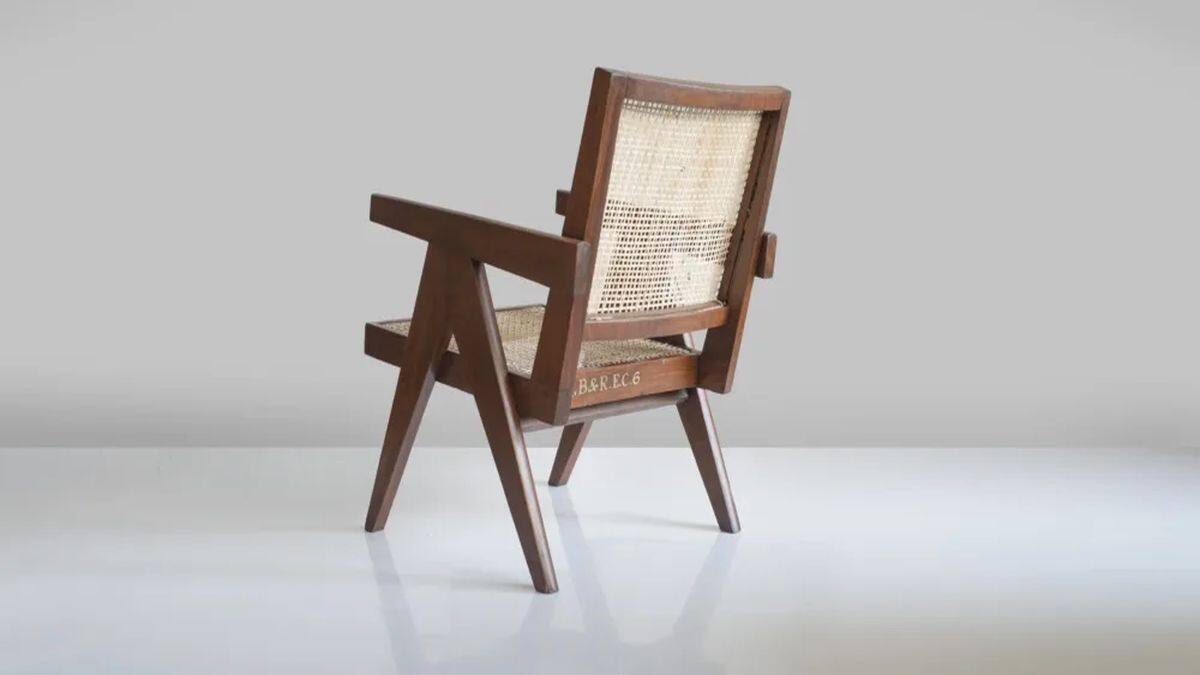
Architect Ashiesh Shah told CNN, “Corbusier and Jeanneret created a distinct, minimalist aesthetic that was so indigenous to our climate and materials, and also what we could afford. So this chair is a symbol of this rich design history.”
What has happened to the Chandigarh chairs since then?
By the 1990s, these chairs were discarded to make way for a new furniture aesthetic. Some pieces were thrown on the streets. Some were broken apart in junkyards and used as firewood.
But as they say, one man’s trash can be another man’s treasure. A few French gallerists and art dealers travelled to the country to collect these chairs for restoration. From there, the chairs entered international galleries, design publications, and auction catalogues.
In 2004, Chandigarh chairs were featured in an auction at Sotheby’s. At first, their price at these events was Rs 14 lakh. However, as time has passed and they have become more famous, their price has gone up significantly. One pair of Chandigarh chairs sold for Rs 42.5 lakh in Chicago, while Parisian auction houses have even sold them for Rs 78 lakh.
The Chandigarh chairs have also become a hit with celebrities. They sit in the homes of award-winning architects like Axel Vervoordt and was even seen on the cover story of Architectural Digest in Kourtney Kardashian’s home office. They are also part of collections of the Victoria and Albert Museum in London and the Museum of Modern Art in New York.
Various other brands have also used the Chandigarh chair for inspiration.
It’s truly been a journey for the Chandigarh chair —born out of a simple design, it has transformed into a trend-defining furniture that will never go out of style.
With inputs from agencies
Tags

Military drones & police check-ups: How Sri Lanka is fighting against worst dengue outbreak in a decade
How Facebook job ad lured 2 Karnataka men into Myanmar cyber scam camp
Why is India seeing 95% cloud cover despite a Super El Niño?
What is CJP’s fourth demand to the government as protests in Delhi intensify?
The new geography of war: Why the Houthis can no longer be ignored