


Why has Centre proposed increasing Lok Sabha size from 543 to 850 seats?
It is expected to be a stormy special session of Parliament from April 16-18. The Centre is set to introduce three bills that would get the ball rolling for delimitation and implementation of women’s reservation in the Lok Sabha and state Assemblies

The Centre has revealed three bills that will set the scene for a fresh delimitation exercise and the rollout of one-third reservation for women in the Lok Sabha and state Assemblies. The strength of the Lok Sabha has also been proposed to increase from the existing 543 members to 850.
These three bills are — the Constitution (One Hundred and Thirty-First Amendment) Bill, 2026, the Delimitation Bill, 2026, and the Union Territories Laws (Amendment) Bill, 2026. The proposed laws will be taken up during the special session of the Parliament to be held from April 16 to 18.
The bills have already sparked the opposition’s ire, with Tamil Nadu Chief Minister MK Stalin warning the Bharatiya Janata Party (BJP) against pushing a Constitutional amendment on delimitation during the upcoming special parliamentary session.
 More from Explainers
Let’s take a closer look.
Lok Sabha seats may rise
The number of Lok Sabha seats could go up. The Constitution (One Hundred and Thirty-First Amendment) Bill, 2026, proposes to amend Article 82 of the Constitution.
The article pertains to the process of readjustment of parliamentary constituencies following each Census.
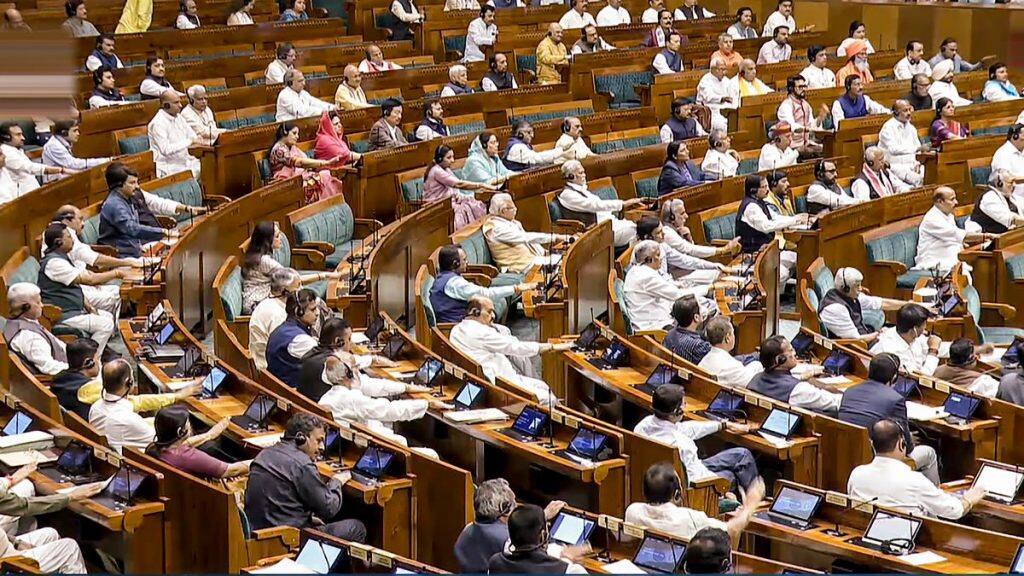
If the bill is passed, the size of the Lok Sabha will increase from the current cap of 550 to 850. This will include 815 MPs from states and 35 from Union Territories (UTs).
Currently, Article 81 (2) and (3) freeze the Lok Sabha seats as per the 1971 Census and the Assembly seats as per the 2001 Census, “until the relevant figures for the first census taken after the year 2026 have been published”.
In normal circumstances, this would have been the 2031 Census. However, the 2021 Census was delayed due to Covid-19 pandemic and is yet to be completed.
The proposed legislation seeks to do away with this proviso entirely. This means the amendment aims to remove the constitutional mandate that delimitation must take place following the 2026 Census.
Thus, the new bill paves the way for delimitation to be carried out on the basis of the data before the 2026-27 Census, according to Live Law.
The bill also proposes an amendment to the marginal heading of Article 82 from “Readjustment after each Census” to “Readjustment of constituencies”. It also deletes the requirement of rearranging the number of Lok Sabha seats in states after every Census.
The bill also suggests amending articles on state Assemblies and reservation for Scheduled Castes (SCs) and Scheduled Tribes (STs) by replacing the basis from the 2001 Census to “such Census” decided by Parliament, Indian Express reported.
Delimitation & implementing women’s quota
Delimitation is the act of drawing boundaries of constituencies and fixing the number of seats in each state for the Lok Sabha and the Legislative Assemblies.
The Delimitation Bill empowers the Central government to form a Delimitation Commission through notification in the official gazette. This panel will be headed by a Supreme Court judge, and include the Chief Election Commissioner, or a nominated Election Commissioner, and the State Election Commissioner of the concerned state as members.
The Delimitation Commission will be responsible for allocating seats across states, redrawing boundaries of constituencies, and deciding reservations for SCs, STs, and women.
This panel will have to ensure that all constituencies are geographically compact. The “physical features, existing boundaries of administrative units, facilities of communication and public convenience” will also have to be considered while redrawing constituencies.
The bill bestows upon the commission powers equivalent to a civil court. Its orders, once published in the Gazette of India, shall “not be called in question in any court of law”.
These bills will get the ball rolling for the implementation of 33 per cent reservation for women in the Lok Sabha and Assemblies of states and UTs. While the Parliament passed the Women’s Reservation Bill in September 2023, its implementation was linked to delimitation after the first Census conducted following the Act.
One-third of seats in the Lok Sabha and state Assemblies, including within SC and ST quotas, will be reserved for women, with the quota valid for 15 years and could be later extended by Parliament.
A government functionary told Hindustan Times (HT) that seats for women will be allotted on a rotation basis for three terms. “The bills will be introduced by the Union law minister Arjun Ram Meghwal in the Lok Sabha on the 16th, the discussion for the passage of the bills is expected to be 18-20 hours in the Lok Sabha and about 10 hours in the Rajya Sabha…” the functionary added.
The statement of objects and reasons of the draft Constitution amendment bill states, "The next census and the consequential delimitation exercise thereafter will take considerable time and thus, delay the effective and dedicated participation of women in our democratic polity.
"Hence, the objective of the proposed bill is to operationalise one-third reservation for women, including women belonging to the Scheduled Castes and the Scheduled Tribes, in the House of the People and the legislative assemblies of the states, the National Capital Territory of Delhi and the Union territories through delimitation exercise to be undertaken on the basis of the population figures of the latest published census," it read.
Why is opposition angry with the bills?
Delimitation has been a politically divisive topic for decades. The freeze on the size of the Lok Sabha was introduced in the 1970s to incentivise population control. While some states, mostly those in the south, succeeded in implementing population control policies, the northern states lagged in following family planning measures.
If delimitation is carried out based on the population alone, southern states fear they will lose out on the number of seats in the Lok Sabha compared to some northern states with higher population growth.
Opposition leaders argue that southern states that controlled population growth will be “penalised” after the delimitation.
The draft of the bills shared with lawmakers on Tuesday (April 14) does not mention the tally or the percentage by which the seats will increase.
Amid this, Tamil Nadu CM Stalin issued a stern warning to the Centre against pushing delimitation during the special session of the Parliament.
He underlined that southern states, including Tamil Nadu, had adhered to the Union government’s previous calls for population control and smaller families. “When the Union government urged us to control population growth, to have smaller families, and to follow family planning measures, we complied. Is this now the punishment for having done what was asked of us with discipline?” Stalin asked in a video message.
Questioning the lack of clarity on the method of carrying out the delimitation exercise, the Tamil Nadu CM warned that any move that harms his state or disproportionately gives more power to northern states would lead to a massive statewide agitation with “every family hitting the streets.”
Senior Congress leader P Chidambaram also raised questions on the three bills, calling them “mischievous and diabolical".
In a post on X today, he argued that a 50 per cent increase in Lok Sabha seats would not be proportionate across states, as delimitation is based on population within constituencies.
“The bills being introduced in the name of implementing Women’s Reservation amount to a death warrant for federal India. The accompanying Delimitation Bill, presented as part of this exercise, would strip southern states — which have successfully implemented population control measures — of their rightful political power,” John Brittas, floor leader of the Communist Party of India (Marxist) in the Rajya Sabha, wrote on X.
How different will expanded Lok Sabha look?
Allaying the concerns of southern states, government sources told CNN-News18 that the representation of each state in the Lok Sabha will rise by 50 per cent.
If this happens, the number of Lok Sabha seats in Uttar Pradesh is expected to jump from 80 to 120. Bihar could see a surge from 40 to 60, Madhya Pradesh from 29 to 43 and Rajasthan from 25 to 37.
Odisha, which has 21 Lok Sabha seats, will bag 10 additional seats. If delimitation was carried out based on the 2011 Census, it would have had 28 seats.
In the south, Karnataka is likely to witness an increase in the Lok Sabha seats from 28 to 42. If delimitation were based solely on the 2011 Census, it would have had 41 seats.
Telangana's seat will now increase from 17 to 25. If delimitation had relied on the 2011 population count, its seats would have surged to 24.
In Andhra Pradesh, the number of Lok Sabha seats will rise from 25 to 37, while in Tamil Nadu from 39 to 59. In case delimitation depended only on the 2011 Census, their seats would have increased to 33 and 49, respectively.
Kerala will get 10 extra Lok Sabha seats, with its tally rising from 20 to 30. Based only on the last census, it would have had 23 seats.
As per the top government source, "The same proportion as it exists today will be maintained. There will be no change in the proportionality of seats between states."
Union Minister Kiren Rijiju has also dismissed concerns of opposition leaders, emphasising that southern states will not lose out on Lok Sabha representation due to delimitation.
"The southern states are fortunate that despite controlling the population growth, despite a lesser number of people in terms of proportionate, in terms of ratio, they still gain because the numbers have risen proportionately," he told reporters on Tuesday.
Rijiju alleged that some people tried to mislead the southern states in the past. "No state is losing. Every region, every state is given the provision of an increase in seats."
With inputs from agencies
Senior Sub-Editor at Firstpost. She writes explainers on myriad subjects without the limitation of beats.

Military drones & police check-ups: How Sri Lanka is fighting against worst dengue outbreak in a decade
How Facebook job ad lured 2 Karnataka men into Myanmar cyber scam camp
Why is India seeing 95% cloud cover despite a Super El Niño?
What is CJP’s fourth demand to the government as protests in Delhi intensify?
The new geography of war: Why the Houthis can no longer be ignored