
Advertisement


Sections
Can China be held responsible for debris from its rocket falling uncontrollably to Earth?
A 23-tonne piece of Chinese space junk crashed into the sea in the Philippines on Sunday. Beijing is a repeat offender and has faced criticism time and again for allowing rocket stages to fall to Earth uncontrolled

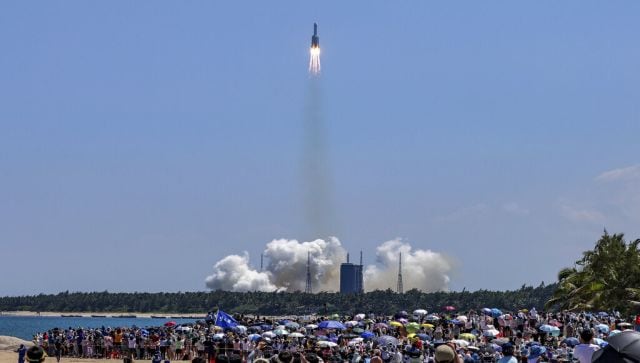
A 23-tonne piece of a Chinese rocket plummeting to Earth had scientists on alert. Where would it crash?Now the debris from the rocket that boosted part of China’s new space station into orbit fell into the sea in the Philippines on Sunday, the Chinese government announced.Most of the final stage of the Long March-5B rocket burned up after entering the atmosphere, the China Manned Space Agency reported. The agency had said earlier that the booster would be allowed to fall unguided.The announcement gave no details of whether the remaining debris fell on land or sea but said the “landing area” was at 119 degrees east longitude and 9.1 degrees north latitude. That is in waters southeast of the Philippine city of Puerto Princesa on the island of Palawan, reports The Associated Press.Luckily, there was no reported damage in a western Philippine region where the debris from the rocket reportedly fell, a Filipino official said Monday. Philippine Space Agency official Marc Talampas said authorities have been advised to be on the lookout for the debris, which may have splashed down into seawaters off Palawan province.China is a repeat offender when it comes to space junk and has faced criticism in the past over its debris, especially objects re-entering Earth.What is space debris?Space junk, or space debris, is any piece of machinery or debris left by humans in space.It can refer to big objects such as dead satellites that have failed or been left in orbit at the end of their mission. It can also refer to smaller things, like bits of debris or paint flecks that have fallen off a rocket, according to the Natural History Museum (NHM), UK.How does junk get into space?Space junk is created because of the objects launched into space from Earth. Debris or satellites left at higher altitudes of 36,000 kilometres – where communications and weather satellites are often placed in geostationary orbits – can continue to circle Earth for hundreds or even thousands of years, according to NHM.Objects in lower orbits of a few hundred kilometres return quickly; they enter the atmosphere and burn up, which stops them from hitting the ground. But the big concern is when parts of rockets fall to Earth uncontrollably.What is an uncontrollable re-entry?Rockets launched by most nations separate the launcher from the payload before leaving the atmosphere with an extra engine on the payload giving a final boost and allowing the launcher to fall more predictably reports Guardian.However, China appears not to want to spend weight on the second engine, and its 5B rocket – one of the largest in use – instead pushes fully into orbit before separating. The bus-sized launch section then travels through orbit for days or weeks before re-entering Earth’s atmosphere, the report says.“It’s important for people to understand that among the 10 tough things that we do in space, debris re-entry is probably one of the toughest ones to predict,” Dr Darren McKnight from satellite tracking company LeoLabs told Cosmos Magazine.[caption id="attachment_10995891" align="alignnone" width="640"]![There was no reported damage in a western Philippine region, where debris from the rocket that boosted part of China’s new space station reportedly fell. AP]() There was no reported damage in a western Philippine region, where debris from the rocket that boosted part of China’s new space station reportedly fell. AP[/caption]How did the debris from the Chinese rocket launch hit earth?The July 24 launch of the Long March-5B, China’s most powerful rocket, carried the Wentian laboratory into orbit. It was attached on Monday to the Tianhe main module, where three astronauts live.The remains of a separate cargo spacecraft that serviced the station fell into a predetermined area of the South Pacific after most of it burned up on re-entry.Has China been responsible for similar incidents in the past?Yes. China has faced criticism for allowing rocket stages to fall to Earth uncontrolled before.NASA accused Beijing last year of “failing to meet responsible standards regarding their space debris” after parts of a Chinese rocket landed in the Indian Ocean near the Maldives.In April, a large metal ring and sphere suspected to be from a Chinese rocket fell from the sky in a village in Maharashtra. Another object – a large, metal ball around half a metre (1.5 feet) in diameter – fell in another village in the district.In May 2020, two villages in Ivory Coast were hit by objects – including a 12-metre section of pipe – that appeared to have come from a Chinese Long March 5B.Even the country’s first space station, Tiangong-1, crashed into the Pacific Ocean in 2016 after Beijing confirmed it lost control.What has been China’s response to NASA’s allegations?Chinese foreign ministry spokesperson Zhao Lijian said that Chinese space exploration had always followed “international law and … customary practice”, and the probability of the debris causing harm was “extremely low”.Zhao said the unit had been designed with unspecified “special technology”, and the “overwhelming majority” of its components would burn up on re-entry into the atmosphere, according to a report in Guardian.But what happens if space junk causes damage?According to the Space Liability Convention of 1972, a launching State shall be liable to pay compensation for damage caused by its space objects on the surface of the Earth or to aircraft, and liable for damage due to its faults in space. The Convention also provides for procedures for the settlement of claims for damages.Nasa was fined $400 for littering when parts of its Skylab space station hit Western Australia in the 1970s. However, it has still not paid up.However, there are no international rules to stop uncontrolled re-entries of junk for space.The United States and the European Union conduct a risk assessment before a launch. If there is a greater than one in 10,000 chance of causing injury it will not go ahead with it. It looks like China has been slack.With inputs from agenciesRead all the Latest News, Trending News, Cricket News, Bollywood News,India News and Entertainment News here. Follow us on Facebook, Twitter and Instagram.
There was no reported damage in a western Philippine region, where debris from the rocket that boosted part of China’s new space station reportedly fell. AP[/caption]How did the debris from the Chinese rocket launch hit earth?The July 24 launch of the Long March-5B, China’s most powerful rocket, carried the Wentian laboratory into orbit. It was attached on Monday to the Tianhe main module, where three astronauts live.The remains of a separate cargo spacecraft that serviced the station fell into a predetermined area of the South Pacific after most of it burned up on re-entry.Has China been responsible for similar incidents in the past?Yes. China has faced criticism for allowing rocket stages to fall to Earth uncontrolled before.NASA accused Beijing last year of “failing to meet responsible standards regarding their space debris” after parts of a Chinese rocket landed in the Indian Ocean near the Maldives.In April, a large metal ring and sphere suspected to be from a Chinese rocket fell from the sky in a village in Maharashtra. Another object – a large, metal ball around half a metre (1.5 feet) in diameter – fell in another village in the district.In May 2020, two villages in Ivory Coast were hit by objects – including a 12-metre section of pipe – that appeared to have come from a Chinese Long March 5B.Even the country’s first space station, Tiangong-1, crashed into the Pacific Ocean in 2016 after Beijing confirmed it lost control.What has been China’s response to NASA’s allegations?Chinese foreign ministry spokesperson Zhao Lijian said that Chinese space exploration had always followed “international law and … customary practice”, and the probability of the debris causing harm was “extremely low”.Zhao said the unit had been designed with unspecified “special technology”, and the “overwhelming majority” of its components would burn up on re-entry into the atmosphere, according to a report in Guardian.But what happens if space junk causes damage?According to the Space Liability Convention of 1972, a launching State shall be liable to pay compensation for damage caused by its space objects on the surface of the Earth or to aircraft, and liable for damage due to its faults in space. The Convention also provides for procedures for the settlement of claims for damages.Nasa was fined $400 for littering when parts of its Skylab space station hit Western Australia in the 1970s. However, it has still not paid up.However, there are no international rules to stop uncontrolled re-entries of junk for space.The United States and the European Union conduct a risk assessment before a launch. If there is a greater than one in 10,000 chance of causing injury it will not go ahead with it. It looks like China has been slack.With inputs from agenciesRead all the Latest News, Trending News, Cricket News, Bollywood News,India News and Entertainment News here. Follow us on Facebook, Twitter and Instagram.
 There was no reported damage in a western Philippine region, where debris from the rocket that boosted part of China’s new space station reportedly fell. AP[/caption]How did the debris from the Chinese rocket launch hit earth?The July 24 launch of the Long March-5B, China’s most powerful rocket, carried the Wentian laboratory into orbit. It was attached on Monday to the Tianhe main module, where three astronauts live.The remains of a separate cargo spacecraft that serviced the station fell into a predetermined area of the South Pacific after most of it burned up on re-entry.Has China been responsible for similar incidents in the past?Yes. China has faced criticism for allowing rocket stages to fall to Earth uncontrolled before.NASA accused Beijing last year of “failing to meet responsible standards regarding their space debris” after parts of a Chinese rocket landed in the Indian Ocean near the Maldives.In April, a large metal ring and sphere suspected to be from a Chinese rocket fell from the sky in a village in Maharashtra. Another object – a large, metal ball around half a metre (1.5 feet) in diameter – fell in another village in the district.In May 2020, two villages in Ivory Coast were hit by objects – including a 12-metre section of pipe – that appeared to have come from a Chinese Long March 5B.Even the country’s first space station, Tiangong-1, crashed into the Pacific Ocean in 2016 after Beijing confirmed it lost control.What has been China’s response to NASA’s allegations?Chinese foreign ministry spokesperson Zhao Lijian said that Chinese space exploration had always followed “international law and … customary practice”, and the probability of the debris causing harm was “extremely low”.Zhao said the unit had been designed with unspecified “special technology”, and the “overwhelming majority” of its components would burn up on re-entry into the atmosphere, according to a report in Guardian.But what happens if space junk causes damage?According to the Space Liability Convention of 1972, a launching State shall be liable to pay compensation for damage caused by its space objects on the surface of the Earth or to aircraft, and liable for damage due to its faults in space. The Convention also provides for procedures for the settlement of claims for damages.Nasa was fined $400 for littering when parts of its Skylab space station hit Western Australia in the 1970s. However, it has still not paid up.However, there are no international rules to stop uncontrolled re-entries of junk for space.The United States and the European Union conduct a risk assessment before a launch. If there is a greater than one in 10,000 chance of causing injury it will not go ahead with it. It looks like China has been slack.With inputs from agenciesRead all the Latest News, Trending News, Cricket News, Bollywood News,India News and Entertainment News here. Follow us on Facebook, Twitter and Instagram.
First Published:Aug 01, 2022, 19:39:46 IST
Advertisement
Advertisement

Who is Sandeep Lamba, the Delhi cop removed from protest site duty after slapping female protester?
Sandeep Lamba, an Additional Deputy Commissioner of Police (DCP) (North East District), was seen slapping a female CJP protester in a video on July 20. Lamba has now been removed from the protest site and sent back to his original station. In 2021, Lamba was awarded the Union Home Minister’s medal for excellent investigation
4 min read
Explorers discover wreckage of plane 72 years later. Will this help in finding MH370?
On April 11, 1952, a Pan Am Flight 526A, crashed into the Atlantic Ocean, killing 52 of the 69 people on board. After decades of effort, explorers have found the wreck of the plane at the bottom of the seabed near Puerto Rico. The discovery offers new hope to families who lost loved ones in the Malaysia Airlines Flight 370 crash in 2014
5 min read
Cruise missiles, drones and more... The deadly arsenal of the Houthis
The Houthis have evolved into one of the world's most formidable non-state military forces, deploying anti-ship ballistic missiles, cruise missiles, drones and explosive boats to threaten Red Sea shipping. Their latest attacks on Saudi oil tankers have raised concerns over shipping through the Bab el-Mandeb Strait amid the Strait of Hormuz crisis
10 min read
Why India may not witness a medal rush at 2026 Commonwealth Games
A 125-strong Indian contingent is in Glasgow for the 2026 Commonwealth Games, starting today (July 23), chasing international glory. However, with a roster of sports such as badminton and wrestling being cut from the event, the country’s medal chances have been drastically reduced
4 min read
Delhi Police asks personnel to wear uniform: What the law says on cops in plainclothes during protests
The Delhi Police has instructed all its personnel to wear uniforms when they report for duty at Jantar Mantar for crowd control. This comes after outrage grew over videos of men in civilian clothes or without name tags hitting protesters in the Capital. Is it legal for the police to ditch uniforms during protests?
4 min read
Advertisement
Advertisement