


Explained: The diplomatic thaw in Australia-China ties and what it means for the Pacific
After years of strained ties and trade sanctions, Australia and China have intensified efforts to mend their relationship. On Monday, ministers of the two nations met in what was described as 'another important step’ in that direction

The Australian minister said he has accepted Wang's invitation to visit Beijing in the “near future”.SCMP also reported that the Monday meeting between Farrell and Wang could lead to Australia’s prime minister Anthony Albanese visiting Beijing later this year.Why did the relationship sour between Australia and China?Australia and China have had a strained diplomatic relationship over the past few years.Amid concerns over China’s alleged growing influence in Australian politics, in 2018, Canberra barred Chinese firms Huawei and ZTE telecommunications from building their 5G networks.The same year in October, China started an anti-dumping investigation into Australian barley imports.In 2020, the relations took a further nosedive after Canberra pushed for an international inquiry into the origins of COVID-19, severely irking Bejing.Responding to this, the Asian giant alleged that the then-Scott Morrison-led Australian government was joining forces with the United States to spread “anti-China propaganda”.In retaliation, China also imposed sanctions on a variety of Australian imports including coal, barley, wine, beef and lobsters.The diplomatic altercation was again fuelled as China detained Australian journalist Cheng Lei and Australian writer Dr Yang Hengjun, accusing them of national security-related offences.Concern over human rights also dented the ties between the two allies. As reports of China sending Uyghur Muslims to detention camps emerged, Australia responded and expressed “deep concern” over the “human rights situation.”China also imposed a freeze on high-level talks with Australia.In 2021, Australia approached the World Trade Organization to resolve trade disputes with China. Moreover, it also struck down the Belt and Road Initiative deal that China signed with the Australian state of Victoria, as per SCMP.As per a study by KPMG and the University of Sydney, Chinese investment in Australia plummeted 70 per cent in 2021 from the US$1.9 billion reported in 2020, reported SCMP.Amid growing tensions, Australia tried to stretch its markets away from China, which is the country's largest trading partner – both in exports and imports. In this regard, Canberra signed a free trade deal with India which came into effect in December last year.However, even as tensions prevailed, China remained Australia’s largest export partner as Beijing restrained from restricting the highly lucrative iron ore trade, noted Bloomberg.How are the ties slowly improving?The relations between Canberra and Beijing have "improved substantially" since the Albanese-led Labor government came to power in Australia last May, as per The Diplomat. The thaw started in November 2022 after Chinese president Xi Jinping met Australian prime minister Albanese on the sidelines of the G20 summit in Indonesia’s Bali.The meeting between the two leaders paved the way for Australia’s foreign affairs minister Penny Wong’s official visit to Beijing last December. This resulted in both sides committing to hold dialogues on wide-ranging issues including defence, as per The Conversation.
Since then, China has also reportedly eased its unofficial ban on Australian coal imports.Australia will also be able to export lobsters to China in March this year, as per the SCMP report.[caption id="attachment_12125052" align="alignnone" width="640"]
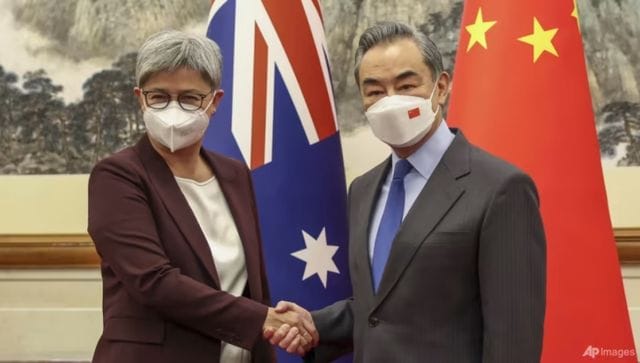
Australian foreign minister Penny Wong travelled to Beijing last year in December. AP File Photo[/caption]Last month, Chinese ambassador Xiao Qian said Beijing and Canberra are deliberating if Australia’s complaint at the World Trade Organization on Chinese tariffs on wine and barley could be resolved bilaterally.Can the ties fully go back to normal?Only time will tell.Carl Thayer, an emeritus professor of politics at the University of New South Wales in Australia, told SCMP that the meetings such as the Monday ones are “baby steps”, especially as Australian exporters and Chinese buyers have already turned to other markets.“The expectations [in Australia] have always been tempered,” Thayer added.According to Wang Yong, a professor at the School of International Studies at Peking University, for the two nations to resort to trade ties to pre-2020 levels, Beijing would want Canberra to “step back from the pursuit of stronger security ties in the Asia-Pacific region led by the United States”.“I think the gradual resumption of normal trade relations is good for the interest of both sides,” Wang told SCMP.“I think it’s possible to return to pre-2020 levels, but both sides have to pay attention to a more challenging issue, which is the role of the US,” the professor added.Notably, Australia has bolstered its alliance with the US and its security partnership with Japan even as its diplomatic detente continues with Beijing.Over the last few years, Australia has tried to connect with “like-minded democracies” such as Japan, India and the US as well as reduce its dependence on China.Australian defence minister Richard Marles has also expressed willingness to further deepen ties with the US.He said last October that Australia’s “alliance with the United States is completely central to our national security and to our worldview”.In Japan last December, Marles said Beijing was pursuing “the largest military build up since World War Two … without transparency or reassurance to the region of China’s strategic intent”.China has been wary of the Quadrilateral Initiative (Quad) – comprising the United States, India, Japan and Australia, as well as Aukus – a trilateral security partnership between the United States, United Kingdom, and Australia.Formed in 2007, the Quad is seen by analysts as an effort to counter China’s expansion in the Indo-pacific region, as per Indian Express.The Aukus partnership, which aims to provide “conventionally armed nuclear-powered submarines” to Australia, has faced flak from China which has called it “a violation of the object and purpose” of the Nuclear Non-Proliferation Treaty.Reiterating China’s concerns over Aukus, Xiao said last month that the deal might serve the interests of other countries and not Australia’s – an indirect reference to claims that Canberra will become dependent on the US.With inputs from agenciesRead all the Latest News, Trending News, Cricket News, Bollywood News, India News and Entertainment News here. Follow us on Facebook, Twitter and Instagram.
Sub-Editor at Firstpost. Writing Explainers on everything from politics to space.

Military drones & police check-ups: How Sri Lanka is fighting against worst dengue outbreak in a decade
How Facebook job ad lured 2 Karnataka men into Myanmar cyber scam camp
Why is India seeing 95% cloud cover despite a Super El Niño?
What is CJP’s fourth demand to the government as protests in Delhi intensify?
The new geography of war: Why the Houthis can no longer be ignored