
Advertisement


Sections
Do Americans not have enough money to pay for even groceries right away?
Food inflation in the US is sky-high and Americans are struggling to buy their everyday groceries. A large number of them are turning to 'Buy Now Pay Later' apps, which allow them to shell out money for their purchases in instalments

We all know about America’s extensive use of buying things on credit. Now, with the US seeing an inflation like no other and prices of food and groceries soaring to new highs, Americans are opting for the credit system and a huge amount of them are using Buy Now, Pay Later (BNPL) apps to purchase their daily needs.We take a closer look at what exactly are these apps and why an increasing number of Americans are choosing to use them for their provisions.Buy Now Pay Later apps‘Buy Now Pay Later isn’t some new trend in the market. They have been around for long, but the only difference is that earlier they were used for the purchase of big-ticket items such as a house or a car or some exotic holiday.The Buy Now Pay Later payments resemble a personal loan — your payments are split into equal instalments over a period of time. What is most attractive about this form of payment is that they are often interest-free as long you make your payments on time and in full. Some apps charge interest if consumers want to spread payments out for a longer period of time and late fees can accrue quickly if a payment is missed.The American market has several Buy Now Pay Later apps such as Klarna, Affirm, Afterpay, Apple Pay and Sezzle.Growth of Buy Now Pay Later appsBNPL is a payment option you may see more now than you did in the earlier 2000s. During hard economic times when inflation is high, BNPL is a helpful option for people making purchases.A September 2022 Consumer Financial Protection Bureau (CFPB) revealed that the number of BNPL loans originated in the US by the five lenders it surveyed grew from 16.8 million to 180 million.These BNPL apps have blossomed in the past two-three years and the COVID-19 pandemic is partially the reason for it. For instance, Australia-based Afterpay saw active US customers more than double to 6.5 million in the fiscal year ending 30 June 2020, and its sales more than tripled in the July-September quarter from a year earlier.The same can be said for other BNPL apps too. Now, consumers are also using these same BNPL apps for everyday buys, such as grocery shopping, bill payments or fuel top-ups. A survey carried out from LendingTree Inc and reported by Bloomberg showed that almost half of all Americans have used BNPL apps, and of those, about one in five rely on such apps to buy groceries.In December 2022, downloads for the top four apps exceeded three million, a 20 per cent increase over the same month in 2020, according to research from Bank of America. A CFPB report had similar figures to share. The five main lenders had loans worth $24.2 billion in 2021, a staggering increase to the $2 billion in 2019.Experts have also noted that the use of these BNPL apps is evolving. First, used for high-cost items, today, they are being used for most things.[caption id="attachment_12482222" align="alignnone" width="640"]![]() The breakdown of how consumers are using Buy Now Pay Later apps in March 2023. Graphic: Pranay Bhardwaj[/caption]At first, buy now, pay later shoppers were typically high earners who used repayment options to cover fashion, beauty or large travel purchases, Colleen McCreary, consumer financial advocate for Credit Karma, was quoted as saying to NBC News. But in recent years, the income range of shoppers has become wider, she said, “It’s becoming more and more a replacement for people who don’t have any other options,” she said. “They’re just grabbing whatever option that they can get at the checkout line to get what they need.”Food pain in AmericaIf the pandemic was one reason the use of BNPL apps rose, inflation and soaring food prices is another reason for their booming business. Food inflation is still very high in the US and prices of groceries are at unbelievable levels.Ordinary Americans have been watching their grocery bills climb to new heights as prices rise on eggs, cereals, meat, dairy, fruits, and vegetables — virtually everything they eat. According to the US Department of Agriculture, the price of food for home consumption rose by 11.4 per cent last year — the highest yearly percent change since 1974 — and it’s expected to rise by another 8.6 per cent in 2023.[caption id="attachment_12482232" align="alignnone" width="640"]
The breakdown of how consumers are using Buy Now Pay Later apps in March 2023. Graphic: Pranay Bhardwaj[/caption]At first, buy now, pay later shoppers were typically high earners who used repayment options to cover fashion, beauty or large travel purchases, Colleen McCreary, consumer financial advocate for Credit Karma, was quoted as saying to NBC News. But in recent years, the income range of shoppers has become wider, she said, “It’s becoming more and more a replacement for people who don’t have any other options,” she said. “They’re just grabbing whatever option that they can get at the checkout line to get what they need.”Food pain in AmericaIf the pandemic was one reason the use of BNPL apps rose, inflation and soaring food prices is another reason for their booming business. Food inflation is still very high in the US and prices of groceries are at unbelievable levels.Ordinary Americans have been watching their grocery bills climb to new heights as prices rise on eggs, cereals, meat, dairy, fruits, and vegetables — virtually everything they eat. According to the US Department of Agriculture, the price of food for home consumption rose by 11.4 per cent last year — the highest yearly percent change since 1974 — and it’s expected to rise by another 8.6 per cent in 2023.[caption id="attachment_12482232" align="alignnone" width="640"]![]() The rise of food prices. Graphic: Pranay Bhardwaj[/caption]Regular Americans have been feeling the pain of rising food prices. For instance, Alana Auston, a 24-year-old senior strategic planner from Flint Township, Michigan, told TIME magazine her family of three is now spending twice as much on groceries compared to last year.Also read: How California floods could drive up food prices in the USThe food prices have risen so drastically that a recent survey by financial software company Propel showed that almost a third were skipping meals, eating less, or relying on food banks.But why has food prices soared sky-high?There’s a multitude of reasons. There are supply-chain snags, the avian flu epidemic that is driving up the cost of eggs, climate issues like drought and the war in Ukraine, which has raised the cost of commodities.And despite some experts stating that using BNPL apps for groceries and other items can be risky business, the common American is simply worried about putting food on their plate and not the long-term risks.As Faith Smith told Bloomberg, “I’m worried. I’m living paycheck to paycheck even though I shouldn’t be. Using these services is the only means of survival.”With inputs from agenciesRead all the Latest News, Trending News, Cricket News, Bollywood News,India News and Entertainment News here. Follow us on Facebook, Twitter and Instagram.
The rise of food prices. Graphic: Pranay Bhardwaj[/caption]Regular Americans have been feeling the pain of rising food prices. For instance, Alana Auston, a 24-year-old senior strategic planner from Flint Township, Michigan, told TIME magazine her family of three is now spending twice as much on groceries compared to last year.Also read: How California floods could drive up food prices in the USThe food prices have risen so drastically that a recent survey by financial software company Propel showed that almost a third were skipping meals, eating less, or relying on food banks.But why has food prices soared sky-high?There’s a multitude of reasons. There are supply-chain snags, the avian flu epidemic that is driving up the cost of eggs, climate issues like drought and the war in Ukraine, which has raised the cost of commodities.And despite some experts stating that using BNPL apps for groceries and other items can be risky business, the common American is simply worried about putting food on their plate and not the long-term risks.As Faith Smith told Bloomberg, “I’m worried. I’m living paycheck to paycheck even though I shouldn’t be. Using these services is the only means of survival.”With inputs from agenciesRead all the Latest News, Trending News, Cricket News, Bollywood News,India News and Entertainment News here. Follow us on Facebook, Twitter and Instagram.
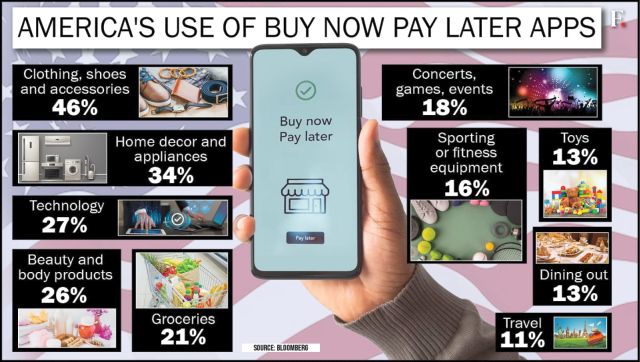 The breakdown of how consumers are using Buy Now Pay Later apps in March 2023. Graphic: Pranay Bhardwaj[/caption]At first, buy now, pay later shoppers were typically high earners who used repayment options to cover fashion, beauty or large travel purchases, Colleen McCreary, consumer financial advocate for Credit Karma, was quoted as saying to NBC News. But in recent years, the income range of shoppers has become wider, she said, “It’s becoming more and more a replacement for people who don’t have any other options,” she said. “They’re just grabbing whatever option that they can get at the checkout line to get what they need.”Food pain in AmericaIf the pandemic was one reason the use of BNPL apps rose, inflation and soaring food prices is another reason for their booming business. Food inflation is still very high in the US and prices of groceries are at unbelievable levels.Ordinary Americans have been watching their grocery bills climb to new heights as prices rise on eggs, cereals, meat, dairy, fruits, and vegetables — virtually everything they eat. According to the US Department of Agriculture, the price of food for home consumption rose by 11.4 per cent last year — the highest yearly percent change since 1974 — and it’s expected to rise by another 8.6 per cent in 2023.[caption id="attachment_12482232" align="alignnone" width="640"]
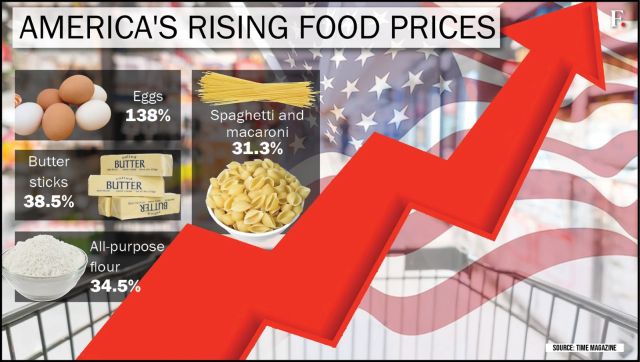 The rise of food prices. Graphic: Pranay Bhardwaj[/caption]Regular Americans have been feeling the pain of rising food prices. For instance, Alana Auston, a 24-year-old senior strategic planner from Flint Township, Michigan, told TIME magazine her family of three is now spending twice as much on groceries compared to last year.Also read: How California floods could drive up food prices in the USThe food prices have risen so drastically that a recent survey by financial software company Propel showed that almost a third were skipping meals, eating less, or relying on food banks.But why has food prices soared sky-high?There’s a multitude of reasons. There are supply-chain snags, the avian flu epidemic that is driving up the cost of eggs, climate issues like drought and the war in Ukraine, which has raised the cost of commodities.And despite some experts stating that using BNPL apps for groceries and other items can be risky business, the common American is simply worried about putting food on their plate and not the long-term risks.As Faith Smith told Bloomberg, “I’m worried. I’m living paycheck to paycheck even though I shouldn’t be. Using these services is the only means of survival.”With inputs from agenciesRead all the Latest News, Trending News, Cricket News, Bollywood News,India News and Entertainment News here. Follow us on Facebook, Twitter and Instagram.
First Published:Apr 20, 2023, 17:09:39 IST
Advertisement
Advertisement

Military drones & police check-ups: How Sri Lanka is fighting against worst dengue outbreak in a decade
Sri Lanka is fighting its most severe dengue outbreak in nearly a decade, with infections rising sharply across the nation. Military drones have been deployed to tackle the outbreak, which has claimed 56 lives. Health officials said the outbreak is being driven primarily by the DENV-2 variant of the virus
3 min read
How Facebook job ad lured 2 Karnataka men into Myanmar cyber scam camp
The Karnataka Cyber Command has rescued two youths from a scam compound in Myanmar operated by Chinese fraudsters. The duo from Karnataka were lured on the pretext of data-entry jobs. They were asked to work for 16 hours a day and were expected to sleep for six hours daily
4 min read
Why is India seeing 95% cloud cover despite a Super El Niño?
India is witnessing nearly 95 per cent cloud cover despite a Super El Niño, a climate event usually linked to weaker monsoons. Regional weather systems, cyclonic circulations, the monsoon trough and moisture from two seas are temporarily overpowering one of the world's strongest climate phenomena
5 min read
What is CJP’s fourth demand to the government as protests in Delhi intensify?
The protest by the Cockroach Janta Party at Delhi’s Jantar Mantar refuses to die down. The group have made a fourth demand to the Centre, asking that no FIRs are filed against the agitators and that no legal action be taken. The government has expressed willingness to speak to the protesters, but refused to accede on the resignation of Education Minister Dharmandra Pradhan
5 min read
The new geography of war: Why the Houthis can no longer be ignored
The rise of the Houthis marks the emergence of a new geography of war — one in which influence flows not only from capitals and conventional armies, but also from rugged mountains overlooking vital sea lanes
6 min read
Advertisement
Advertisement