
Advertisement


Sections
Afghanistan, Pakistan rocked by 6.5-strong earthquake: Why the region is vulnerable to temblors
An earthquake measuring 6.5 on the Richter scale rattled Afghanistan’s mountainous Hindukush region, bordering Pakistan, killing 11 people in both countries. Tremors were felt as far as North India, where people ran out of their houses. But what causes Afghanistan to see so many temblors?

People in Afghanistan, Pakistan and some parts of North India were jolted awake on Tuesday night after a magnitude 6.5 earthquake struck the areas. Panicked people were seen rushing out of their houses. According to an Associated Press report, 11 people have died in Afghanistan and Pakistan as a result of the quake.According to the US Geological Survey, the epicentre of the quake was 40 kilometres (25 miles) south-southeast of Jurm in Afghanistan’s mountainous Hindukush region, bordering Pakistan and Tajikistan. The quake struck 188 kilometres (116 miles) deep below the Earth’s surface, causing it to be felt over a wide area.Describing the tremors, Aziz Ahmad, a Kabul resident, told the Associated Press, “In my life this was first time I have experienced such powerful quake, everyone was terrified. We couldn’t dare to get back homes.”The 6.5-strong quake is the latest temblor to strike Afghanistan — in June 2022, the area was flattened and over 1,000 people died after a magnitude 5.9 tremor southeastern provinces of Paktika and Khost.Also read: From Turkey to Nepal, the deadliest earthquakes that rocked the worldWe take a closer look at why Afghanistan is so prone to earthquakes and why these temblors rattle parts of India.Quake jolts AfghanistanOn Tuesday night, northern Afghanistan first felt the 6.5-strong earthquake in the Hindu Kush mountain range, near the remote northern Afghan province of Badakhshan.Sharafat Zaman Amar, Taliban’s appointed spokesman for the public health ministry, was quoted as saying that so far two people had died and around 20 others had been injured in the earthquake in Afghanistan.Zaman Amar said, “Unfortunately, there could be more casualties as the quake was so powerful, in most parts of the country. All hospitals and health facilities are ready to save lives of people.”The country is prone to seismic upheavals — it has seen eight major quakes since 1991.[caption id="attachment_12330752" align="alignnone" width="640"]![]() Graphic: Pranay Bhardwaj[/caption]Experts say that Afghanistan, which is located in the mountainous Hindu Kush region, is part of the Alpide belt — the second most seismically active region in the world after the Pacific Ring of Fire.Also read: 18 ‘significant’ quakes in 24 days: Is the Earth shaking more and is a big jolt imminent?The Alpide belt runs about 15,000 kilometres, from the southern part of Eurasia through the Himalayas and into the Atlantic. Along with the Hindu Kush, it includes a number of mountain ranges, such as the Alps, Atlas Mountains and the Caucasus Mountains.[caption id="attachment_12330652" align="alignnone" width="640"]
Graphic: Pranay Bhardwaj[/caption]Experts say that Afghanistan, which is located in the mountainous Hindu Kush region, is part of the Alpide belt — the second most seismically active region in the world after the Pacific Ring of Fire.Also read: 18 ‘significant’ quakes in 24 days: Is the Earth shaking more and is a big jolt imminent?The Alpide belt runs about 15,000 kilometres, from the southern part of Eurasia through the Himalayas and into the Atlantic. Along with the Hindu Kush, it includes a number of mountain ranges, such as the Alps, Atlas Mountains and the Caucasus Mountains.[caption id="attachment_12330652" align="alignnone" width="640"]![]() People come out of a restaurant after a tremor was felt in Lahore, Pakistan. Reuters[/caption]Moreover, it is the location where the Arabian, Indian and Eurasian tectonic plates meet. The Earth’s crust is made up of 15 tectonic plates, which create earthquakes when they shift against each other at their borders. The boundary between the Indian and Eurasian plates exists near Afghanistan’s border with Pakistan.Experts also add that the quakes, regardless of their intensity, are particularly damaging in Afghanistan because of the poor infrastructure. Dr Brian Baptie, seismologist with the British Geological Survey, told the BBC, “Afghanistan is particularly vulnerable, because the buildings there are not earthquake-resistant. They tend to be built of timber and adobe — a type of mud brick — or out of weak concrete.”Seismologist Lucy Jones, a visiting associate researcher at the California Institute of Technology, agreed on this observation. In a report to Scientific American, she was quoted as saying, “It isn’t the geology — it’s just the type of construction. There are no quake-proof buildings. It’s mostly river stones held together with some sort of mortar — and mortar behaves awfully in earthquakes.”Besides poor housing, a lot of damage which is caused by earthquakes in Afghanistan is owing to landslides. These landslides can flatten houses in the mountain villages and also cause widespread flooding. This also makes hinders rescue operations by authorities.[caption id="attachment_12330642" align="alignnone" width="640"]
People come out of a restaurant after a tremor was felt in Lahore, Pakistan. Reuters[/caption]Moreover, it is the location where the Arabian, Indian and Eurasian tectonic plates meet. The Earth’s crust is made up of 15 tectonic plates, which create earthquakes when they shift against each other at their borders. The boundary between the Indian and Eurasian plates exists near Afghanistan’s border with Pakistan.Experts also add that the quakes, regardless of their intensity, are particularly damaging in Afghanistan because of the poor infrastructure. Dr Brian Baptie, seismologist with the British Geological Survey, told the BBC, “Afghanistan is particularly vulnerable, because the buildings there are not earthquake-resistant. They tend to be built of timber and adobe — a type of mud brick — or out of weak concrete.”Seismologist Lucy Jones, a visiting associate researcher at the California Institute of Technology, agreed on this observation. In a report to Scientific American, she was quoted as saying, “It isn’t the geology — it’s just the type of construction. There are no quake-proof buildings. It’s mostly river stones held together with some sort of mortar — and mortar behaves awfully in earthquakes.”Besides poor housing, a lot of damage which is caused by earthquakes in Afghanistan is owing to landslides. These landslides can flatten houses in the mountain villages and also cause widespread flooding. This also makes hinders rescue operations by authorities.[caption id="attachment_12330642" align="alignnone" width="640"]![]() Hotel guests gather outside their hotel after an earthquake in Amritsar. Tremors from the quake in Afghanistan and Pakistan were felt in different parts of North India. AFP[/caption]Why tremors in North IndiaAs the quake struck Afghanistan and Pakistan, people in parts of North India also felt the tremors, with many of them running out of their houses in high-rise buildings.Local media reported that people across Delhi and Noida ran out of their houses around 10 pm, with some carrying their children wrapped in blankets. In Ghaziabad, in the northern state of Uttar Pradesh, residents were also seen on the streets.Twitter users in Delhi-NCR region of India shared videos of ceiling fans and light fixtures shaking during the massive quake.According to an NDTV report, a Twitter user from Gurugram said that she ran down “11 flights of stairs” as the building shook. In the video that the user shared, several people can be seen in a park below a high-rise apartment.Meenakshi Bansal, a resident of Noida, was quoted as telling The National, “We were about to go for a walk when suddenly we felt that the whole tower was shaking. We immediately rushed out of the house. The bed was shaking. It was very scary.”But why was an earthquake in Afghanistan felt in north India? J L Gautam, head of office and Scientist at National Center for Seismology, has the answer to this. In a Hindustan Times report, he explained, “The Hindu Kush region is very active seismologically. The reason why people in northwest India and Delhi felt it for relatively longer time is because of the depth. The depth of the fault is over 150 km so primary waves were felt at first followed by secondary waves.”Let’s understand this better. Shock waves travel farther and last longer when the depth of the quake is great, but their effect or intensity is low. If the depth is low, then shock waves are not felt at larger distances but have high intensity. Hence, the quake in Afghanistan, which had its origin 187.6 km below the earth’s surface, could be felt across a larger distance.For long, experts have long warned of an impending quake in the Indian capital of Delhi. Fortunately, Tuesday night wasn’t the day it’s been dreading.With inputs from agenciesRead all the Latest News, Trending News, Cricket News, Bollywood News,India News and Entertainment News here. Follow us on Facebook, Twitter and Instagram.
Hotel guests gather outside their hotel after an earthquake in Amritsar. Tremors from the quake in Afghanistan and Pakistan were felt in different parts of North India. AFP[/caption]Why tremors in North IndiaAs the quake struck Afghanistan and Pakistan, people in parts of North India also felt the tremors, with many of them running out of their houses in high-rise buildings.Local media reported that people across Delhi and Noida ran out of their houses around 10 pm, with some carrying their children wrapped in blankets. In Ghaziabad, in the northern state of Uttar Pradesh, residents were also seen on the streets.Twitter users in Delhi-NCR region of India shared videos of ceiling fans and light fixtures shaking during the massive quake.According to an NDTV report, a Twitter user from Gurugram said that she ran down “11 flights of stairs” as the building shook. In the video that the user shared, several people can be seen in a park below a high-rise apartment.Meenakshi Bansal, a resident of Noida, was quoted as telling The National, “We were about to go for a walk when suddenly we felt that the whole tower was shaking. We immediately rushed out of the house. The bed was shaking. It was very scary.”But why was an earthquake in Afghanistan felt in north India? J L Gautam, head of office and Scientist at National Center for Seismology, has the answer to this. In a Hindustan Times report, he explained, “The Hindu Kush region is very active seismologically. The reason why people in northwest India and Delhi felt it for relatively longer time is because of the depth. The depth of the fault is over 150 km so primary waves were felt at first followed by secondary waves.”Let’s understand this better. Shock waves travel farther and last longer when the depth of the quake is great, but their effect or intensity is low. If the depth is low, then shock waves are not felt at larger distances but have high intensity. Hence, the quake in Afghanistan, which had its origin 187.6 km below the earth’s surface, could be felt across a larger distance.For long, experts have long warned of an impending quake in the Indian capital of Delhi. Fortunately, Tuesday night wasn’t the day it’s been dreading.With inputs from agenciesRead all the Latest News, Trending News, Cricket News, Bollywood News,India News and Entertainment News here. Follow us on Facebook, Twitter and Instagram.
 Graphic: Pranay Bhardwaj[/caption]Experts say that Afghanistan, which is located in the mountainous Hindu Kush region, is part of the Alpide belt — the second most seismically active region in the world after the Pacific Ring of Fire.Also read: 18 ‘significant’ quakes in 24 days: Is the Earth shaking more and is a big jolt imminent?The Alpide belt runs about 15,000 kilometres, from the southern part of Eurasia through the Himalayas and into the Atlantic. Along with the Hindu Kush, it includes a number of mountain ranges, such as the Alps, Atlas Mountains and the Caucasus Mountains.[caption id="attachment_12330652" align="alignnone" width="640"]
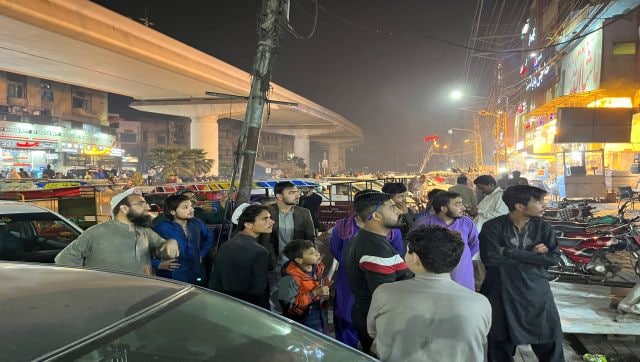 People come out of a restaurant after a tremor was felt in Lahore, Pakistan. Reuters[/caption]Moreover, it is the location where the Arabian, Indian and Eurasian tectonic plates meet. The Earth’s crust is made up of 15 tectonic plates, which create earthquakes when they shift against each other at their borders. The boundary between the Indian and Eurasian plates exists near Afghanistan’s border with Pakistan.Experts also add that the quakes, regardless of their intensity, are particularly damaging in Afghanistan because of the poor infrastructure. Dr Brian Baptie, seismologist with the British Geological Survey, told the BBC, “Afghanistan is particularly vulnerable, because the buildings there are not earthquake-resistant. They tend to be built of timber and adobe — a type of mud brick — or out of weak concrete.”Seismologist Lucy Jones, a visiting associate researcher at the California Institute of Technology, agreed on this observation. In a report to Scientific American, she was quoted as saying, “It isn’t the geology — it’s just the type of construction. There are no quake-proof buildings. It’s mostly river stones held together with some sort of mortar — and mortar behaves awfully in earthquakes.”Besides poor housing, a lot of damage which is caused by earthquakes in Afghanistan is owing to landslides. These landslides can flatten houses in the mountain villages and also cause widespread flooding. This also makes hinders rescue operations by authorities.[caption id="attachment_12330642" align="alignnone" width="640"]
 Hotel guests gather outside their hotel after an earthquake in Amritsar. Tremors from the quake in Afghanistan and Pakistan were felt in different parts of North India. AFP[/caption]Why tremors in North IndiaAs the quake struck Afghanistan and Pakistan, people in parts of North India also felt the tremors, with many of them running out of their houses in high-rise buildings.Local media reported that people across Delhi and Noida ran out of their houses around 10 pm, with some carrying their children wrapped in blankets. In Ghaziabad, in the northern state of Uttar Pradesh, residents were also seen on the streets.Twitter users in Delhi-NCR region of India shared videos of ceiling fans and light fixtures shaking during the massive quake.According to an NDTV report, a Twitter user from Gurugram said that she ran down “11 flights of stairs” as the building shook. In the video that the user shared, several people can be seen in a park below a high-rise apartment.Meenakshi Bansal, a resident of Noida, was quoted as telling The National, “We were about to go for a walk when suddenly we felt that the whole tower was shaking. We immediately rushed out of the house. The bed was shaking. It was very scary.”But why was an earthquake in Afghanistan felt in north India? J L Gautam, head of office and Scientist at National Center for Seismology, has the answer to this. In a Hindustan Times report, he explained, “The Hindu Kush region is very active seismologically. The reason why people in northwest India and Delhi felt it for relatively longer time is because of the depth. The depth of the fault is over 150 km so primary waves were felt at first followed by secondary waves.”Let’s understand this better. Shock waves travel farther and last longer when the depth of the quake is great, but their effect or intensity is low. If the depth is low, then shock waves are not felt at larger distances but have high intensity. Hence, the quake in Afghanistan, which had its origin 187.6 km below the earth’s surface, could be felt across a larger distance.For long, experts have long warned of an impending quake in the Indian capital of Delhi. Fortunately, Tuesday night wasn’t the day it’s been dreading.With inputs from agenciesRead all the Latest News, Trending News, Cricket News, Bollywood News,India News and Entertainment News here. Follow us on Facebook, Twitter and Instagram.
First Published:Mar 22, 2023, 09:54:18 IST
Advertisement
Advertisement

Military drones & police check-ups: How Sri Lanka is fighting against worst dengue outbreak in a decade
Sri Lanka is fighting its most severe dengue outbreak in nearly a decade, with infections rising sharply across the nation. Military drones have been deployed to tackle the outbreak, which has claimed 56 lives. Health officials said the outbreak is being driven primarily by the DENV-2 variant of the virus
3 min read
How Facebook job ad lured 2 Karnataka men into Myanmar cyber scam camp
The Karnataka Cyber Command has rescued two youths from a scam compound in Myanmar operated by Chinese fraudsters. The duo from Karnataka were lured on the pretext of data-entry jobs. They were asked to work for 16 hours a day and were expected to sleep for six hours daily
4 min read
Why is India seeing 95% cloud cover despite a Super El Niño?
India is witnessing nearly 95 per cent cloud cover despite a Super El Niño, a climate event usually linked to weaker monsoons. Regional weather systems, cyclonic circulations, the monsoon trough and moisture from two seas are temporarily overpowering one of the world's strongest climate phenomena
5 min read
What is CJP’s fourth demand to the government as protests in Delhi intensify?
The protest by the Cockroach Janta Party at Delhi’s Jantar Mantar refuses to die down. The group have made a fourth demand to the Centre, asking that no FIRs are filed against the agitators and that no legal action be taken. The government has expressed willingness to speak to the protesters, but refused to accede on the resignation of Education Minister Dharmandra Pradhan
5 min read
The new geography of war: Why the Houthis can no longer be ignored
The rise of the Houthis marks the emergence of a new geography of war — one in which influence flows not only from capitals and conventional armies, but also from rugged mountains overlooking vital sea lanes
6 min read
Advertisement
Advertisement