
Advertisement


Sections
Addicted to 'junk' food, how storks in Spain have altered their migration and breeding patterns
Storks in Europe used to fly south to Africa's Sahel region to spend the winter, stopping in Spain along the way. However, with higher temperatures caused by human-caused climate change and abundant food available at open-air waste disposal sites, most adult storks no longer make such journeys

Colmenar Viejo: The storks float and swoop in formation, circling over a landfill in the foothills of the Sierra de Guadarrama mountains north of Madrid. Then a garbage truck pulls up and disgorges its contents. One by one, they dive to the ground: breakfast is here.Europe's storks used to fly south to Africa's Sahel region to spend the winter, stopping off in Spain along the way. But with higher temperatures driven by human-caused climate change and abundant food available at open-air waste disposal sites, most adult storks no longer make the long and exhausting journey.At Madrid's Colmenar Viejo landfill, around 100 trucks a day dump household waste into a crater that is then covered with sand by diggers. Hundreds of white storks have built nests up to six feet long on roofs and in the bell tower of the nearby church. There are even nests on streetlights."This is a stork paradise because they have grass, pastures and then the landfill, so they have it all here," said Alejandro López García, who is studying Madrid's stork population for his PhD at Madrid's Complutense University.![]() Storks fly in Rivas Vaciamadrid on the outskirts of Madrid. AP[/caption]"With better weather and higher temperatures, insects and worms are more freely available for the storks to eat," said Blas Molina, an ornithologist working with Spanish bird charity SEO/Birdlife. "But every year chicks and adults die because they ingest plastics or rubber that they think are worms," Molina added. "In many cases, their legs get tangled in plastic cords cutting off their blood supply, and they die from that eventually."The negative effects of the storks' garbage diet also reach human populations. Storks from across Europe will still make a short hop southwards during the winter, but if they are feeding at trash sites then potentially toxic chemicals can be transferred to reservoirs and drinking water sources they stop at along the way. "All the pollutants that you have here, or potentially toxic compounds, end up in those waters," López García explained.There is also a clear trend for storks to build nests away from traditional wetlands to urban-adjacent areas, López García said. These large birds are fiercely loyal to their nesting sites and will return to them year after year, concentrating their populations around landfills across Spain.Increasingly, humans and storks are living alongside each other, in a sometimes awkward compromise. White storks can boast a wingspan of up to seven feet, and can weigh up to 10 pounds, so require ample space to nest. In Rivas-Vaciamadrid, a commuter town to the southeast of Madrid, the birds have settled in the metro station and local church.Councilwoman Carmen Rebollo called the storks "our neighbours," and said the birds were generally well liked. However, managing their living space was a challenge.[caption id="attachment_12124552" align="alignnone" width="640"]
Storks fly in Rivas Vaciamadrid on the outskirts of Madrid. AP[/caption]"With better weather and higher temperatures, insects and worms are more freely available for the storks to eat," said Blas Molina, an ornithologist working with Spanish bird charity SEO/Birdlife. "But every year chicks and adults die because they ingest plastics or rubber that they think are worms," Molina added. "In many cases, their legs get tangled in plastic cords cutting off their blood supply, and they die from that eventually."The negative effects of the storks' garbage diet also reach human populations. Storks from across Europe will still make a short hop southwards during the winter, but if they are feeding at trash sites then potentially toxic chemicals can be transferred to reservoirs and drinking water sources they stop at along the way. "All the pollutants that you have here, or potentially toxic compounds, end up in those waters," López García explained.There is also a clear trend for storks to build nests away from traditional wetlands to urban-adjacent areas, López García said. These large birds are fiercely loyal to their nesting sites and will return to them year after year, concentrating their populations around landfills across Spain.Increasingly, humans and storks are living alongside each other, in a sometimes awkward compromise. White storks can boast a wingspan of up to seven feet, and can weigh up to 10 pounds, so require ample space to nest. In Rivas-Vaciamadrid, a commuter town to the southeast of Madrid, the birds have settled in the metro station and local church.Councilwoman Carmen Rebollo called the storks "our neighbours," and said the birds were generally well liked. However, managing their living space was a challenge.[caption id="attachment_12124552" align="alignnone" width="640"]![]() The storks feed on insects, rodents and worms they pull from rubbish, supplementing their diet. But for this traditional symbol of good luck and fertility, danger lurks among the mounting piles of trash. AP[/caption]"The only difficulty that we can have with them is that at a certain moment they make excessively heavy nests or they can damage a roof, but at that moment we try to reduce, adapt or move the nests," she said.López García admitted that the rapid spread of storks in the last few decades around Madrid had caused tensions. "Areas with two nests in the village church, in the municipality or in the town hall is fine, but if the concentration is 30 nests, well then that can start to bother people," he said.
The storks feed on insects, rodents and worms they pull from rubbish, supplementing their diet. But for this traditional symbol of good luck and fertility, danger lurks among the mounting piles of trash. AP[/caption]"The only difficulty that we can have with them is that at a certain moment they make excessively heavy nests or they can damage a roof, but at that moment we try to reduce, adapt or move the nests," she said.López García admitted that the rapid spread of storks in the last few decades around Madrid had caused tensions. "Areas with two nests in the village church, in the municipality or in the town hall is fine, but if the concentration is 30 nests, well then that can start to bother people," he said.
Researchers found 36,217 of Europe's approximately 450,000 white storks in Spain in fall 2020, according to a census.That makes it the most popular host country for this breed on the continent, along with Poland. In the Madrid area alone, López García said, his working group recently counted 2,300 breeding pairs of birds, compared with just 200 registered in 1984.The higher temperatures are likely to keep rising, meaning more and more birds will be drawn to Madrid in winter. Other species like swallows are also no longer migrating further south into Africa.Researchers at Zurich Technical University have predicted that the average temperature in the Spanish capital's coldest month will increase by 3.1 Celsius (37.5 F) by 2050.The storks feed on insects, rodents and worms they pull from rubbish, supplementing their diet. But for this traditional symbol of good luck and fertility, danger lurks among the mounting piles of trash.[caption id="attachment_12124582" align="alignnone" width="640"]
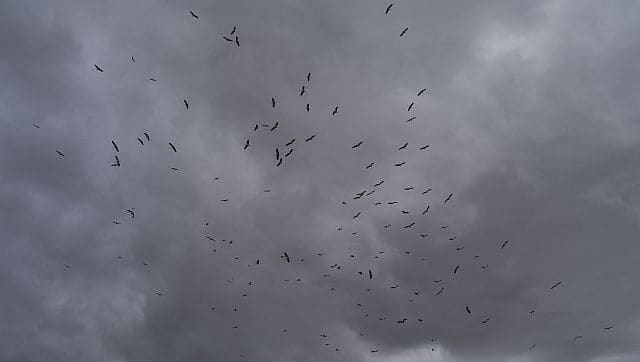 Storks fly in Rivas Vaciamadrid on the outskirts of Madrid. AP[/caption]"With better weather and higher temperatures, insects and worms are more freely available for the storks to eat," said Blas Molina, an ornithologist working with Spanish bird charity SEO/Birdlife. "But every year chicks and adults die because they ingest plastics or rubber that they think are worms," Molina added. "In many cases, their legs get tangled in plastic cords cutting off their blood supply, and they die from that eventually."The negative effects of the storks' garbage diet also reach human populations. Storks from across Europe will still make a short hop southwards during the winter, but if they are feeding at trash sites then potentially toxic chemicals can be transferred to reservoirs and drinking water sources they stop at along the way. "All the pollutants that you have here, or potentially toxic compounds, end up in those waters," López García explained.There is also a clear trend for storks to build nests away from traditional wetlands to urban-adjacent areas, López García said. These large birds are fiercely loyal to their nesting sites and will return to them year after year, concentrating their populations around landfills across Spain.Increasingly, humans and storks are living alongside each other, in a sometimes awkward compromise. White storks can boast a wingspan of up to seven feet, and can weigh up to 10 pounds, so require ample space to nest. In Rivas-Vaciamadrid, a commuter town to the southeast of Madrid, the birds have settled in the metro station and local church.Councilwoman Carmen Rebollo called the storks "our neighbours," and said the birds were generally well liked. However, managing their living space was a challenge.[caption id="attachment_12124552" align="alignnone" width="640"]
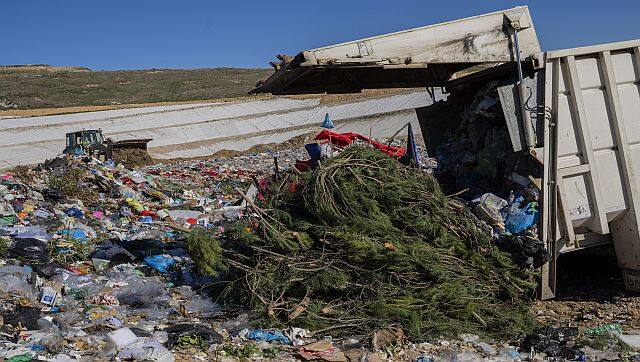 The storks feed on insects, rodents and worms they pull from rubbish, supplementing their diet. But for this traditional symbol of good luck and fertility, danger lurks among the mounting piles of trash. AP[/caption]"The only difficulty that we can have with them is that at a certain moment they make excessively heavy nests or they can damage a roof, but at that moment we try to reduce, adapt or move the nests," she said.López García admitted that the rapid spread of storks in the last few decades around Madrid had caused tensions. "Areas with two nests in the village church, in the municipality or in the town hall is fine, but if the concentration is 30 nests, well then that can start to bother people," he said.
Now that the storks have altered their migration and breeding patterns to adapt to the plentiful garbage piles on offer, a new threat looms.In 2020, Spain adopted into national law a European Union directive that aims to stop all organic waste ending up in landfills. This is precisely the waste that fills with mice, insects and worms that the storks flock to eat."This means that the food they are eating right now would cease to exist," López García said, suggesting that an area for storks to feed to be maintained at the garbage dumps. "What we're proposing is that there's a smooth transition that doesn't happen overnight or a closure of landfills."However, the ultimate benefit of reducing planet-warming methane by cutting organic material in dump sites outweighs the benefit of the food source that the storks can find here, according to López García. "In the medium-to-long term, the feeding from landfills is negative for them," he said.Read all the Latest News, Trending News, Cricket News, Bollywood News,India News and Entertainment News here. Follow us on Facebook, Twitter and Instagram.
First Published:Feb 08, 2023, 18:34:29 IST
Advertisement
Advertisement

Military drones & police check-ups: How Sri Lanka is fighting against worst dengue outbreak in a decade
Sri Lanka is fighting its most severe dengue outbreak in nearly a decade, with infections rising sharply across the nation. Military drones have been deployed to tackle the outbreak, which has claimed 56 lives. Health officials said the outbreak is being driven primarily by the DENV-2 variant of the virus
3 min read
How Facebook job ad lured 2 Karnataka men into Myanmar cyber scam camp
The Karnataka Cyber Command has rescued two youths from a scam compound in Myanmar operated by Chinese fraudsters. The duo from Karnataka were lured on the pretext of data-entry jobs. They were asked to work for 16 hours a day and were expected to sleep for six hours daily
4 min read
Why is India seeing 95% cloud cover despite a Super El Niño?
India is witnessing nearly 95 per cent cloud cover despite a Super El Niño, a climate event usually linked to weaker monsoons. Regional weather systems, cyclonic circulations, the monsoon trough and moisture from two seas are temporarily overpowering one of the world's strongest climate phenomena
5 min read
What is CJP’s fourth demand to the government as protests in Delhi intensify?
The protest by the Cockroach Janta Party at Delhi’s Jantar Mantar refuses to die down. The group have made a fourth demand to the Centre, asking that no FIRs are filed against the agitators and that no legal action be taken. The government has expressed willingness to speak to the protesters, but refused to accede on the resignation of Education Minister Dharmandra Pradhan
5 min read
The new geography of war: Why the Houthis can no longer be ignored
The rise of the Houthis marks the emergence of a new geography of war — one in which influence flows not only from capitals and conventional armies, but also from rugged mountains overlooking vital sea lanes
6 min read
Advertisement
Advertisement