
Advertisement


Sections
50th anniversary of Picasso's death: Why the world can't get enough of the Spanish master
The genius of Pablo Picasso's talent seems largely beyond dispute. His emergence at the start of the 20th Century, just as the last obstacles to free expression were being dismantled, left him free to explore in every direction

Paris: Why can't the world get enough of Pablo Picasso? On the 50th anniversary of his death, it seems the appetite for the Spanish master is inexhaustible.Picasso's ceramics, Picasso's sculptures, Picasso and feminism, Picasso's use of white, celebrity photographs of Picasso... the list of exhibitions marking the half-century since his death on 8 April, 1973 runs on and on."Picasso gobbles everything up, and still we are hungry for more," grandson Olivier Widmaier-Picasso told AFP, adding that he was "fascinated by the number of curators, historians and researchers that continue to find new angles to explore."Explaining his ubiquity is another matter.The genius of his talent seems largely beyond dispute, and this combined with his emergence at the start of the 20th Century, just as the last obstacles to free expression were being dismantled, leaving him free to explore in every direction.And he simply never stopped, working from his teens right up to his death on the Cote d'Azur at 91."He remains above everyone," said Bernard Blistene, a former director of the Pompidou Centre modern art museum in Paris.[caption id="attachment_12412032" align="alignnone" width="640"]![]() An art educator giving explanations to a group of youth visitors next to The Couple (The Wretched Ones) 1904 by Pablo Picasso (centre left) and Jeanne Hebuterne, seated' 1918 by Amadeo Modigliani, two masterpieces part of the Merzbacher Collection exhibited at the Kunsthaus Zurich. File image/AFP[/caption]"The permanent invention, the journey across all the great currents of modernity, the continuous experimentation for 80 years, the desire to please and displease... all of it is without equal," Blistene told AFP.No more 'muses'The MeToo movement has slightly rattled the elevated plinth on which Picasso's reputation stands, as accusations that he was an abusive misogynist towards his wives and girlfriends trigger calls for a reappraisal."We must stop talking about the women in his life as 'muses'. Some committed suicide, others sank into madness," said Emilie Bouvard, former curator at the Picasso Museum in Paris.The exception was Francoise Gilot, the only mistress who dumped Picasso and lived to see 50 years pass since the death of "the tyrannical, superstitious and egotistical being" that she denounced in a famous book in the 1960s.
An art educator giving explanations to a group of youth visitors next to The Couple (The Wretched Ones) 1904 by Pablo Picasso (centre left) and Jeanne Hebuterne, seated' 1918 by Amadeo Modigliani, two masterpieces part of the Merzbacher Collection exhibited at the Kunsthaus Zurich. File image/AFP[/caption]"The permanent invention, the journey across all the great currents of modernity, the continuous experimentation for 80 years, the desire to please and displease... all of it is without equal," Blistene told AFP.No more 'muses'The MeToo movement has slightly rattled the elevated plinth on which Picasso's reputation stands, as accusations that he was an abusive misogynist towards his wives and girlfriends trigger calls for a reappraisal."We must stop talking about the women in his life as 'muses'. Some committed suicide, others sank into madness," said Emilie Bouvard, former curator at the Picasso Museum in Paris.The exception was Francoise Gilot, the only mistress who dumped Picasso and lived to see 50 years pass since the death of "the tyrannical, superstitious and egotistical being" that she denounced in a famous book in the 1960s.![]() A man looks at a sculpture representing Spanish artist Pablo Picasso at the gallery ADN's stand during the International Contemporary Art Fair, ARCO, in Madrid. File image/AFP[/caption]Meanwhile, crowds are flocking to a much lighter retrospective at the Picasso Museum in Paris curated by fashion designer Paul Smith.It suggests the sexual politics have done nothing to undermine the simple pleasure that comes from seeing Picasso's work."I made it very decorative because the idea is that young school children and teenagers will come and see his work in a different light," Smith told AFP."Many of us have already seen Picasso many times around the world, so we hope to show it in a new way."Read all the Latest News, Trending News, Cricket News, Bollywood News,India News and Entertainment News here. Follow us on Facebook, Twitter and Instagram.
A man looks at a sculpture representing Spanish artist Pablo Picasso at the gallery ADN's stand during the International Contemporary Art Fair, ARCO, in Madrid. File image/AFP[/caption]Meanwhile, crowds are flocking to a much lighter retrospective at the Picasso Museum in Paris curated by fashion designer Paul Smith.It suggests the sexual politics have done nothing to undermine the simple pleasure that comes from seeing Picasso's work."I made it very decorative because the idea is that young school children and teenagers will come and see his work in a different light," Smith told AFP."Many of us have already seen Picasso many times around the world, so we hope to show it in a new way."Read all the Latest News, Trending News, Cricket News, Bollywood News,India News and Entertainment News here. Follow us on Facebook, Twitter and Instagram.
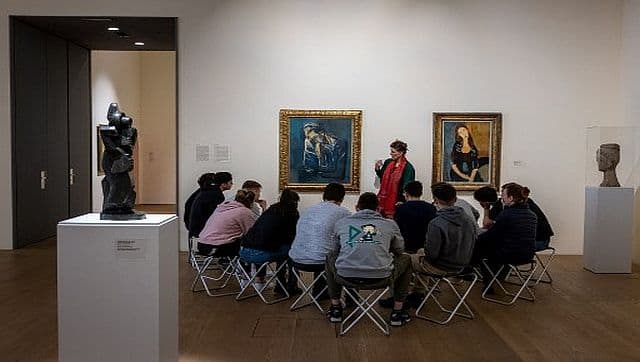 An art educator giving explanations to a group of youth visitors next to The Couple (The Wretched Ones) 1904 by Pablo Picasso (centre left) and Jeanne Hebuterne, seated' 1918 by Amadeo Modigliani, two masterpieces part of the Merzbacher Collection exhibited at the Kunsthaus Zurich. File image/AFP[/caption]"The permanent invention, the journey across all the great currents of modernity, the continuous experimentation for 80 years, the desire to please and displease... all of it is without equal," Blistene told AFP.No more 'muses'The MeToo movement has slightly rattled the elevated plinth on which Picasso's reputation stands, as accusations that he was an abusive misogynist towards his wives and girlfriends trigger calls for a reappraisal."We must stop talking about the women in his life as 'muses'. Some committed suicide, others sank into madness," said Emilie Bouvard, former curator at the Picasso Museum in Paris.The exception was Francoise Gilot, the only mistress who dumped Picasso and lived to see 50 years pass since the death of "the tyrannical, superstitious and egotistical being" that she denounced in a famous book in the 1960s.
But the damage has been limited.Picasso still regularly tops the list for highest-grossing artists at auction: his paintings generated $494 million (Rs 4,052 crore) last year alone, according to Artprice.There is a balance to be found, said Bouvard."Picasso is someone who appropriated things, people," she said. His work often spoke of violence and sexuality — often with brutal, even courageous honesty — but he also turned those feelings on the women in his life."Dealing with this question means speaking differently but fairly about Picasso," said Bouvard.That only opens up more ways to prime the pump of the Picasso industry.An exhibition at the Brooklyn Museum this summer, promising to reevaluate the artist "through a feminist lens", is being curated by comedian Hannah Gadsby, one of Picasso's most outspoken critics.[caption id="attachment_12412042" align="alignnone" width="640"]
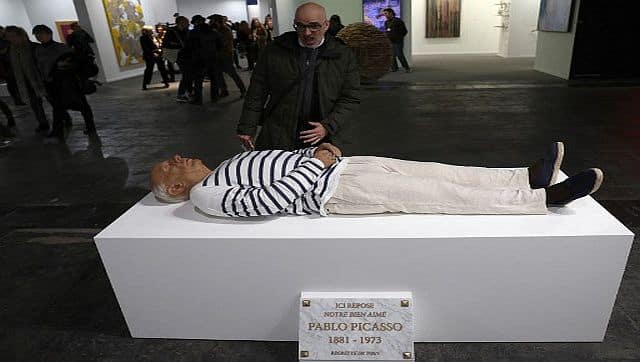 A man looks at a sculpture representing Spanish artist Pablo Picasso at the gallery ADN's stand during the International Contemporary Art Fair, ARCO, in Madrid. File image/AFP[/caption]Meanwhile, crowds are flocking to a much lighter retrospective at the Picasso Museum in Paris curated by fashion designer Paul Smith.It suggests the sexual politics have done nothing to undermine the simple pleasure that comes from seeing Picasso's work."I made it very decorative because the idea is that young school children and teenagers will come and see his work in a different light," Smith told AFP."Many of us have already seen Picasso many times around the world, so we hope to show it in a new way."Read all the Latest News, Trending News, Cricket News, Bollywood News,India News and Entertainment News here. Follow us on Facebook, Twitter and Instagram.
First Published:Apr 08, 2023, 10:01:59 IST
Advertisement
Advertisement

Military drones & police check-ups: How Sri Lanka is fighting against worst dengue outbreak in a decade
Sri Lanka is fighting its most severe dengue outbreak in nearly a decade, with infections rising sharply across the nation. Military drones have been deployed to tackle the outbreak, which has claimed 56 lives. Health officials said the outbreak is being driven primarily by the DENV-2 variant of the virus
3 min read
How Facebook job ad lured 2 Karnataka men into Myanmar cyber scam camp
The Karnataka Cyber Command has rescued two youths from a scam compound in Myanmar operated by Chinese fraudsters. The duo from Karnataka were lured on the pretext of data-entry jobs. They were asked to work for 16 hours a day and were expected to sleep for six hours daily
4 min read
Why is India seeing 95% cloud cover despite a Super El Niño?
India is witnessing nearly 95 per cent cloud cover despite a Super El Niño, a climate event usually linked to weaker monsoons. Regional weather systems, cyclonic circulations, the monsoon trough and moisture from two seas are temporarily overpowering one of the world's strongest climate phenomena
5 min read
What is CJP’s fourth demand to the government as protests in Delhi intensify?
The protest by the Cockroach Janta Party at Delhi’s Jantar Mantar refuses to die down. The group have made a fourth demand to the Centre, asking that no FIRs are filed against the agitators and that no legal action be taken. The government has expressed willingness to speak to the protesters, but refused to accede on the resignation of Education Minister Dharmandra Pradhan
5 min read
The new geography of war: Why the Houthis can no longer be ignored
The rise of the Houthis marks the emergence of a new geography of war — one in which influence flows not only from capitals and conventional armies, but also from rugged mountains overlooking vital sea lanes
6 min read
Advertisement
Advertisement