
Advertisement


Sections
Were 3 Palestinians shot at in US because of their scarves?
Three Palestinian students have been injured after they were shot by a gunman in Vermont, USA on Saturday. The American-Arab Anti-Discrimination Committee claims the attack took place because they were wearing keffiyehs. These scarves have become a symbol of Palestinian resistance and solidarity

Tragedy struck three Palestinian students in the American state of Vermont on Saturday while they were walking home from dinner. The victims, identified as Hisham Awartani, Kinnan Abdel Hamid and Tahseen Ahmed, were shot at and sustained critical injuries after an armed suspect confronted them on the road.According to investigations, the trio, all aged 20, were visiting the home of one victim’s relatives in Burlington for the Thanksgiving holiday when they were confronted by a white male with a handgun. The suspect was on foot in the area. Without speaking, he discharged at least four rounds from the pistol and is believed to have fled on foot.According to the American-Arab Anti-Discrimination Committee (ADC), two of the victims are in intensive care. Furthermore, the group has slammed the attack and wrote on X: “We have reason to believe that the shooting was motivated by the three [victims] being Arab.“The three victims were wearing a keffiyeh and speaking Arabic. A man shouted and harassed the victims.”Abed A Ayoub, the director of the Arab American Anti-Discrimination Committee was later quoted as saying: “We are praying for a full recovery of the victims, and will support the families in any way that is needed. Given the information collected and provided, it is clear that the hate was a motivating factor in this shooting.“We call on law enforcement to investigate it as such. The surge in anti-Arab and anti-Palestinian sentiment we are experiencing is unprecedented, and this is another example of that hate turning violent.”In light of this attack, we take a closer look at what is a keffiyeh and how has it become a symbol of the Palestine?The keffiyehAlso spelled as kuffiya, the keffiyeh is a square-shaped cotton headdress with a distinctive chequered pattern worn in many parts of the Arab world. Traditionally black and white in colour, it is draped over the head of Palestinian men.In addition to the iconic black and white pattern, the Palestinian keffiyeh also features other patterns that hold significant cultural and historical meanings. One of these patterns is the fishnet pattern, which represents the fishing traditions of the Palestinian coastal communities and their deep connection to the sea.Today, it is secured around the necks of human rights activists, anti-war protesters, sports stars and celebrities – transcending gender, religion and nationality.Dr Anas Iqtait, an Australian National University lecturer, told SBS News that the keffiyeh has been worn by Palestinians and across the Arab world for “hundreds and hundreds of years”. “It is as deep as the Palestinian identity,” he is quoted as saying.[caption id="attachment_13435842" align="alignnone" width="640"]![]() The keffiyeh is today seen as a symbol of solidarity with the Palestinian cause. However, it has evolved over the years. File image/Reuters[/caption]However, the origins of the scarf lie in the area known today as Iraq. The word is connected with the Iraqi city of Kufa, south of Baghdad along the Euphrates River.It is sometimes called a hatta in the Levant dialect, and ghatrah in the Gulf region.The keffiyeh was originally worn by Palestinian men in the Ottoman Empire to protect them from the sun and the cold during winter as they worked their fields. Anu Lingala, author of A Socio-political History of the Keffiyeh, told Middle East Eye that the keffiyeh was in line with covering one's head, which is an important aspect of the culture. “[The keffiyeh] afforded breathability through air pockets created by folds in the fabric,” she said.Also read: Why people are using watermelon emojis to support PalestineKeffiyeh – a symbol of PalestineHowever, it evolved over the years and earned political connotations as time passed. In 1936, during the Arab Revolt against the British, the Palestinian rebel group, known as the Fedayeen, wore the keffiyeh over their entire heads to cover their faces to conceal their identities and avoid arrest.This led to British authorities to ban the headscarf, a move that did not go down well with the Palestinian population and wearing the keffiyeh became an act of resistance.In the 1960s, the keffiyeh became synonymous with Palestinian solidarity, largely owing to Yasser Arafat. The former Palestinian leader popularised the clothing – he was never seen without it. Maha Saca, head of the Palestinian Heritage Centre in Bethlehem, was quoted as telling Middle East Eye, “Abu Ammar [Arafat] would never be seen at any event without it.”[caption id="attachment_13435832" align="alignnone" width="640"]
The keffiyeh is today seen as a symbol of solidarity with the Palestinian cause. However, it has evolved over the years. File image/Reuters[/caption]However, the origins of the scarf lie in the area known today as Iraq. The word is connected with the Iraqi city of Kufa, south of Baghdad along the Euphrates River.It is sometimes called a hatta in the Levant dialect, and ghatrah in the Gulf region.The keffiyeh was originally worn by Palestinian men in the Ottoman Empire to protect them from the sun and the cold during winter as they worked their fields. Anu Lingala, author of A Socio-political History of the Keffiyeh, told Middle East Eye that the keffiyeh was in line with covering one's head, which is an important aspect of the culture. “[The keffiyeh] afforded breathability through air pockets created by folds in the fabric,” she said.Also read: Why people are using watermelon emojis to support PalestineKeffiyeh – a symbol of PalestineHowever, it evolved over the years and earned political connotations as time passed. In 1936, during the Arab Revolt against the British, the Palestinian rebel group, known as the Fedayeen, wore the keffiyeh over their entire heads to cover their faces to conceal their identities and avoid arrest.This led to British authorities to ban the headscarf, a move that did not go down well with the Palestinian population and wearing the keffiyeh became an act of resistance.In the 1960s, the keffiyeh became synonymous with Palestinian solidarity, largely owing to Yasser Arafat. The former Palestinian leader popularised the clothing – he was never seen without it. Maha Saca, head of the Palestinian Heritage Centre in Bethlehem, was quoted as telling Middle East Eye, “Abu Ammar [Arafat] would never be seen at any event without it.”[caption id="attachment_13435832" align="alignnone" width="640"]![]() Former Palestinian leader Yasser Arafat was never seen without the keffiyeh. In fact, he is credited with making the Palestinian scarf popular across the world. File image/Reuters[/caption]In fact, some say that Arafat’s keffiyeh and the way he placed it – with the longer end of the fabric placed over his right shoulder – was to resemble a map of pre-1948 Palestine.Notably, when Israel banned essentially banned the waving of the Palestinian flag in Gaza and the West Bank between 1967 and 1993, many Palestinians waved the kaffiyeh instead.The keffiyeh was later worn as a symbol of solidarity during the First Intifada in 1987 and Second Intifada of 2000. Then Palestinian youth wore the scarf around the neck, as they realised that a full-face covering made them easy targets for Israeli soldiers.Because of its presence in conflict, it has also become a polarising piece of cloth. Early this October, Berlin state authorities banned the wearing of the keffiyeh in schools, saying it could be a “threat to school peace.”Also read: Is TikTok pushing anti-Israel content? Why are calls to ban the app growing in US?Keffiyehs in Israel-Hamas protestsAnd ever since the war broke out between Israel and Hamas after the latter launched a horrific attack on 7 October, several protesters – both Palestinian and non-Palestinians have depicted or worn the keffiyeh to show their solidarity.In early November, when college campuses became the ground for anti-Israel protests following their merciless bombing of the Gaza Strip, students were seen holding keffiyeh scarves on campus and chanting slogans of ‘Shame’ against Israel.[caption id="attachment_13435812" align="alignnone" width="640"]
Former Palestinian leader Yasser Arafat was never seen without the keffiyeh. In fact, he is credited with making the Palestinian scarf popular across the world. File image/Reuters[/caption]In fact, some say that Arafat’s keffiyeh and the way he placed it – with the longer end of the fabric placed over his right shoulder – was to resemble a map of pre-1948 Palestine.Notably, when Israel banned essentially banned the waving of the Palestinian flag in Gaza and the West Bank between 1967 and 1993, many Palestinians waved the kaffiyeh instead.The keffiyeh was later worn as a symbol of solidarity during the First Intifada in 1987 and Second Intifada of 2000. Then Palestinian youth wore the scarf around the neck, as they realised that a full-face covering made them easy targets for Israeli soldiers.Because of its presence in conflict, it has also become a polarising piece of cloth. Early this October, Berlin state authorities banned the wearing of the keffiyeh in schools, saying it could be a “threat to school peace.”Also read: Is TikTok pushing anti-Israel content? Why are calls to ban the app growing in US?Keffiyehs in Israel-Hamas protestsAnd ever since the war broke out between Israel and Hamas after the latter launched a horrific attack on 7 October, several protesters – both Palestinian and non-Palestinians have depicted or worn the keffiyeh to show their solidarity.In early November, when college campuses became the ground for anti-Israel protests following their merciless bombing of the Gaza Strip, students were seen holding keffiyeh scarves on campus and chanting slogans of ‘Shame’ against Israel.[caption id="attachment_13435812" align="alignnone" width="640"]![]() Students participate in a protest in support of Palestine and for free speech outside of the Columbia University campus in New York City. Several students have been wearing the keffiyeh to showcase their solidarity with the Palestinian cause. AFP[/caption]On 26 October, at a march for Gaza in Lower Manhattan, keffiyehs were worn by a diverse group carrying Palestinian flags. Three men, who were sandwiched between two halal carts, prayed on top of a keffiyeh in lieu of a prayer mat.In fact, a post on X urged people to wear the keffieyh, saying: “Your solidarity means everything to us.”In Beirut, Lebanon too, demonstrators wore the keffiyeh during a march at Martyrs’ Square.In Cuba, President Miguel Díaz-Canel was seen participating in a pro-Palestinian march on 26 November at Havana’s iconic boardwalk, wearing the black-and-white Palestinian keffiyeh.[caption id="attachment_13435822" align="alignnone" width="640"]
Students participate in a protest in support of Palestine and for free speech outside of the Columbia University campus in New York City. Several students have been wearing the keffiyeh to showcase their solidarity with the Palestinian cause. AFP[/caption]On 26 October, at a march for Gaza in Lower Manhattan, keffiyehs were worn by a diverse group carrying Palestinian flags. Three men, who were sandwiched between two halal carts, prayed on top of a keffiyeh in lieu of a prayer mat.In fact, a post on X urged people to wear the keffieyh, saying: “Your solidarity means everything to us.”In Beirut, Lebanon too, demonstrators wore the keffiyeh during a march at Martyrs’ Square.In Cuba, President Miguel Díaz-Canel was seen participating in a pro-Palestinian march on 26 November at Havana’s iconic boardwalk, wearing the black-and-white Palestinian keffiyeh.[caption id="attachment_13435822" align="alignnone" width="640"]![]() Cuban president Miguel Díaz-Canel and his wife Lis Cuesta both wear keffiyehs and march during a pro-Palestinian demonstration in Havana, Cuba. AP[/caption]Australian-American basketball player Kyrie Irving on 20 November made headlines when he donned the headscarf during a post-match press conference. Irving did not remove the keffiyeh until the end of his conference speech.In Australia, students were seen wearing the keffiyeh and marching down the streets of Sydney in support of Palestine.It’s important to note here that while the keffiyeh is synonymous with resistance, it has also earned a space in pop culture. Several fashion brands have sold their versions of the keffiyeh. According to Omar Joseph Nasser-Khoury, a Palestinian designer, told The Guardian: It’s almost become commonplace” to see the design co-opted.And according to Amani Hassan, programme director at The Arab British Centre, this has led to the keffiyeh losing its original meaning.With inputs from agencies
Cuban president Miguel Díaz-Canel and his wife Lis Cuesta both wear keffiyehs and march during a pro-Palestinian demonstration in Havana, Cuba. AP[/caption]Australian-American basketball player Kyrie Irving on 20 November made headlines when he donned the headscarf during a post-match press conference. Irving did not remove the keffiyeh until the end of his conference speech.In Australia, students were seen wearing the keffiyeh and marching down the streets of Sydney in support of Palestine.It’s important to note here that while the keffiyeh is synonymous with resistance, it has also earned a space in pop culture. Several fashion brands have sold their versions of the keffiyeh. According to Omar Joseph Nasser-Khoury, a Palestinian designer, told The Guardian: It’s almost become commonplace” to see the design co-opted.And according to Amani Hassan, programme director at The Arab British Centre, this has led to the keffiyeh losing its original meaning.With inputs from agencies
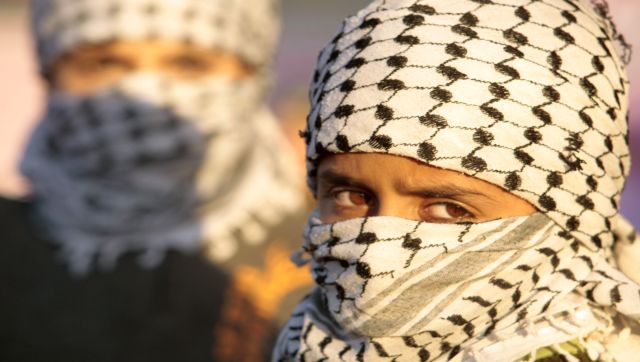 The keffiyeh is today seen as a symbol of solidarity with the Palestinian cause. However, it has evolved over the years. File image/Reuters[/caption]However, the origins of the scarf lie in the area known today as Iraq. The word is connected with the Iraqi city of Kufa, south of Baghdad along the Euphrates River.It is sometimes called a hatta in the Levant dialect, and ghatrah in the Gulf region.The keffiyeh was originally worn by Palestinian men in the Ottoman Empire to protect them from the sun and the cold during winter as they worked their fields. Anu Lingala, author of A Socio-political History of the Keffiyeh, told Middle East Eye that the keffiyeh was in line with covering one's head, which is an important aspect of the culture. “[The keffiyeh] afforded breathability through air pockets created by folds in the fabric,” she said.Also read: Why people are using watermelon emojis to support PalestineKeffiyeh – a symbol of PalestineHowever, it evolved over the years and earned political connotations as time passed. In 1936, during the Arab Revolt against the British, the Palestinian rebel group, known as the Fedayeen, wore the keffiyeh over their entire heads to cover their faces to conceal their identities and avoid arrest.This led to British authorities to ban the headscarf, a move that did not go down well with the Palestinian population and wearing the keffiyeh became an act of resistance.In the 1960s, the keffiyeh became synonymous with Palestinian solidarity, largely owing to Yasser Arafat. The former Palestinian leader popularised the clothing – he was never seen without it. Maha Saca, head of the Palestinian Heritage Centre in Bethlehem, was quoted as telling Middle East Eye, “Abu Ammar [Arafat] would never be seen at any event without it.”[caption id="attachment_13435832" align="alignnone" width="640"]
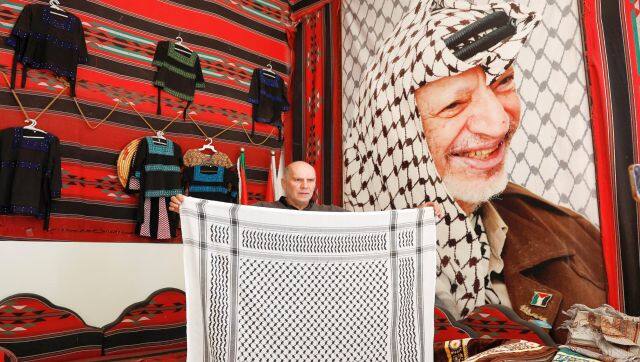 Former Palestinian leader Yasser Arafat was never seen without the keffiyeh. In fact, he is credited with making the Palestinian scarf popular across the world. File image/Reuters[/caption]In fact, some say that Arafat’s keffiyeh and the way he placed it – with the longer end of the fabric placed over his right shoulder – was to resemble a map of pre-1948 Palestine.Notably, when Israel banned essentially banned the waving of the Palestinian flag in Gaza and the West Bank between 1967 and 1993, many Palestinians waved the kaffiyeh instead.The keffiyeh was later worn as a symbol of solidarity during the First Intifada in 1987 and Second Intifada of 2000. Then Palestinian youth wore the scarf around the neck, as they realised that a full-face covering made them easy targets for Israeli soldiers.Because of its presence in conflict, it has also become a polarising piece of cloth. Early this October, Berlin state authorities banned the wearing of the keffiyeh in schools, saying it could be a “threat to school peace.”Also read: Is TikTok pushing anti-Israel content? Why are calls to ban the app growing in US?Keffiyehs in Israel-Hamas protestsAnd ever since the war broke out between Israel and Hamas after the latter launched a horrific attack on 7 October, several protesters – both Palestinian and non-Palestinians have depicted or worn the keffiyeh to show their solidarity.In early November, when college campuses became the ground for anti-Israel protests following their merciless bombing of the Gaza Strip, students were seen holding keffiyeh scarves on campus and chanting slogans of ‘Shame’ against Israel.[caption id="attachment_13435812" align="alignnone" width="640"]
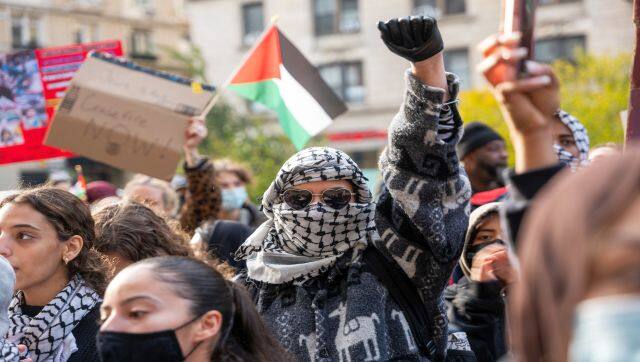 Students participate in a protest in support of Palestine and for free speech outside of the Columbia University campus in New York City. Several students have been wearing the keffiyeh to showcase their solidarity with the Palestinian cause. AFP[/caption]On 26 October, at a march for Gaza in Lower Manhattan, keffiyehs were worn by a diverse group carrying Palestinian flags. Three men, who were sandwiched between two halal carts, prayed on top of a keffiyeh in lieu of a prayer mat.In fact, a post on X urged people to wear the keffieyh, saying: “Your solidarity means everything to us.”In Beirut, Lebanon too, demonstrators wore the keffiyeh during a march at Martyrs’ Square.In Cuba, President Miguel Díaz-Canel was seen participating in a pro-Palestinian march on 26 November at Havana’s iconic boardwalk, wearing the black-and-white Palestinian keffiyeh.[caption id="attachment_13435822" align="alignnone" width="640"]
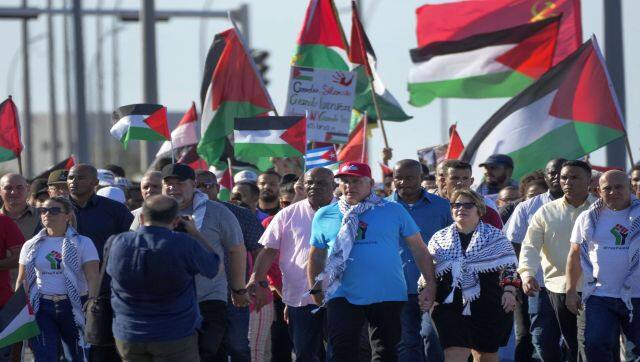 Cuban president Miguel Díaz-Canel and his wife Lis Cuesta both wear keffiyehs and march during a pro-Palestinian demonstration in Havana, Cuba. AP[/caption]Australian-American basketball player Kyrie Irving on 20 November made headlines when he donned the headscarf during a post-match press conference. Irving did not remove the keffiyeh until the end of his conference speech.In Australia, students were seen wearing the keffiyeh and marching down the streets of Sydney in support of Palestine.It’s important to note here that while the keffiyeh is synonymous with resistance, it has also earned a space in pop culture. Several fashion brands have sold their versions of the keffiyeh. According to Omar Joseph Nasser-Khoury, a Palestinian designer, told The Guardian: It’s almost become commonplace” to see the design co-opted.And according to Amani Hassan, programme director at The Arab British Centre, this has led to the keffiyeh losing its original meaning.With inputs from agencies
First Published:Nov 27, 2023, 16:41:27 IST
Advertisement
Advertisement

Military drones & police check-ups: How Sri Lanka is fighting against worst dengue outbreak in a decade
Sri Lanka is fighting its most severe dengue outbreak in nearly a decade, with infections rising sharply across the nation. Military drones have been deployed to tackle the outbreak, which has claimed 56 lives. Health officials said the outbreak is being driven primarily by the DENV-2 variant of the virus
3 min read
How Facebook job ad lured 2 Karnataka men into Myanmar cyber scam camp
The Karnataka Cyber Command has rescued two youths from a scam compound in Myanmar operated by Chinese fraudsters. The duo from Karnataka were lured on the pretext of data-entry jobs. They were asked to work for 16 hours a day and were expected to sleep for six hours daily
4 min read
Why is India seeing 95% cloud cover despite a Super El Niño?
India is witnessing nearly 95 per cent cloud cover despite a Super El Niño, a climate event usually linked to weaker monsoons. Regional weather systems, cyclonic circulations, the monsoon trough and moisture from two seas are temporarily overpowering one of the world's strongest climate phenomena
5 min read
What is CJP’s fourth demand to the government as protests in Delhi intensify?
The protest by the Cockroach Janta Party at Delhi’s Jantar Mantar refuses to die down. The group have made a fourth demand to the Centre, asking that no FIRs are filed against the agitators and that no legal action be taken. The government has expressed willingness to speak to the protesters, but refused to accede on the resignation of Education Minister Dharmandra Pradhan
5 min read
The new geography of war: Why the Houthis can no longer be ignored
The rise of the Houthis marks the emergence of a new geography of war — one in which influence flows not only from capitals and conventional armies, but also from rugged mountains overlooking vital sea lanes
6 min read
Advertisement
Advertisement