


Revisiting KG George's Adaminte Variyellu — A nuanced film on real, flawed women trapped in patriarchy
What makes KG George’s Adaminte Variyellu an important film is that while it gives space to three women protagonists, there is no pretence of the world becoming a better place for her.

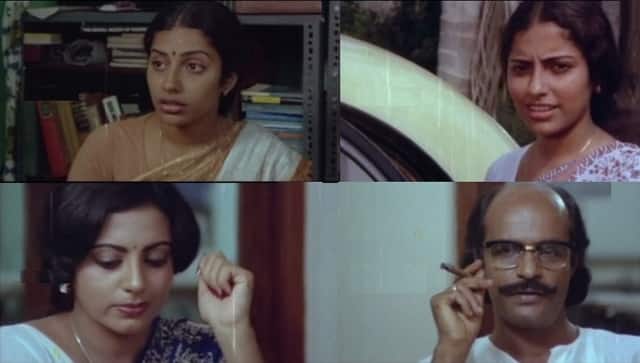
Stills from Aadaminte Vaariyellu[/caption]Years of desertion and exploitation has turned Alice cold and bitter and the nurturing instincts in her have long been dead. It is a wretched family portrait — a debauched and greedy father, a mother who is consumed in misery and children who feel unloved. When her daughter begins menstruating, it is the maid who helps the weeping child. When in school, she elopes with a boy, it was about seeking validation of love which she never got at home. Even there, Mamachan (Bharath Gopy), typically blames Alice for neglecting their daughter. The sexist patriarch in him would rather make plans for his son as he feels the daughter will eventually get married. “What will she do with all that education? She will marry someone. But you are my future.”Meanwhile, Vasanthi, does every possible domestic duty at home (two decades later Jeo Baby made an entire film on her called The Great Indian Kitchen), without getting a single kind word from anyone. From making food for everyone at home, cleaning, dusting, taking care of her son, dropping, and picking him from school, silently enduring the abusive mother-in-law and unemployed alcoholic husband, doing a day job and coming back home to the same old drudgery, her days are laborious and thankless. Vasanthi is submissive—someone who lets her callous husband wake her up in the middle of her disturbed sleep, just so he can have sex with her. When he tries to force himself on her, she runs away and weeps in a corner. She is a human robot, even at her government office, where she is unable to loosen up with her co-workers. Despite being the sole breadwinner of the house, her worth remains unacknowledged.
Some of the bleakest situations in the movie are dealt with a clinical logic. Like the scene soon after Ammini’s pregnancy is revealed — “In the quest to find pleasure, you didn’t realise such things could occur, did you?” asks a scornful Alice. “You shut up. I will deal with it,” Mamachan tells her. “Where are you planning to dispose of her dead body?” she retorts.You cannot help but wonder why Alice does not empathise with Ammini. Perhaps she is too immersed in her own despair to sympathise with another woman.In Vasanthi’s storyline, the director leaves clues suggesting her gradual nervous breakdown. The narrative of her downward spiral is brilliant. In one scene, Vasanthi is unable to write a leave letter. On another occasion, she offers her rice batter-coated hands to shake hands with a friend who comes home.Two scenes stand out. The first is the one in which Mamachan warns Alice to be more cautious about her affair as they have two teenage children. Alice looks at him derisively and wonders how he can be sure about her children’s paternity as he has forced her to sleep with his business partners during several occasions. The second is the one in which Mamachan enters the room as Alice breaks up with her lover (Mammootty). You expect fireworks, perhaps remorse on both their faces. Instead, you see Alice putting her sunglasses on slowly and exiting without a backward glance at either man. But in the end that betrayal is what breaks her down. If Srividya subtly brings forth the trauma and neglect she had to withstand in her two-decade-old marriage, Bharath Gopi internalises the casual brutality of Mamachan.Though certain scenes have a crudeness sometimes associated with KG George films (when Alice’s daughter examines her developing feminine physique in the mirror or when she matures into a woman), you cannot discount their impact on screen. Having said that, a few scenes such as those of Alice’s death or Ammini’s delivery could use more finesse.KG George lends a surrealistic touch to the final scene. As Ammini and other women run out of a welfare home, they appear to be running out of the cinematic ‘frame’ — breaking free from the imposing gaze of society. They are seen flouting the directions of the filmmaker, knocking down the camera. And you see him, a representative of the patriarchal society, throw up his hands in despair!What makes Adaminte Variyellu an important film is that while it gives space to three women protagonists, there is no pretence of the world becoming a better place for her. KG George gives you no gratifying conclusions or promises of a better world. Nor is there any superfluous commentary on the empowerment of women. The film simply shows the ugly, warped existence of a woman in a man’s world, a reality that remains disturbingly true to his day.Neelima Menon has worked in the newspaper industry for more than a decade. She runs an exclusive Malayalam movie portal called fullpicture.in. She is known for her detailed and insightful features on misogyny, and the lack of representation of women in Malayalam cinema.Read all the Latest News, Trending News, Cricket News, Bollywood News, India News and Entertainment News here. Follow us on Facebook, Twitter and Instagram.

How Spider-Man actor Tom Holland has been on a sobriety journey of 4.5 years after being "addicted to alcohol"
Sitar virtuoso Rishab Sharma steals the spotlight with Rs 35.8 lakh Jacob & Co Ram Janmabhoomi watch at ‘Ramayana’ event: Here's what makes it rare
Amitabh Bachchan reveals being admitted to the ICU and undergoing surgery, calls recovery 'the most difficult phase of life'
Avengers Doomsday trailer out: What to expect from Marvel's ultimate crossover
Christopher Nolan banned the orchestra for 'The Odyssey': The sound of gongs, scrap metal and more