


Passing movie review: Rebeca Hall's brave, bold and brilliant directorial debut is thousand layers of grey
By eliminating colour from the palette of a story that is hinged on skin tone and the world it carries, Rebecca Hall keeps the audience unsettled, from start to finish.

Language: English
With her head strategically lowered under a cloche hat that is shielding most of her face, we see a woman making her way through a toy store in what we soon learn is central New York. From afar, we would not imagine this person to be anything other than an upper-middle-class white woman, in a summer dress running errands in the city, in a milieu that is decidedly white. It is only when the camera gives us a slightly oblique view of her face, is when we realise that we are looking at someone who is “passing” – a word used to signify the act of coloured people “passing” as white. But we are still perplexed.
Renowned actress and first-time director Rebecca Hall choosing to adapt Nella Larsen’s 1929 novel Passing in black and white, is not just a stylistic manoeuvre. By eliminating colour from a story that is hinged on skin tone and the world it carries, Hall keeps the audience unsettled, from start to finish – almost as unsettled the film’s key protagonist Irene (Tessa Thompson), whose world almost capsizes when her former childhood friend Clare (Ruth Negga) walks back into her life, after a chance meeting.
 More from Entertainment
On a sweltering afternoon of errands, Irene cautiously walks into Drayton Hotel to escape the heat. She is nervous under her ‘white cover’ – the premium Drayton is the last place this Harlem resident should be seen in. When she catches the gaze of this gorgeous blonde woman, staring at her from across the room, Irene is nearly about to flee when the lady stops her. It takes her a few long moments to recognise her childhood friend Clare from Chicago who she has not seen in at least a dozen years. As she sizes up Clare’s blonde and bright self with a close and confused gaze, Irene slowly realises what she is looking at. As for Clare, she candidly admits that as much as a strange coincidence their meeting is, it was also something she had been hoping for.The tension between them is palpable – they both know the other is passing. While for Irene, it is a tool she selectively uses for convenience, for Clare, passing is survival, a ticket to her new life, or rather life itself, as her boorish, racist, and very rich husband John (Alexander Skarsgard) has no idea of her coloured roots. But meeting Irene reignites in her a “wild desire” to reconnect with her self-denied blackness, if not entirely return to it, as she tells her in a letter. Despite Irene’s efforts to sever ties, Clare soon ingratiates herself into her friend’s upper middle-class Harlem life, ostensibly built on a sound foundation of brownstone and ornate furniture, that revolves around her doctor husband Brian Redfield (Andre Holland) and their two boys. We also soon realise that Irene’s efforts to keep her friend at bay, may not have been in all earnestness. Clare and Irene are drawn to each other like magnets, and they could not be more opposing forces. The former, who has chosen a life of hiding, is unbridled in every other way, be it in her boldness or her sexuality, and her honesty when she steps into Harlem, every other day, under some ruse or another.

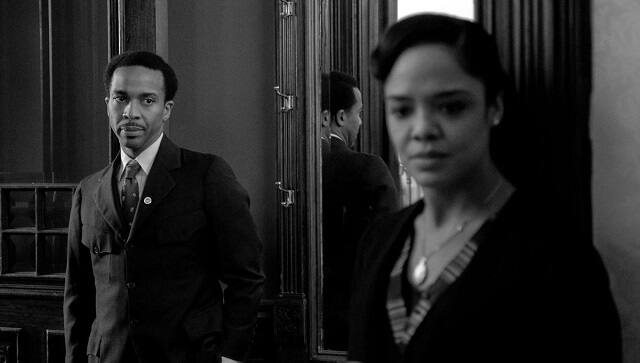
For a film that is focused on harsh realities, Passing unfolds like a daydream. Cinematographer Eduard Grau deftly uses daylight and distorted lens treatment to create some surreal imagery that stays in our heads. The dance of curtains in an afternoon breeze, an embrace under dead branches, a stretching of arms under a flood of sunlight, or pristine white snow falling on dark skin – it is sheer poetry that we see. For the most part, the film is a story told through silences. Grau compliments the director’s brilliance with his close and gentle study of the faces of the characters. A tight aspect ratio of 4:3 lends every frame a boxy feel that further underscores the constraints the characters are feeling. Hall gives her actors ample emotional freedom to bring out their characters, and every actor milks the opportunity. But in terms of framing, they are not allowed to breathe. They must act within certain boundaries, just like the roles they are playing — another instance of cinematic brilliance that Hall achieves in her directorial debut.
But her greatest mastery lies in choosing her two actresses. Thompson and Negga are the embodiment of a strange mix of conflict and harmony.
Negga, a picture of glamour and grace under that blonde dyed hair; her piercing stare when she looks at Irene, the actress brings alive Clare’s pain and rebellion in every expression and every bit of her body language. Negga lives and breathes the beautiful stubbornness of Clare, and it is hard to take our eyes off her. In sharp contrast, Thompson plays Irene with a studied restraint and contemplation, and yet in her searching glances and simmering restlessness, she makes you feel Irene’s extreme discomfort with her own self, where she is hiding a lot while appearing to be living her truth. She too has chosen a life of pretense like Clare, and yet nothing like her. These two are tied together by their roots and flung apart by their choices. It is this constant push-and-pull dance they are caught in, which is almost cathartic, and makes them soulmates of sorts — “a thing that cannot be registered” in Irene’s words, but whose existence cannot be denied.
Passing shows how race is more of a social construct than a biological truth. These women are light enough to pass off as white, and yet the truth of their roots confines them in a white world. And more than the realities of colour, the film is also about how we pass for all sorts of things in our lives. It is about perception and context. There is no monolithic version of blackness or whiteness. Hall choosing coloured actors for these two roles, and treating them under a black-and-white lens, is a brave, bold, and brilliant choice. We can never tell how black they are or how white, and it makes us think about how we perceive these colours as binaries. But they are not. Visually, they are a thousand layers of grey, just like the film is.
Passing is streaming on Netflix.
Rating: ****

How Spider-Man actor Tom Holland has been on a sobriety journey of 4.5 years after being "addicted to alcohol"
Sitar virtuoso Rishab Sharma steals the spotlight with Rs 35.8 lakh Jacob & Co Ram Janmabhoomi watch at ‘Ramayana’ event: Here's what makes it rare
Amitabh Bachchan reveals being admitted to the ICU and undergoing surgery, calls recovery 'the most difficult phase of life'
Avengers Doomsday trailer out: What to expect from Marvel's ultimate crossover
Christopher Nolan banned the orchestra for 'The Odyssey': The sound of gongs, scrap metal and more